Use of ICT to Support Market Research (Edexcel A-Level Business): Revision Notes
📚Revision Notes
Use of ICT to Support Market Research
Introduction to ICT in market research
ICT has transformed how businesses conduct market research, providing cost-effective tools to gather consumer insights more quickly and efficiently than traditional methods. Modern technology enables businesses to collect both primary and secondary data through digital platforms, reaching wider audiences while reducing costs.
Note
The shift from traditional research methods to ICT-based approaches represents one of the most significant changes in marketing practice over the past two decades. Businesses that embrace these digital tools gain substantial competitive advantages through faster, cheaper, and more comprehensive market insights.
Company websites
Online surveys
Businesses use their websites to host online surveys, which function similarly to postal questionnaires but with enhanced capabilities. After completing an online transaction, customers may receive an email directing them to a survey page.
Key advantages of online surveys:
- Flexibility – surveys can adapt based on individual responses, taking respondents down different question paths
- 24/7 availability – customers can complete surveys at any time
- Low administration costs – minimal expense compared to postal or face-to-face methods
- Sophisticated design – conditional logic allows for tailored questions (e.g., "yes" responses lead to one question set, "no" to another)
Important
Major Limitation: Despite these benefits, many customers still ignore online surveys, reducing response rates. This remains one of the primary challenges businesses face when using this research method.
Review systems
Many businesses incorporate review functionality into their websites, allowing customers to share experiences after purchasing or using products. These systems provide valuable qualitative feedback directly from consumers.
Example
Real-World Application: TripAdvisor
TripAdvisor, the online hotel booking platform, uses customer reviews extensively. Businesses can analyze feedback from both their own customers and competitors' customers, gaining insights into market perceptions and service quality across the industry.
This dual-source approach provides both internal feedback (improving their own services) and competitive intelligence (understanding market standards and competitors' strengths/weaknesses).
Secondary research through competitor websites
Company websites serve as valuable sources of secondary data. By analyzing competitor websites, businesses can gather market intelligence easily and at minimal cost.
Information available from competitor analysis:
- Pricing strategies
- Product ranges and specifications
- Delivery terms and conditions
- Payment options
- Store locations
- Current special offers and promotions
- Useful links to suppliers or partners
Businesses can also use comparison websites to identify the cheapest suppliers in their market, helping inform pricing decisions and competitive positioning.
Note
Competitor website analysis is particularly valuable because it provides real-time, publicly available information at zero cost. This makes it an essential tool for businesses of all sizes, from small startups to large corporations.
Databases
What is a database?
A database functions as a digital filing system that stores large volumes of business data. Every computer-using business compiles and maintains databases, which can be updated and accessed when required for analysis or decision-making.
Database structure and terminology
Understanding database structure requires familiarity with three key terms:
- File – the collection of all related records in a database
- Record – all the information relating to one entry (e.g., all details about one customer: Jane Brown's name, address, age, occupation, and income)
- Field – the headings under which information is organized (e.g., Name, Address, Age, Occupation, Income)
Example
Database Structure Example: Finance Company Customer Database
Consider a finance company's customer database:
- The file contains all customer records for the entire database
- Each record represents one customer (e.g., Jane Brown with all her details)
- The fields are the categories: Surname, First Name, Address, Town, Age, Occupation, Annual Income
Think of it like a spreadsheet where:
- The entire spreadsheet = File
- Each row = Record (one customer)
- Each column heading = Field (Name, Address, etc.)
Database facilities
Effective databases provide several essential functions:
User-definable record format – businesses can customize fields to match their specific data requirements, choosing which information to capture for each record.
File-searching facility – enables users to find specific information using search criteria. For instance, identifying all customers with income over $33,000, or applying multiple criteria such as "all female customers earning over $33,000."
File sorting facility – allows data reorganization into different orders, such as arranging customer records by ascending income level or alphabetically by surname.
Calculation capabilities – performs calculations on field data within records, useful for generating reports and analysis.
Note
Memory Aid: Database Functions
Remember database facilities with "SSCC":
- Search – find specific records
- Sort – organize data in different orders
- Calculate – perform mathematical operations
- Customize – define your own field structure
Commercial use and data protection
Database information has commercial value. Market research companies compile extensive databases over time, which can be purchased by businesses seeking customer contact details or market insights.
Important
Legal Requirement: The Data Protection Act
The Data Protection Act regulates how personal data is stored digitally. Any organization storing personal information on computer systems must:
- Register with the Data Protection Office
- Comply with data protection principles
- Respond to individuals' requests for information held about them
This legislation protects consumer privacy while allowing legitimate business use of customer data. Failure to comply can result in significant penalties and legal consequences.
Note
Exam Tip: When evaluating databases in assessment questions, consider both the practical benefits (searching, sorting, analysis) and legal obligations (Data Protection Act compliance). Questions often test your understanding of both operational and regulatory aspects.
Social networking
Platforms for market research
Few businesses can overlook social media's role in modern marketing research. Platforms such as Facebook, Twitter, YouTube, blogs, and coupon sites provide cost-effective tools for gaining insights into customers, markets, and brand perception.
Research methods using social media
Social media platforms offer multiple techniques for conducting market research:
Trend analysis – businesses can search recent posts and popular terms to identify emerging trends and discover what customers discuss in real-time. This provides immediate market intelligence unavailable through traditional research methods.
Hashtag searches – particularly on Twitter, businesses can set up automated searches using hashtags related to their brand, industry, or products. This delivers instant notifications when customers, clients, or competitors mention key terms, enabling rapid response to market conversations.
Observation and interaction – unlike traditional question-driven research methods, social media allows businesses to observe natural customer discussions or participate as equals in conversations. This approach reveals insights that might remain hidden when research is constrained by predetermined questions.
Note
Why Social Media Differs from Traditional Research
Traditional research methods depend on asking the right questions – simply rewording a question can produce drastically different answers, limiting research quality. Social media's interactive nature overcomes this limitation by gathering information through observation and engagement rather than structured questioning.
This represents a fundamental shift from reactive research (responding to predetermined questions) to proactive discovery (uncovering insights through natural behavior observation).
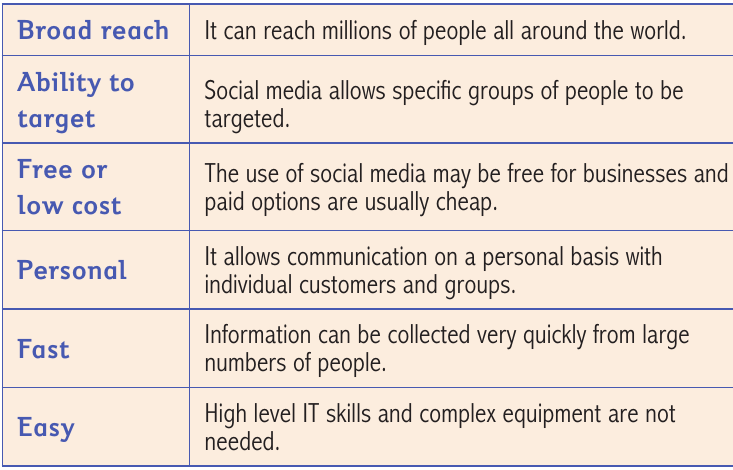
Advantages of social media research
-
Broad reach – social platforms connect businesses with millions of potential respondents worldwide, far exceeding the reach of traditional surveys
-
Targeting capability – despite their broad reach, social media tools enable precise targeting of specific demographic groups, ensuring research focuses on relevant market segments
-
Cost-effectiveness – many social media functions are free for businesses, with paid options typically remaining inexpensive compared to traditional research methods like focus groups or postal surveys
-
Personal communication – platforms facilitate direct, personal interaction with individual customers and groups, building relationships while gathering feedback
-
Speed – information can be collected rapidly from large numbers of people, providing quick insights for time-sensitive decisions
-
Accessibility – high-level IT skills and complex equipment are unnecessary, making social media research accessible to businesses of all sizes
Note
Exam Tip: When analyzing social media as a research tool, contrast it with traditional methods by highlighting its real-time nature, cost advantages, and ability to uncover unexpected insights through observation rather than questioning. Questions often ask you to evaluate the effectiveness compared to conventional approaches.
Remember!
Summary
Key Points to Remember:
Three Main ICT Tools for Market Research:
- Company websites – online surveys, review systems, competitor analysis
- Databases – organized data storage with search, sort, and calculation facilities
- Social networking platforms – real-time observation and interaction
Company Websites:
- Online surveys offer flexible, 24/7 data collection but often suffer from low response rates
- Review systems provide qualitative feedback from customers
- Competitor websites offer free secondary research on pricing, products, and promotions
Databases:
- Structure: Files contain Records, which contain Fields
- Facilities: User-definable format, searching, sorting, and calculations
- Data Protection Act compliance is mandatory for all personal data storage
Social Media Research:
- Offers real-time insights and observation-based learning
- Provides broad reach with targeting capability
- Cost-effective compared to traditional methods
- Allows businesses to observe natural customer behavior rather than relying solely on predetermined questions
Critical Framework: ICT has transformed market research by reducing costs, increasing speed, and enabling broader reach while maintaining targeting precision. The shift from question-driven to observation-based research represents a fundamental change in how businesses understand their markets.
Summary
Key Terms for Revision:
- Database – electronic filing system for storing business data
- Record – all information relating to one database entry
- Field – heading categories organizing database information
- Data Protection Act – legislation regulating digital storage of personal information
- Hashtag search – social media technique for monitoring brand/product mentions
- ICT – Information and Communications Technology
- Primary data – information collected firsthand by the business
- Secondary data – information that already exists from other sources