Mass Markets and Niche Markets (Edexcel A-Level Business): Revision Notes
📚Revision Notes
Mass Markets and Niche Markets
Introduction to markets and marketing
A market is where buyers and sellers come together to exchange goods and services. Modern markets exist in many forms - physical locations, telephone sales, mail order, and increasingly online through the internet.
Marketing involves much more than just selling products. According to the Chartered Institute of Marketing, marketing is "the management process responsible for identifying, anticipating and satisfying customer requirements profitably."
Marketing activities include:
- Identifying consumer needs and wants
- Designing products to meet these needs
- Understanding competitive threats
- Communicating product information to customers
- Setting appropriate prices
- Persuading customers to purchase
- Making products available in convenient locations
Note
Marketing is a comprehensive process that extends far beyond simple transactions. It encompasses the entire journey from understanding what customers want to delivering products that meet those needs profitably.
Mass markets
A mass market exists when a business sells the same products to all consumers and markets them in the same way. This approach targets the largest possible customer base without differentiating between different customer groups.
Characteristics of mass markets
Mass markets typically involve:
- Large customer numbers (potentially billions globally)
- Standardised products sold to everyone
- Uniform marketing approach across all customers
- High production volumes
- Fast-moving consumer goods (e.g. crisps, breakfast cereals, soft drinks)
Note
Think of products you see in every supermarket and convenience store - these are typically mass market products. They're designed to appeal to the widest possible audience rather than specific customer groups.
Advantages of mass markets
Economies of scale: Producing large quantities reduces the unit cost of each item. Lower costs can lead to competitive pricing or higher profit margins.
Large customer base: Access to millions or billions of potential customers creates significant revenue opportunities.
High sales potential: The sheer size of the market means successful products can generate substantial sales volumes and profits.
Disadvantages of mass markets
Intense competition: Many businesses compete for market share, making it difficult to stand out.
High marketing costs: Businesses must invest heavily in advertising and promotion to compete effectively.
Example
Real-World Example: Coca-Cola's Marketing Investment
Coca-Cola spent approximately $3.3 billion on global advertising in 2013. This massive investment demonstrates the high costs associated with competing in mass markets, where businesses must constantly promote their products to maintain visibility and market share.
Less customer focus: With such large markets, it becomes harder to meet specific customer needs or preferences.
Important
Mass market businesses must balance the benefits of economies of scale against the challenges of intense competition and high marketing costs. Success requires substantial investment and the ability to appeal to diverse customer groups simultaneously.
Niche markets
A niche market is a small, specialised market segment that serves customers with specific needs or interests. These segments have sometimes been overlooked or 'untouched' by larger businesses.
Example
Real-World Example: The Banana Guard
The Banana Guard represents a niche market product - a protective case designed specifically for transporting bananas without bruising. This addresses a very specific customer need that mass market businesses typically ignore. While the potential customer base is limited, those who need this solution are willing to pay for a specialised product.
Characteristics of niche markets
Niche markets involve:
- Small customer numbers
- Specialised products or services
- Customers with specific needs or interests
- Limited market size
- Targeted marketing approach
Note
Zumiez targets the niche market of surfing, skateboarding and snowboarding enthusiasts rather than attempting to serve all sports equipment customers. This focused approach allows them to build expertise and loyalty within their specific market segment.
Advantages of niche markets
Less competition: Small firms can survive by supplying niche markets that larger businesses overlook or ignore.
Customer focus: Easier to understand and meet the specific needs of a smaller, more defined customer group.
Premium pricing: When there is little or no competition, businesses can charge higher prices for specialised products.
Customer loyalty: Serving specific needs well can create strong, loyal customer relationships.
Disadvantages of niche markets
Attracts competition: If a business successfully exploits a niche market, larger competitors may notice and enter the market.
Easily overtaken: Niche markets are very small and cannot support many competing firms. A large business entering the market can easily dominate smaller rivals.
Lack of risk spreading: Businesses relying on a single niche market are vulnerable. If they lose their position in that market, they have no other products or markets to fall back on.
Limited growth potential: The small size of niche markets restricts how much the business can grow.
Important
While niche markets offer advantages like premium pricing and customer loyalty, businesses must be aware of their vulnerability. A single large competitor entering the market or changes in customer preferences could threaten the entire business if it lacks diversification.
Measuring the market
Market size
Market size can be measured in two ways:
Market value: The total amount customers spend buying products in the market.
Example
Market Value Example: UK Fast-Food Market
The UK fast-food market was valued at $29.4 billion in 2014, including all branded chains and independent outlets. This represents the total spending by customers across the entire market over that year.
Market volume: The physical quantity of products produced and sold. Volume can also measure users, subscribers or viewers - such as the number of mobile phone users or percentage of households with digital television.
Example
Market Volume Example: Global Steel Production
Global crude steel production in 2014 was 1,661 million tonnes. This volume measurement shows the physical quantity produced, which is particularly useful for commodities and products where physical units matter more than monetary value.
Note
Different markets vary considerably in size. The market for savoury snacks in one year will be much smaller than the footwear market in the same period. Understanding whether to measure value or volume depends on the nature of the market and what insights are most useful for business decisions.
Market share
Market share (also called market penetration) shows the proportion of a particular market held by a business, product or brand. It is expressed as a percentage.
Formula:
Why market share matters
Identifies market leaders: Shows which business dominates the market, influencing both the leader's strategy and competitors' responses.
Influences business strategy: A business with small market share might set objectives to increase share by a specific percentage over time.
Indicates success or failure: Changes in market share reveal whether business strategies are working effectively.
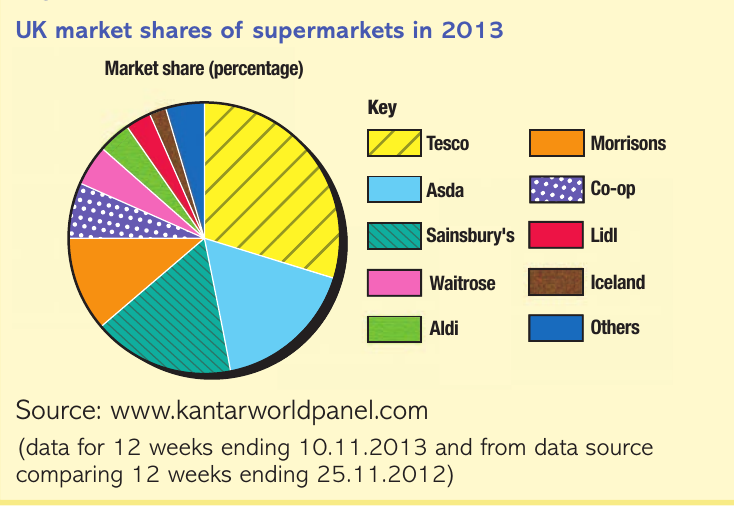
Example
Market Share Example: UK Supermarkets 2013
The chart shows UK supermarket market shares in 2013. Tesco was the market leader with nearly one-third (approximately 33%) of the total market. The top four supermarkets (Tesco, Asda, Sainsbury's, Morrisons) controlled 75.3% of the market, demonstrating how just four firms dominated the entire sector.
This concentration of market power shows the challenges facing smaller retailers trying to compete in this mass market.
Important
Market share is a critical metric for assessing competitive position. Businesses must monitor their market share over time to understand whether their strategies are gaining or losing ground against competitors. Even small changes in market share can represent millions in revenue in large markets.
::question{#}
Brands in markets
A brand name distinguishes a product from others in the market. Branding is particularly important in mass markets where numerous products compete for market share.
Purposes of branding
- Differentiation: Makes the product stand out from rival offerings
- Customer loyalty: Builds repeat purchases and long-term relationships
- Product recognition: Helps customers identify the product quickly
- Image development: Creates associations and perceptions around the product
- Premium pricing: Strong brands can command higher prices
Note
Examples of powerful brands include Google, BBC, Toyota, Nike and Apple. These brands have built such strong recognition and loyalty that customers often choose them without considering alternatives, demonstrating the immense value of successful branding.
Dynamic markets
Markets rarely stay the same over time - they are dynamic, meaning they constantly change. Markets may grow, shrink, fragment, emerge or completely disappear.
Example
Dynamic Market Example: The Decline of Cassette Tapes
The UK market for cassette tapes no longer exists as consumers switched to DVDs and digital downloads. This demonstrates how entire markets can disappear as technology and consumer preferences evolve.
Businesses must adapt to dynamic markets to survive.
Important
Warning: The Cost of Failing to Adapt
Kodak's failure to respond to digital photography in the 1980s, continuing to focus on film cameras, eventually led to the company's liquidation when that market collapsed. This serves as a critical reminder that even large, established businesses can fail if they don't adapt to changing market conditions.
Businesses must continuously monitor market trends and be willing to evolve their products and strategies, even if it means abandoning previously successful approaches.
Remember!
Summary
Key Points to Remember:
-
Mass markets sell standardised products to large numbers of customers, benefiting from economies of scale but facing intense competition and high marketing costs
-
Niche markets serve small, specialised customer groups, allowing premium pricing and customer focus but limiting growth and creating vulnerability
-
Market size measures the total scale of a market using either value (money spent) or volume (quantity sold)
-
Market share = - shows what proportion of the market a business controls
-
Brands help products stand out in competitive markets by creating differentiation, loyalty and recognition, particularly important in mass markets
-
Dynamic markets constantly change - businesses must adapt to survive or risk facing the same fate as Kodak