Addition polymers (Edexcel GCSE Chemistry): Revision Notes
📚Revision Notes
Addition Polymers
Note
Polymers are long molecules made up of smaller units called monomers.
- Monomers are the building blocks that join together to make a polymer. The process of joining monomers to form polymers is called polymerisation.
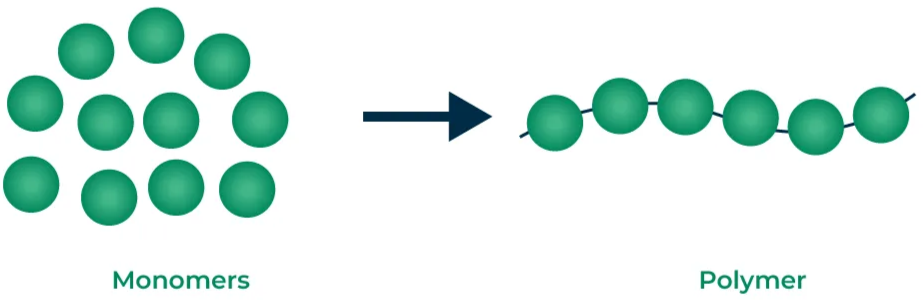
Polymerisation Reactions
Polymerisation is the reaction where monomers link up to create a polymer. Sometimes, special conditions like high pressure or a catalyst (a substance that speeds up the reaction) are needed for polymerisation to happen.
Addition Polymerisation
Addition polymerisation is one type of polymerisation.
Note
In addition polymerisation, monomers with a double bond between two carbon atoms join together to form a long polymer chain.
- Only one type of monomer is used, and it repeats to form the polymer.
Key Points About Addition Polymerisation:
One Monomer: Only one kind of monomer is used in the process.
For example, ethene is the monomer that makes poly(ethene).
One Product: The reaction forms only one product, which is the polymer.
For example, poly(ethene) is formed from ethene monomers.
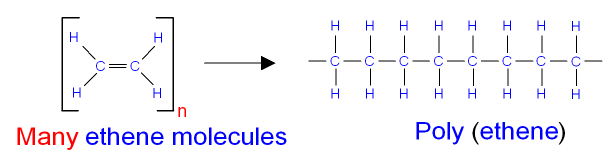
Note
Common Addition Polymers: Examples of addition polymers include:
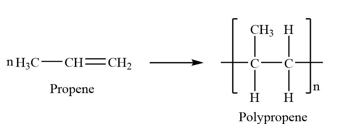
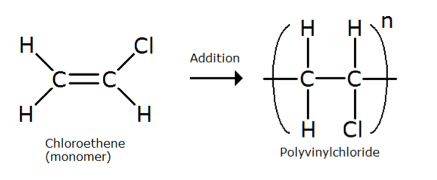
How to Represent Addition Polymers
Displaying the polymer: To represent an addition polymer, we draw the repeating unit of the polymer. This is a section of the polymer that repeats over and over.
Note
Brackets and 'n':
Extending bonds: The bonds from the carbon atoms in the repeating unit must extend beyond the brackets, showing that the chain continues.
| Polymer | Properties | Uses |
|---|---|---|
| Poly(ethene) | Flexible, electrical insulator, cheap | Plastic bags, bottles, wire insulation |
| Poly(propene) | Flexible, strong, tough, mouldable | Crates, furniture, robes |
| Poly(chloroethene) (PCV) | Tough, cheap | Window frames, water pipes |
| Poly(terafluoroethene) (PTFE) | Unreactive, tough, non-stick | Non stick pans. Waterproof clothing |