Nanoparticles (Edexcel GCSE Chemistry): Revision Notes
📚Revision Notes
Nanoparticles
Note
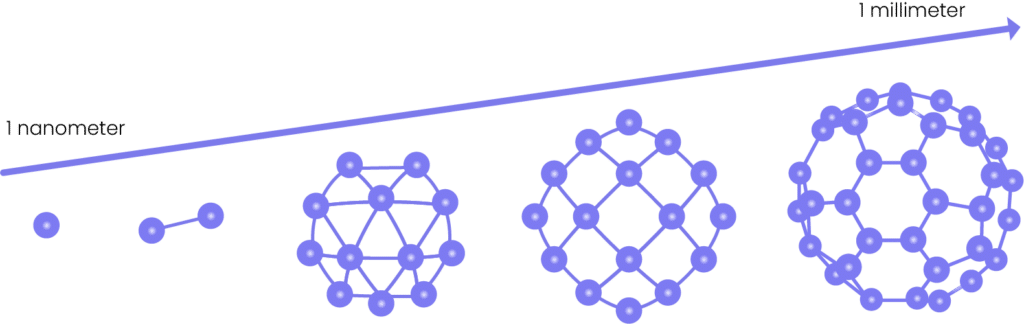
Nanoparticles are extremely small particles that range in size from 1-100 nanometres across.
- 1 nanometre (nm) = 0.000000001 metres.
- Nanoparticles are larger than atoms, as they contain hundreds of atoms, but are much smaller than most visible particles or molecules.
High Surface Area to Volume Ratio
- As particles decrease in size, their surface area becomes large compared to their volume. This gives nanoparticles a high surface area to volume ratio.
- This high ratio allows nanoparticles to have different properties compared to larger particles of the same material, making them useful in various applications.
- Because of their large surface area, they can be used as catalysts, helping speed up reactions by providing more surface for the reaction to occur on.
Below is a table with multiple uses, advantages and disadvantages of nanoparticles:
| Category | Advantages | Disadvantages | Uses |
|---|---|---|---|
| Medicine | • Can deliver drugs directly to cells, improving treatment effectiveness | • Potential unknown health risks as they could pass through biological barriers (e.g., skin, blood-brain barrier) | • Drug delivery systems (targeting specific areas in the body) |
| Electronics | • Improve the performance of electronic devices (e.g., faster processors, smaller components) | • Expensive to produce | • Used in transistors, circuits, and displays for smaller, more efficient devices |
| Sunscreens | • Better protection from harmful UV rays due to more even coverage | • Possible environmental damage (e.g., nanoparticles can accumulate in aquatic ecosystems) | • Used in sunscreens for UV protection |
| Cosmetics | • Improve texture and absorption of products | • Potential skin penetration and unknown long-term effects | • Found in makeup and anti-ageing creams |
| Catalysts | • Provide a larger surface area to speed up reactions | • Can be difficult to recover from the reaction mixtures after use | • Used in industrial chemical processes (e.g., speeding up reactions in the production of chemicals or fuels) |
| Clothing | • Antimicrobial properties help to reduce odour and kill bacteria | • Potential release of harmful particles into the environment during washing | • Used in fabrics for sportswear, socks, and other clothing |
| Construction | • Increased strength and durability in materials | • Costly and potentially toxic during manufacturing | • Used in concrete, paints, and coatings to enhance strength and water resistance |
| Environmental | • Can help clean up pollutants by breaking down harmful substances (e.g., in water treatment) | • Risk of nanoparticles contaminating ecosystems | • Used in water purification systems and environmental remediation projects |
| Food Packaging | • Can help to extend the shelf life of food by preventing bacterial growth | • Possible ingestion of nanoparticles with unknown health consequences | • Used in food packaging to improve preservation and freshness |
Potential Risks of Nanoparticles
- Unknown health effects: Because of their small size, nanoparticles can easily move through the body, potentially causing long-term health problems, but the exact effects are still being researched.
- Environmental concerns: Once nanoparticles are part of the waste chain, they may enter the environment, potentially getting into microorganisms, the food chain, and eventually animals and plants.
- Their large surface area could also make them toxic in certain conditions, but more studies are needed.
Specific Types of Nanoparticles
- Fullerenes:
- Fullerenes are used in lubricants for machinery, such as gears or artificial joints.
- Silver Nanoparticles:
- Silver nanoparticles are added to polymer fibres for things like surgical masks and wound dressings.
- They provide antibacterial properties, helping prevent infections.