Positive ions - Flame Tests (Edexcel GCSE Chemistry): Revision Notes
📚Revision Notes
8.3.1 Flame Tests
Note
Flame tests are a simple method used to identify certain metal ions based on the colour they produce when burned. When a small sample of a compound containing a metal ion is heated in a flame, the metal ion gives off a colour. This distinctive colour allows chemists to determine which metal ion is present in the compound.
Common Metal Ions and Their Flame Colours
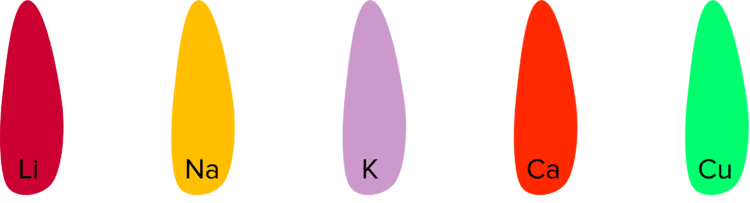
Here are some of the common metal ions you might test for, along with the colours they produce:
Note
- Lithium (Li⁺): Burns with a crimson flame.
- Sodium (Na⁺): Burns with a yellow flame.
- Potassium (K⁺): Burns with a lilac flame.
- Calcium (Ca²⁺): Burns with an orange/red flame.
- Copper (Cu²⁺): Burns with a green flame.
How Flame Tests Work
When you heat a metal ion, the energy from the flame excites the electrons in the metal ion, causing them to jump to higher energy levels. When these electrons fall back to their original levels, they release energy in the form of light. The specific wavelength (or colour) of this light is unique to each metal ion, which is why each ion produces a different flame colour.
Practical Uses of Flame Tests
The distinct colours produced by different metal ions during flame tests are not only useful in laboratory settings but also have practical applications in the real world. For instance, pyrotechnics—the art of making fireworks—often relies on metal ions to create vibrant colours in firework displays. The choice of metal ions allows manufacturers to design fireworks that explode in specific colours, adding to the spectacle of events like New Year's Eve or public celebrations.