Production of ethanol (Edexcel GCSE Chemistry): Revision Notes
📚Revision Notes
Production of ethanol
Fermentation of Sugar
Note
Fermentation is a process where yeast is used to convert sugars (a type of carbohydrate) into ethanol (alcohol) and carbon dioxide. This is a natural method of producing ethanol.
Conditions for Fermentation:
- Sugar dissolved in water: The sugar, usually from crops like sugar cane or corn, is mixed with water to create a solution.
- Yeast: Yeast contains an enzyme called zymase, which acts as a catalyst and helps speed up the fermentation reaction.
- Temperature of 30°C to 40°C: This is the ideal temperature range for fermentation. At these temperatures, enzymes work fastest (enzyme theory), but too high a temperature can kill the yeast.
- Anaerobic conditions: Fermentation must happen in the absence of oxygen (anaerobic conditions). If oxygen is present, ethanol will turn into ethanoic acid (vinegar).
Note
The chemical equation for fermentation is:
This shows that glucose (C₆H₁₂O₆) is broken down into ethanol (C₂H₅OH) and carbon dioxide (CO₂).
Availability of Resources:
Plenty of land: Fermentation relies on growing crops like sugar cane or corn, so it works best where there is a lot of land and a warm climate.
Note
Steps in the Fermentation Process:
- Mix yeast and glucose solution: Yeast is added to a solution of sugar (like glucose) in a clean container, which is sealed and left in a warm place.
- Alcohol concentration: Once the ethanol concentration reaches about 10-20%, the fermentation stops because the alcohol kills the yeast.
- Separation: The yeast settles at the bottom of the container, leaving an ethanol solution on top, which can be extracted.
Distillation of Ethanol:
Since the ethanol produced through fermentation is dilute (around 10-20% ethanol), the mixture can be distilled to produce a more concentrated solution.
Advantages and Disadvantages of Fermentation:
| Advantages | Disadvantages |
|---|---|
| ⩥ Requires lower temperatures, so less energy is needed | ⩥ A batch process, which is less efficient for large-scale production |
| ⩥ Sugar cane is a renewable resource | ⩥ Slower reaction compared to industrial processes |
| ⩥ Less environmental impact compared to using fossil fuels | ⩥ The ethanol produced is impure, so it needs fractional distillation to purify it |
Fractional Distillation of Ethanol
Note
After fermentation, fractional distillation is used to separate ethanol from the water and other impurities, increasing the ethanol concentration.
How Fractional Distillation Works:
- Boiling point difference: Ethanol has a lower boiling point than water (78°C compared to 100°C), so it evaporates first when the mixture is heated.
- Condensation: The ethanol vapour is passed through a Lieberg condenser, which cools it back into a liquid by using cold water around the tube.
- Collection: The condensed ethanol is collected in a separate flask, leaving water and other impurities behind.
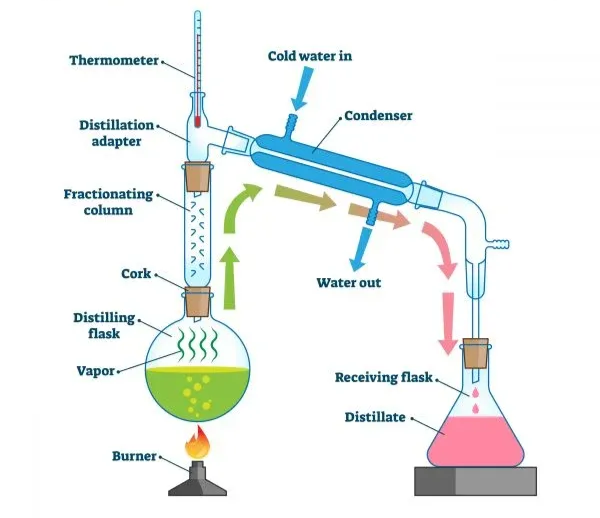
This method produces ethanol concentrations above 20%, suitable for further uses, including fuel and alcoholic beverages.