Half-life (Edexcel GCSE Physics Combined Science): Revision Notes
📚Revision Notes
Half-life
Note
Half-life is the time it takes for half of the unstable nuclei in a sample of a radioactive substance to decay. This means that after each half-life, the activity (how many decays happen per second) of the substance decreases by half.
The activity of a radioactive substance is measured in becquerels (Bq), where 1 Bq means one decay per second.
Note
Key Points about Half-Life:
- It's a random process, meaning we cannot predict exactly when an individual atom will decay, but we can predict how many atoms will decay over a certain amount of time.
- Every time one half-life passes, the number of remaining unstable nuclei is reduced by half.
Half-Life Calculation Examples
1. Thorium-243 Half-Life Example:
Note
Thorium-243 has a half-life of 25 days. If a sample has an initial activity of 600 counts per second: a) What is the activity after 25 days?
After one half-life (25 days), the activity will halve:
b) What is the activity after 50 days?
After another half-life (50 days in total), the activity will halve again:
2. Calculating Unstable Nuclei:
Note
A sample starts with 40,000 nuclei and has a half-life of 30 minutes. How many unstable nuclei are left after 2 hours? a) Calculate the number of half-lives passed:
2 hours = 120 minutes, so:
b) Calculate the number of unstable nuclei after 4 half-lives:
After each half-life, the number of nuclei halves:
So, after 4 half-lives, 2,500 nuclei remain.
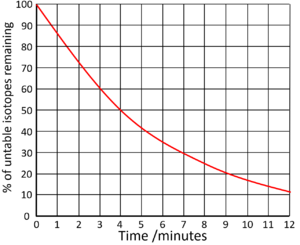
How to Work Out Half-Life from a Graph
To find the half-life from a decay graph:
- Start with the initial number of unstable nuclei (or activity).
- Half that number.
- Find the time on the graph where the number has halved. This time is the half-life. For example, if you start with 80 nuclei and it takes 2 days to decay to 40 nuclei, then the half-life is 2 days.