Nuclear fission (Edexcel GCSE Physics Combined Science): Revision Notes
📚Revision Notes
Nuclear fission
Nuclear Fission
Note
Nuclear fission occurs when an unstable nucleus splits into two or more pieces (two small nuclei fuse to form a heavier nucleus, releasing a lot of energy).
Note
When the nucleus splits, two smaller nuclei are produced. These will be of different elements than the original nucleus. The new nuclei are also unlikely to be the same size as one another. All of the fission products have kinetic energy.
Two or three neutrons are also produced when fission occurs. These also have kinetic energy. If any of these neutrons are moving slowly enough to be absorbed by another atom, they may cause that nucleus to undergo fission as well. This is called a chain reaction.
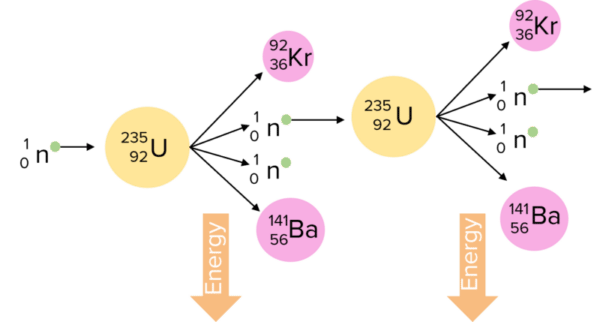
The energy that is not transferred to the smaller nuclei or the neutrons is released as gamma rays. In a nuclear power station, these gamma rays can be used to heat water, producing steam to turn turbines and generate electricity.
In nuclear power stations, the amount of energy produced is controlled by controlling how fast the chain reaction can occur. Control rods, which absorb neutrons, are lowered into the nuclear reactor to slow down the chain reaction and then lifted out of the reactor to speed up the chain reaction.
Note
If an uncontrolled chain reaction occurs, a huge amount of energy may be released in an explosion. This is how nuclear weapons work.
Note
Key Points:
- Spontaneous fission is rare. Usually, for fission to occur, the unstable nucleus must first absorb a neutron.
- When the unstable nucleus absorbs a neutron, it splits into two smaller nuclei, roughly equal in size, and it then emits two or three neutrons and gamma rays.
- Energy is released by the fission reaction.
- This neutron may collide with another radioactive nucleus.
- This nucleus absorbs the neutron and becomes unstable.
- This nucleus splits, releasing another neutron and producing more energy.
- This is a chain reaction, as energy is being released, and one 'split' causes another to occur.
- A neutron needs to be absorbed initially before it splits because it needs a little extra energy before it can split and release lots of energy – like a ramp on a cliff, the neutron gives it enough of a kick to get over the ramp to fall.
- After the nucleus splits, it leaves two smaller nuclei roughly equal in size.
- And they both (along with the neutrons) have kinetic energy.
- If the chain reaction is not controlled, it will increase at an exponential rate – which is what happens in a nuclear weapon.
- This process is used in nuclear fission with uranium nuclei.
Nuclear Fission Diagrams
Note
The process:
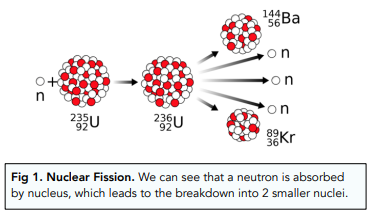
- The nucleus absorbs a neutron. In most fission reactions, the unstable nucleus will absorb a neutron as the first step.
- The nucleus splits into 2. Once the neutron has been absorbed, the nucleus will split into 2 smaller nuclei. Energy is released through the fission reaction.
- Neutrons and gamma rays are emitted. The nucleus will also emit 2 or 3 high-energy neutrons when the fission reaction is happening. As well as 2 or 3 neutrons, gamma rays are also emitted
Drawing Nuclear Fission:
Below, we can see a representation of nuclear fission. You may be asked to draw a diagram like this in an exam, so here's how to do it:
- Draw a neutron. This is essentially a small circle. You can label it 'n'.
- Draw a large nucleus. As you can see in the diagram below, the nucleus must be made up of smaller particles.
- Draw 2 more nuclei. Since this is a fission reaction, we need to draw the 2 neutrons that are produced.
- Draw 2 or 3 neutrons. Fission reactions produce more neutrons, which we need to represent on our diagram as small circles again.
- Draw more fission reactions. From one of the neutrons, draw an arrow to another nuclei. This is the continuation of the chain reaction.
The end product should look similar to the diagram below: