Microwave & infrared (Edexcel GCSE Physics Combined Science): Revision Notes
📚Revision Notes
Microwave & infrared
Microwaves
Microwaves in Communication:
Microwaves in Ovens:
Microwaves are used in satellite communication because they can pass through the Earth's atmosphere, which contains water vapour.
The wavelengths used in communication are different from those used in microwave ovens. This is because communication microwaves must travel long distances through the atmosphere without being absorbed.
In microwave ovens, microwaves are used to cook food by heating water molecules inside the food.
The microwaves penetrate a few centimetres into the food and are absorbed by water molecules, transferring their energy.
This energy heats the water molecules, which then transfer the heat to the rest of the food, cooking it from the inside.
Infrared Radiation (IR)
Infrared Radiation & Temperature:
Infrared radiation is emitted by all hot objects. The hotter the object, the more IR radiation it gives off.
Infrared cameras detect this radiation and convert it into an electrical signal, which is then displayed on a screen as a thermal image.
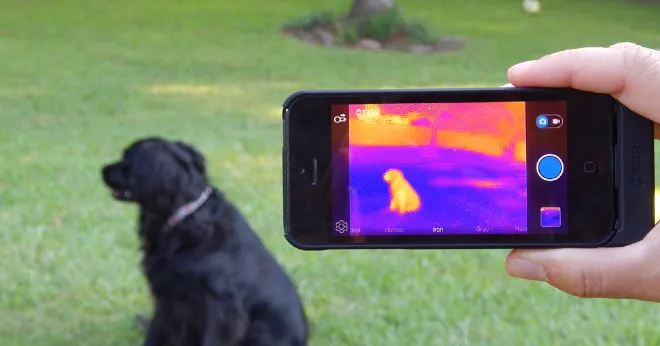
Uses of Infrared Cameras:
- Thermal imaging helps the police detect suspects in the dark.
- Security systems use infrared sensors to trigger alarms or lights when they detect motion or heat.
Infrared in Cooking:
Infrared radiation can be used to cook food. For example, toasters use IR to heat up and cook food by increasing its temperature when absorbed.
Infrared in Electric Heaters:
- Electric heaters contain a long wire that heats up when an electric current flows through it. This wire emits both infrared radiation and visible light.
- The IR is absorbed by objects and air in the room, transferring energy and raising the temperature.

Infrared for Communication
Infrared radiation is also used to transfer information between devices, like phones or TV remotes. This communication only works over short distances and the receiver must be in the line of sight of the IR emitter.
Optical Fibres:
Note
Optical fibres are thin strands of glass or plastic that carry data over long distances.
- These fibres use infrared pulses to transfer large amounts of data very quickly.
- To prevent dispersion (which could cause information loss), only a single wavelength of IR is used inside the fibre.
- The data is transferred through total internal reflexion, which keeps the IR signals bouncing inside the fibre, allowing data to travel over long distances without loss.