Esters (AQA A-Level Chemistry): Revision Notes
📚Revision Notes
7.3.2 Esters
Esters
Esters are organic compounds derived from carboxylic acids and alcohols, containing the functional group. They are widely used in various industries due to their distinct properties, including pleasant odours, versatility in chemical synthesis, and the ability to be modified into different forms.
Structure and Nomenclature of Esters
-
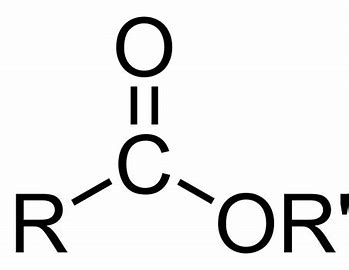
Structure: Esters have the general structure ', where R represents the part from the acid, and R' from the alcohol.
-
Naming Conventions:
- The name is based on the parent carboxylic acid and alcohol from which it is derived.
- The suffix oate replaces oic acid from the carboxylic acid name, while the alkyl chain attached to the oxygen is derived from the alcohol name.
- For example, ethyl ethanoate is derived from ethanol and ethanoic acid. Carboxylic acids and alcohols react in the presence of heat and a strong acid catalyst (e.g.),
-
This reaction is called esterification.
-
The formation of the ester above can be represented by the equation:
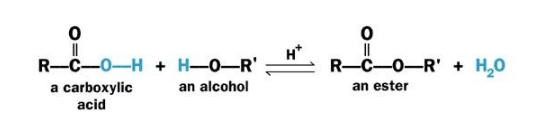
- Water is eliminated from the reactants so this is a condensation reaction.
- It's also Reversible reaction
Common Uses of Esters
Esters are essential in various applications due to their physical and chemical properties:
Perfumes and Food Flavourings:
-
Esters are widely used in fragrances and flavourings because of their pleasant, fruity scents.
-
For instance, ethyl methanoate has a raspberry-like smell and is used as a flavour additive in foods and confectioneries.
-
Natural and synthetic esters contribute to the scents of fruits and flowers, with complex mixtures often responsible for the characteristic aromas. Plasticisers:
-
Plasticisers are esters added to polymers, particularly PVC (polyvinyl chloride), to enhance flexibility.
-
In rigid PVC (used for pipes), ester plasticisers increase flexibility by weakening intermolecular forces, allowing the polymer chains to slide past each other.
-
This makes PVC suitable for products like cling film and other soft plastic materials. Solvents:
-
Esters, such as ethyl ethanoate, are common solvents for organic compounds due to their low toxicity, moderate volatility, and relatively low boiling point (around 77°C).
-
They are used in products like glues, nail varnishes, and other cosmetics, providing efficient dissolving capabilities with minimal health risks.
3. Naturally Occurring Esters: Vegetable Oils and Animal Fats
Triglycerides:
- Vegetable oils and animal fats are naturally occurring esters known as triglycerides. These are formed from propane-1,2,3-triol (glycerol) and three molecules of fatty acids.
- Fatty acids in triglycerides are long-chain carboxylic acids, such as stearic acid.
- Formation: A triglyceride forms when glycerol reacts with three fatty acid molecules, eliminating three molecules of water. This reaction is also known as esterification.
Vegetable Oils and Animal Fats
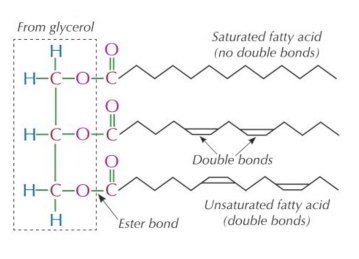
Vegetable oils and animal fats are esters of propane-1,2,3-triol (glycerol) and 3 long chain carboxylic acids called fatty acids.
-
The esters formed in this way are known as triglycerides.
-
The fatty acids can be saturated or unsaturated
-
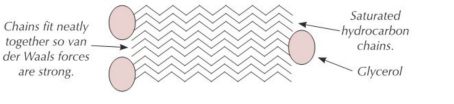
Saturated fatty acids: fatty acids which do not have a double bond in the hydrocarbon chain.
-
Fats are triglycerides that are solid at room temp. This is because fats are mainly made of saturated fatty acids, which are straight (they can therefore fit neatly together)
-
This increases the van der Waals' forces between them, leading to a higher melting point.
-
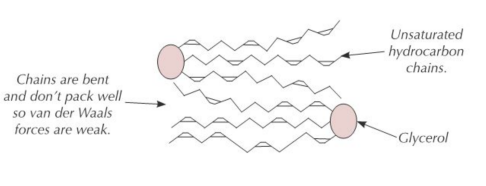
Unsaturated fatty acids: fatty acids which have at least one C=C double bond in the hydrocarbon chain.
-
Oils are triglycerides that are liquid at room temp. - This is because they mainly have unsaturated fatty acids, which are bent and have kinks that obstruct packing.
-
This decreases the van der Waals' forces between them, leading to lower melting point.
Hydrolysis of Vegetable Oils and Fats
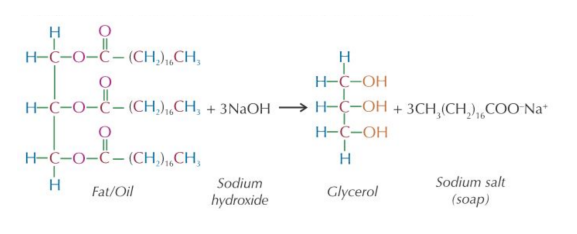
- Vegetable oils and animal fats are esters and can be hydrolysed in alkaline conditions to give soap (salts of long-chain carboxylic acids) and glycerol.
- This reaction is sometimes called saponification, meaning 'soap making'.
- Saponification: the alkaline hydrolysis of fats into glycerol and the salts of the fatty acids present in the fat.