Basic Properties (AQA A-Level Chemistry): Revision Notes
📚Revision Notes
7.5.2 Basic Properties
Properties of Amines
Basicity of Amines
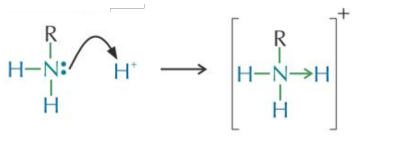
- Amines as Weak Bases: Amines act as weak bases due to the lone pair of electrons on the nitrogen atom, which can accept protons ( ions). This lone pair allows amines to accept protons, behaving similarly to ammonia.
- Reaction with Acids: All amines, regardless of their structure, react with strong acids to form alkylammonium salts, a reaction similar to ammonia.
Reactions of Amines with Acids
- When amines react with acids, they follow a general pattern, accepting a proton to form a positive alkylammonium ion paired with the acid's conjugate base: Ammonia:
Primary Amines:
Secondary Amines:
Tertiary Amines
Note
Example Reaction:
Note on Charges: Charges on ions are often explicitly shown, as in to clearly indicate the formation of an ammonium salt.
Comparative Basic Strength of Amines
-
Lone Pair Availability and Basicity: The basicity of ammonia and amines depends on how readily the nitrogen atom's lone pair can be donated. Greater availability of this lone pair results in a stronger base.
-
Influence of Alkyl Groups (Positive Inductive Effect): The electron-donating effect of alkyl groups attached to the nitrogen increases electron density around the nitrogen atom, making the lone pair more available for bonding with protons.
- Primary Amines: Primary amines have one alkyl group attached to nitrogen. Alkyl groups donate electron density through a "positive inductive effect," which raises the electron density around nitrogen, strengthening the base.
- Secondary Amines: Secondary amines have two alkyl groups, leading to a stronger positive inductive effect and thus greater electron density around nitrogen compared to primary amines. Consequently, secondary amines are stronger bases than primary amines.
- Tertiary Amines: Tertiary amines, with three alkyl groups, exhibit an even higher electron-donating effect, making them generally the strongest bases among ammonia, primary, and secondary amines. Ammonia and the amines are weak bases (proton acceptors).
-
They are weak bases because the lone pair of electrons on the N atom is able to accept a.
-
The ability of amines to act as bases depends on the availability of the lone pair of electrons on the N atom.
-
Increased electron density of the lone pair on the N atom ➜ increased ability to accept ➜ stronger bases
Explaining Base Strength of Amines
Primary, Secondary, and Tertiary Amines Compared to Ammonia
- Alkyl groups are more electron releasing than atoms (have a greater 'inductive effect').
- The more alkyl groups substituted on to the atom in place of H atoms, the more electron density is pushed on to the atom.
- Therefore, the more alkyl groups attached to the atom, the greater the electron density of the lone pair on the N atom, the stronger a base the amine is.
- This means in order of increases base strength: < 1° < 2° < 3°
Aromatic Amines Compared to Aliphatic Amines
- The lone pair on the N atom is partially delocalised into the benzene ring.
- This means the electron density of the lone pair on the N atom is reduced meaning that aromatic amines are weaker bases than aliphatic amines.
- Therefore in order of increased base strength: Aromatic < < 1° < 2° < 3°
Nucleophilic Properties
Ammonia and the amines are nucleophiles (electron-pair donors). They are nucleophiles because they have a lone pair of electrons on the N atom.