Condensation Polymers (AQA A-Level Chemistry): Revision Notes
📚Revision Notes
7.6.1 Condensation Polymers
Polymer: a long chain of repeating units joined together. It is saturated. Monomer: unit which breaks its double bond to form a repeating unit; It is a small, unsaturated molecule. Condensation polymer: a polymer that is formed when monomers join together, eliminating a small molecule such as water (or ) in the process.
Condensation polymers are formed by reactions between:
- Dicarboxylic acids + diols, which forms a polyester. Dicarboxylic acids + diamines, which forms a polyamide (or polypeptide).
- The 'Di' prefix means "2 of"
- TWO groups on a Diol - TWO groups on a Dicarboxylic acid - TWO -groups on a Diamine Polyesters.
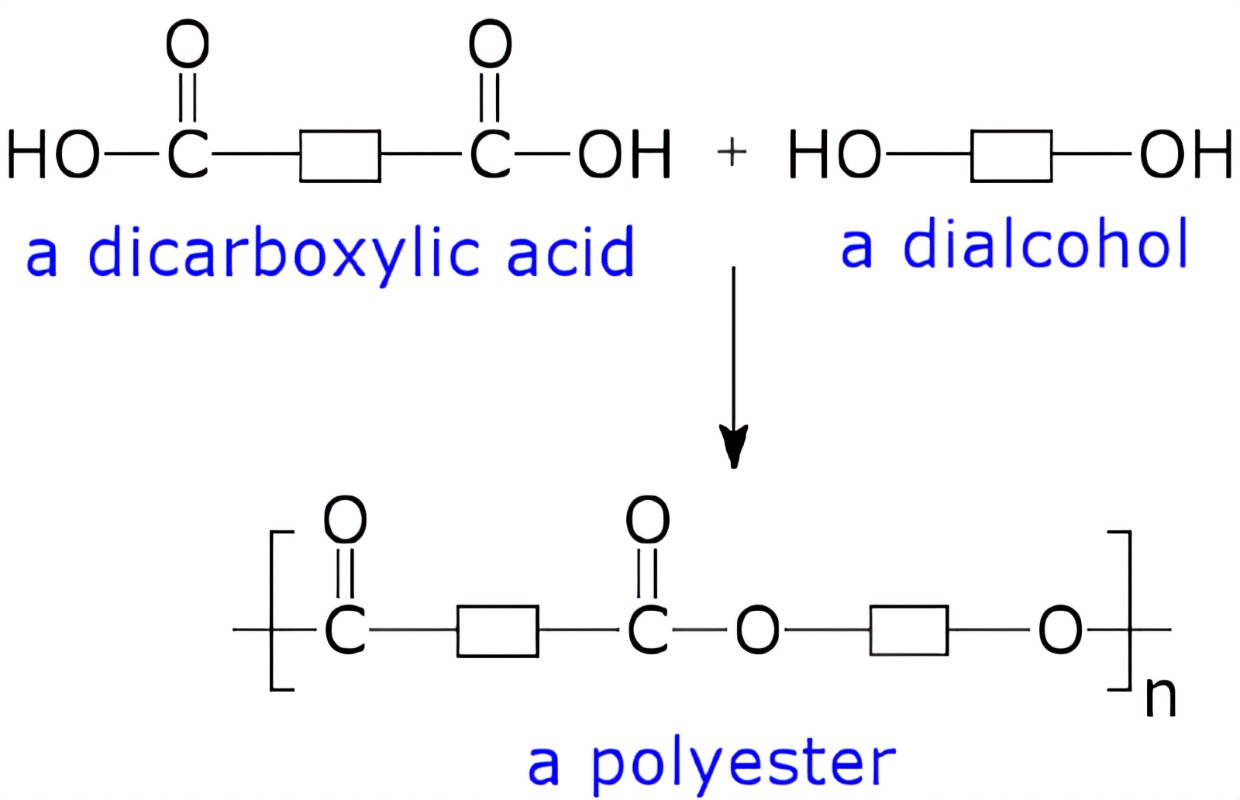
Reactions between dicarboxylic acids and diols make polyesters.
-
The carboxyl groups of dicarboxylic acid can react with the -OH groups of diols to form ester links.
-
A water molecule is lost each time an ester link is formed. Therefore, this is a condensation reaction.
-
There are permanent dipole-dipole attractions between the polymer chains in polyesters due to the the polar bonds in the ester linkage.
-
Therefore, there are greater forces of attraction between the polymer chains in polyesters compared to the weak van der Waals forces between addition polymer chains.
Terylene (a polyester)
- You need to know the makeup of 3 polymers
- One of these is a polyester and two are polyamides. This is the first one: Terylene.
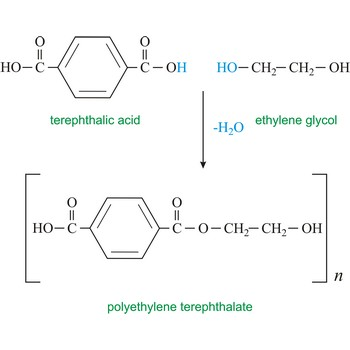
Terylene is used to make plastic bottles (and similar plastic products) and is recycable.
Polyamides
-
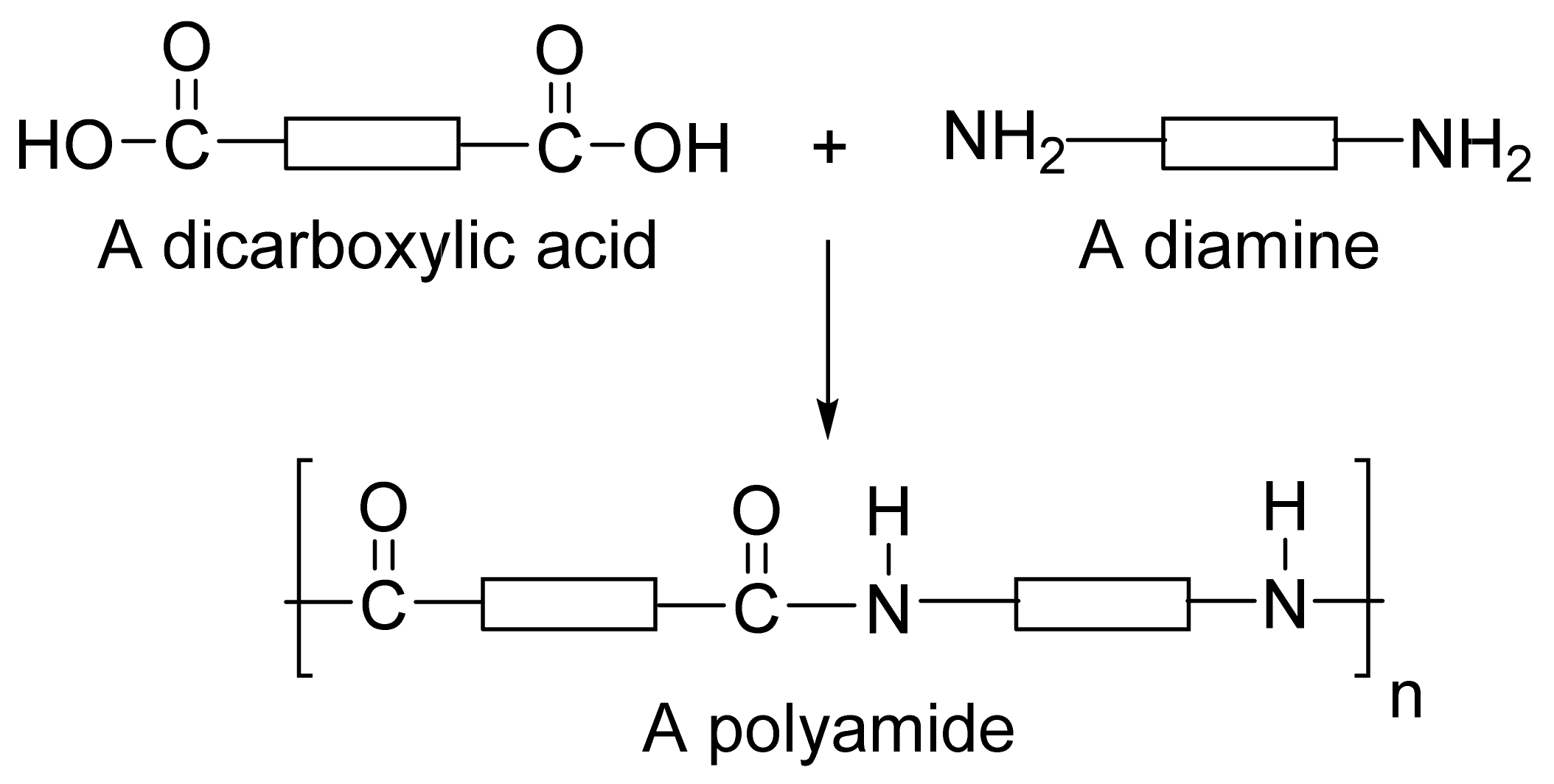
Reactions between dicarboxylic acids and diamines make polyamides.
-
The carboxyl groups of dicarboxylic acid react with the diaminesamino groups to from amide links.
-
A water molecule is lost each time an amide link is formed, so this is a condensation reaction.
-
There are H-bonds between the polymer chains in polyamides due to the presence of bonds and bonds.
-
This means there are greater forces of attraction between the polymer chains in polyamides compared to the weak van der Waals forces between addition polymer chains.
Nylon 6,6 (a polyamide)
Monomer 1: a dicarboxylic acid, hexanedioic acid. Nonomer 2: a diamine, 1,6-diaminohexane.
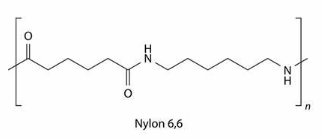
• Nylon is used to make fabrics, ropes, and medical prosthetics.
Kevlar (a polyamide)
Monomer 1: a dicarboxylic acid, benzene-1,4-dicarboxylic acid. Monomer 2: a diamine, 1,4-diaminobenzene.
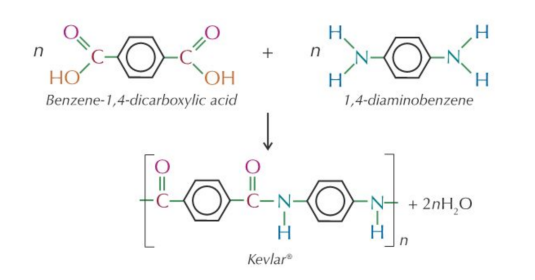
- Kevlar is used to make bullet-proof vests (because it's strong, stable and also fire resistant).
Polypeptides
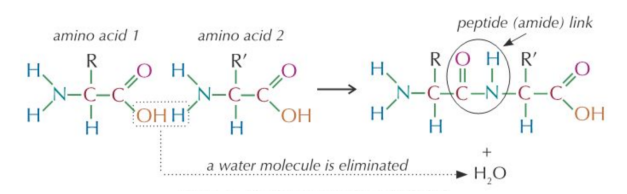
- Amino acids (more on these in the amino acids topic) contain an aminefunctional group and a carboxylic acid functional group.
- These groups can react in condensation polymerisation to form polyamides
- They're more commonly called polypeptides when the monomers are amino acids rather than diamines and di-acids.