Cams and followers (AQA GCSE Design and Technology): Revision Notes
📚Revision Notes
Cams and followers
What are cams and followers?
Cams are mechanical devices that convert rotary motion (spinning movement) into reciprocating motion (back and forth movement). Think of them as specially shaped wheels that create different patterns of movement as they rotate. The cam is attached to a rotating shaft, and a follower component sits against the cam's surface, moving up and down as the cam spins.
Note
This system is incredibly useful in engineering because it allows designers to create precise, repeatable movements that follow specific patterns. The beauty of cam systems lies in their ability to convert simple circular motion into complex, controlled linear movements.
You'll find cam and follower systems in many everyday machines, from car engines to manufacturing equipment. The versatility of these mechanisms makes them one of the most important motion conversion systems in mechanical engineering.
Types of cams
Different cam shapes create different movement patterns. Understanding these patterns is essential for selecting the right cam type for your application. Here are the three main types you need to know:
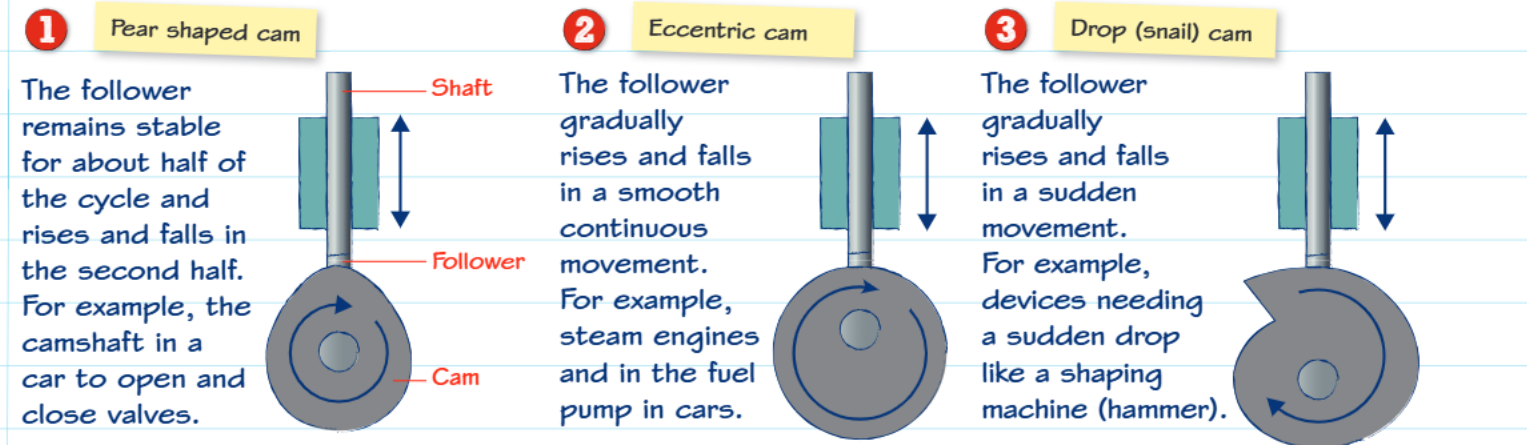
Pear-shaped cam
The pear-shaped cam has a distinctive teardrop profile that creates a specific movement pattern. When this cam rotates, the follower stays stable for approximately half the rotation cycle, then rises and falls during the other half. This creates a period of rest followed by action.
Example
Real-world Application: Car Engine Valves
Car valve systems use pear-shaped cams to control when engine valves open and close:
- Dwell period: The stable portion keeps valves closed during compression and power strokes
- Rise and fall: Opens valves at precisely the right moment for intake and exhaust
- Timing precision: Ensures optimal engine performance and efficiency
Eccentric cam
An eccentric cam is essentially a circular cam that's mounted off-center on its shaft. This offset mounting creates smooth, continuous up and down movement of the follower as the cam rotates. The movement is gentle and predictable, making it ideal for applications requiring consistent motion.
Example
Real-world Applications: Smooth Motion Systems
You'll find eccentric cams in:
- Steam engines: Where smooth motion is essential for efficient operation
- Fuel pump systems: Where consistent pressure delivery is critical
- Textile machinery: For creating uniform weaving patterns
Drop (snail) cam
The drop cam, also called a snail cam because of its spiral shape, produces a very specific movement pattern. The follower rises gradually as it follows the spiral, then suddenly drops when it reaches the end of the spiral and falls back to the beginning.
Example
Real-world Applications: Impact and Shaping Operations
This sudden drop motion is perfect for:
- Manufacturing hammers: Controlled rise followed by quick, powerful strike
- Shaping machines: Precise forming operations requiring rapid return motion
- Automatic tools: Where quick release mechanisms are needed
Understanding cam movement
When studying cams, you need to understand the different types of movement they create. These fundamental motion types combine to create the overall pattern that any cam system produces.
Note
Key Movement Types:
- Rise: The follower moves upward as it follows the cam profile
- Fall: The follower moves downward
- Dwell: The follower remains stationary at the same height
- Stroke: The total range of movement from the highest to lowest position
- Rotation: The spinning movement of the cam itself
Understanding these movements is critical for designing effective cam systems and predicting their behaviour.
Types of followers
The follower is the component that touches the cam and converts its rotation into linear movement. Different follower designs have different characteristics, and choosing the right type is essential for optimal system performance.
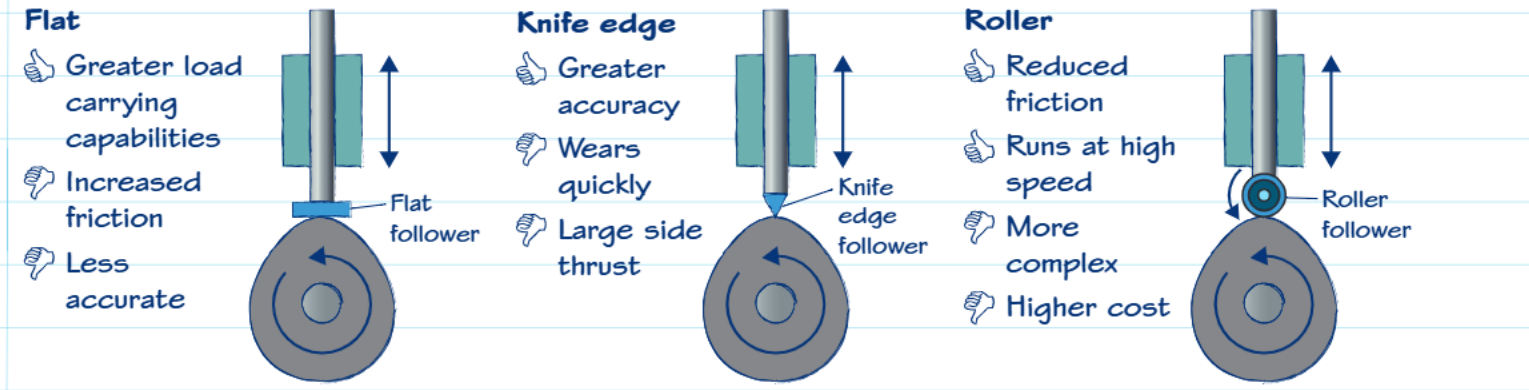
Flat follower
A flat follower has a straight, flat surface that contacts the cam. This design can handle heavy loads effectively because the contact area is large, distributing forces well across the surface.
Advantages:
- Excellent for carrying heavy loads
- Simple and robust design
- Low manufacturing cost
Disadvantages:
- Creates more friction than other types
- Less precise in following complex cam profiles
- Can cause more wear on both cam and follower
Important
Flat followers are best suited for applications where load capacity is more important than precision or speed. They're commonly used in heavy machinery and industrial presses.
Knife edge follower
The knife edge follower has a sharp, pointed contact surface that follows the cam profile very precisely. This design can trace complex cam shapes accurately due to its minimal contact area.
Advantages:
- Extremely accurate in following cam profiles
- Can handle intricate shapes and sudden changes in direction
- Ideal for precision applications
Disadvantages:
- Wears out quickly due to the small contact area
- Creates large side forces that can damage the mechanism
- Not suitable for heavy-duty applications
Important
Critical Limitation: The knife edge design creates high stress concentrations that can lead to rapid wear and failure. Use only in light-duty, precision applications where accuracy is paramount.
Roller follower
A roller follower uses a small wheel or roller that rolls along the cam surface rather than sliding. This reduces friction significantly and allows for higher operating speeds.
Advantages:
- Much less friction than sliding followers
- Can operate at high speeds without excessive wear
- Smoother operation with less vibration
Disadvantages:
- More complex design with additional moving parts
- Higher manufacturing cost
- The roller mechanism can fail if not properly maintained
Note
Roller followers represent the best compromise between performance and complexity for most modern applications. Their reduced friction makes them ideal for high-speed machinery and automotive applications.
Practical applications
Cam and follower systems are everywhere in modern engineering, demonstrating their versatility and reliability. In car engines, they control valve timing to ensure fuel enters and exhaust leaves at exactly the right moments. Manufacturing machines use them to create precise, repeatable movements for cutting, shaping, and assembly operations.
Note
Wide-ranging Applications:
Studies show that cam systems are found in over 80% of mechanical devices that require motion conversion. From the sewing machine in your home to the massive presses in automotive manufacturing, these systems provide the backbone of mechanical motion control.
The beauty of cam systems is their reliability and precision. Once you design the cam profile correctly, it will produce the same motion pattern millions of times with remarkable consistency. This repeatability makes them invaluable in automated manufacturing and precision machinery.
Summary
Key Points to Remember:
- Cams convert rotary motion into reciprocating motion using specially shaped profiles
- Pear-shaped cams provide periods of rest followed by action, perfect for engine valves
- Eccentric cams create smooth, continuous motion ideal for pumps and engines
- Drop cams produce gradual rises followed by sudden falls, excellent for hammers and tools
- Choose your follower type based on your needs: flat for heavy loads, knife edge for precision, roller for high speed and low friction
- The key to successful cam design is matching the cam profile and follower type to your specific application requirements