Composite materials (AQA GCSE Design and Technology): Revision Notes
📚Revision Notes
Composite materials
What are composite materials?
Composite materials are created by combining two or more different materials together to produce a new material with improved properties. The combination results in a material that performs better than any of the individual materials could on their own. This makes composites incredibly useful in modern manufacturing and construction.
Note
The key principle behind composites is that different materials have different strengths and weaknesses. By combining them strategically, engineers can create materials that have multiple desirable properties while minimising the disadvantages of each individual component.
Glass reinforced plastic (GRP)
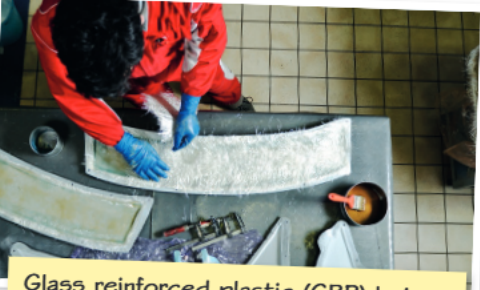
Glass reinforced plastic, commonly known as GRP or fibreglass, is made by reinforcing plastic with strands or woven fibres of glass. The material is constructed by building up multiple layers, which gives it strength and durability.
Properties of GRP
GRP offers several important characteristics that make it valuable for many applications. It provides a good strength-to-weight ratio, meaning it can handle significant loads while remaining relatively lightweight. The material is also rigid, which helps it maintain its shape under stress. One of the major advantages of GRP is that it costs less to produce than carbon fibre alternatives, making it more accessible for various projects. Additionally, GRP can be easily coloured using different resins during the manufacturing process.
Uses of GRP
The versatility of GRP makes it suitable for numerous applications. It's commonly used in manufacturing canoes, where its lightweight yet strong properties are ideal for water sports equipment. The automotive industry uses GRP for car bodies, particularly in specialty vehicles where weight reduction is important. GRP is also used to create rigid pond liners, taking advantage of its water-resistant properties and durability.
Safety considerations
Important
When working with GRP, proper safety precautions are essential. The glass fibres can become airborne during cutting, sanding, or shaping, which can cause respiratory problems if inhaled. Workers must wear appropriate protective equipment and ensure adequate ventilation in work areas.
Carbon fibre reinforced plastic (CFRP)
Carbon fibre reinforced plastic represents the premium end of composite materials. Like GRP, it's made by reinforcing plastic with fibres, but in this case, the reinforcement comes from carbon fibres rather than glass. The construction method is similar, with multiple layers built up to create the final material.
Properties of CFRP
CFRP offers exceptional performance characteristics that justify its higher cost. It has an excellent strength-to-weight ratio, even better than GRP, making it ideal for applications where every gramme matters. The material is extremely rigid, with greater stiffness than glass fibres, which means it maintains its shape exceptionally well under load. This combination of lightness, strength, and rigidity makes CFRP highly sought after in high-performance applications.
Note
While CFRP offers superior performance compared to GRP, the significantly higher cost means it's typically reserved for applications where the enhanced properties justify the expense, such as aerospace and high-end motorsport applications.
Uses of CFRP
The superior properties of CFRP make it the material of choice for demanding applications. In motorsport, CFRP is used extensively for racing car parts and body armour, where the combination of strength and light weight can mean the difference between winning and losing. The aerospace industry also relies heavily on CFRP for aircraft components where weight savings directly translate to fuel efficiency and performance.

Plywood
Plywood represents a different type of composite material, focusing on wood rather than plastic and fibres. It's a manufactured board created by bonding multiple layers of wood veneers together with glue to form a flat, stable sheet.
Construction of plywood
The key to plywood's strength lies in its layered construction. Each layer, called a veneer, is positioned with its grain running at 90 degrees to the adjacent layers. This cross-grain construction is what gives plywood its unique properties. The number of layers is always odd, ensuring the grain direction on both outer faces runs in the same direction.
Note
The cross-grain construction is the secret to plywood's superior stability. By alternating the grain direction of each layer, the natural tendency of wood to expand and contract along the grain is counteracted, resulting in a much more dimensionally stable material.
Properties of plywood
The alternating grain pattern gives plywood stability in all directions, unlike solid wood which is stronger along the grain. This makes plywood less likely to warp, twist, or split compared to solid timber. Plywood is also available in large sheets, making it convenient for construction projects that require wide panels. The material comes in various thicknesses, typically measured in millimetres, with common sizes including 3mm, 6mm, and 9mm variants.
Applications of plywood
Plywood's stability and availability in large sheets make it invaluable in construction and furniture making. It's commonly used for flooring, roofing, wall sheathing, and furniture construction. The material's resistance to warping makes it particularly useful for applications where dimensional stability is crucial.
Choosing the right composite material
When selecting a composite material for a specific application, several factors need consideration. The intended purpose of the product plays a crucial role in material selection. For high-performance applications requiring maximum strength and minimum weight, CFRP might be worth the extra cost. For general applications where cost is a primary concern, GRP might be more suitable. For construction applications requiring large, stable panels, plywood could be the best choice.
Note
Key Selection Factors:
- Performance requirements - strength, weight, stiffness needed
- Cost constraints - budget available for materials
- Environmental conditions - moisture, temperature, chemical exposure
- Manufacturing considerations - ease of working, tooling requirements
The working environment also matters. Some composites perform better in certain conditions, such as moisture resistance or temperature tolerance. Understanding these requirements helps ensure the chosen material will perform reliably throughout its intended lifespan.
Summary
Key Points to Remember:
- Composite materials combine two or more different materials to create enhanced properties that exceed what individual materials can achieve alone
- GRP uses glass fibres for reinforcement and offers good strength-to-weight ratio at a lower cost, making it suitable for canoes, car bodies, and pond liners
- CFRP uses carbon fibres and provides excellent strength-to-weight ratio with superior rigidity, ideal for racing cars and high-performance applications
- Plywood uses alternating wood grain layers at 90-degree angles to create stability in all directions, perfect for construction and furniture applications
- Always consider the intended purpose, cost requirements, and working conditions when selecting the appropriate composite material for any project