Manufactured boards (AQA GCSE Design and Technology): Revision Notes
📚Revision Notes
Manufactured boards
What are manufactured boards?
Manufactured boards are engineered materials created by combining cheaper timber, wood offcuts, chips, or fibres using adhesives and heat treatment. Unlike natural timber, these boards are designed to have consistent properties and dimensions, making them ideal for construction and furniture making where uniformity is important.
Note
The key advantage of manufactured boards is their predictable behaviour - unlike natural timber which can vary significantly in strength and characteristics, manufactured boards offer reliable performance across every sheet produced.
Key features and advantages
Manufactured boards offer several benefits over natural timber that make them popular in construction and manufacturing:
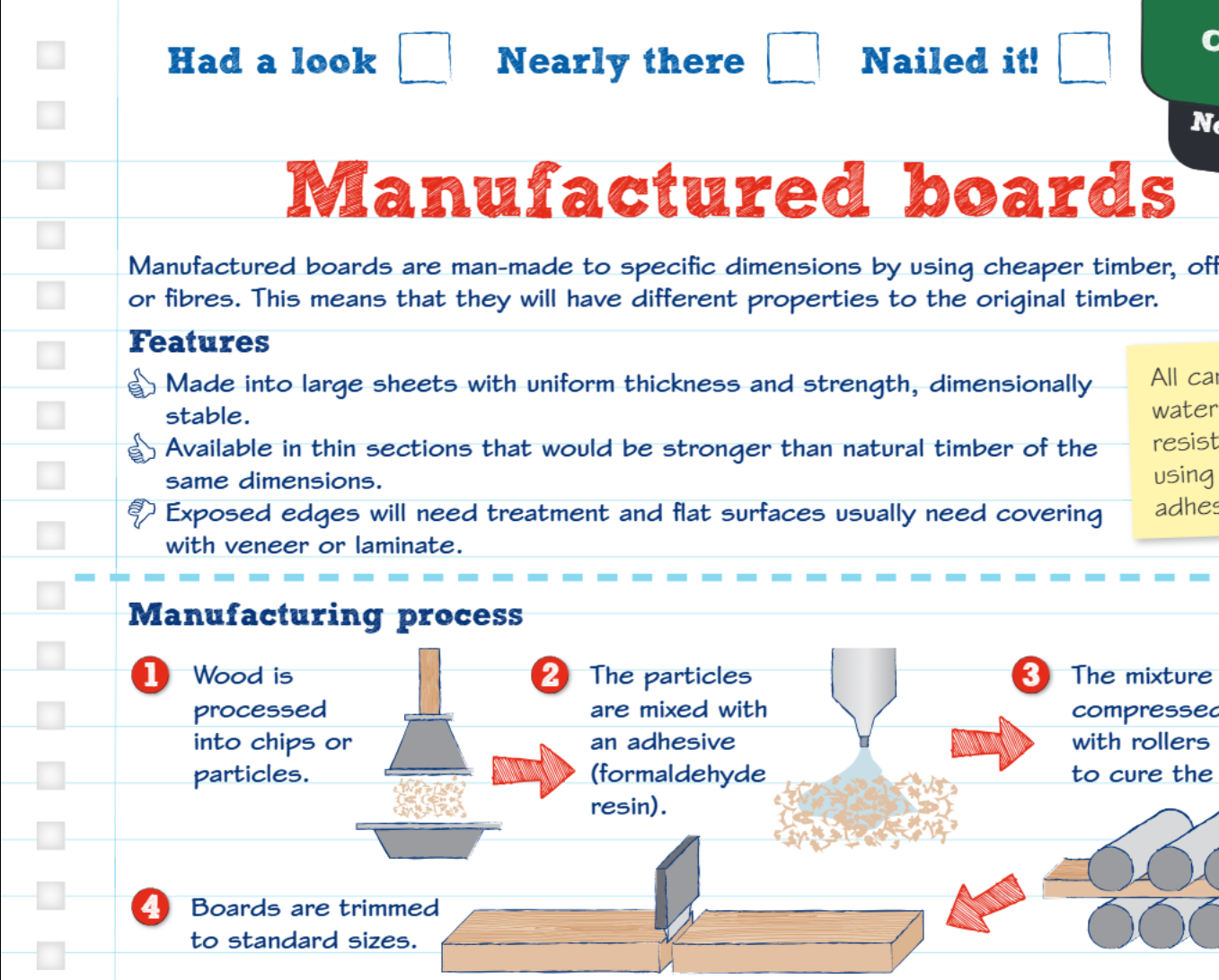
Uniform properties: These boards are produced in large sheets with consistent thickness and strength throughout. This dimensional stability means they won't warp, twist, or split like natural wood might over time.
Note
Dimensional stability is particularly valuable in applications like kitchen cabinets or built-in furniture where precise fitting is essential and movement would cause problems.
Enhanced strength: Despite being made from waste materials or smaller timber pieces, manufactured boards can actually be stronger than natural timber of equivalent thickness. This is because the manufacturing process distributes stress evenly throughout the material.
Surface treatment requirements: The exposed edges of manufactured boards typically need special treatment or covering, and flat surfaces usually require finishing with veneer or laminate to improve appearance and durability.
Water and fire resistance: Different types of adhesives can be used during manufacturing to create boards with improved resistance to moisture and fire, making them suitable for various environments and applications.
Manufacturing process
The production of manufactured boards follows a systematic four-step process that transforms raw wood materials into engineered sheets:
Example
Manufacturing Process: Step-by-Step Production
Step 1 - Material preparation: Raw wood is processed through grinding or chipping equipment to create small particles, chips, or fibres. This breaks down the original timber structure into manageable pieces.
Step 2 - Adhesive mixing: The wood particles are thoroughly mixed with formaldehyde resin, which acts as a binding agent. This adhesive will hold the particles together once the board is formed.
Step 3 - Compression and curing: The adhesive-coated mixture is compressed using industrial rollers under high pressure and heat. This process bonds the particles together and allows the adhesive to cure, creating a solid sheet.
Step 4 - Finishing: The formed boards are trimmed to standard sizes using cutting equipment, ensuring they meet industry specifications for thickness and dimensions.
Types of manufactured boards
Medium density fibreboard (MDF)
MDF is created by combining wood fibres with formaldehyde adhesive under intense heat and pressure. This process produces a board with exceptional smoothness and uniformity.
Note
Key properties:
- Dense material with a very smooth, flat surface that can be easily machined and painted
- Cost-effective as it's manufactured from waste wood materials
- Produces fine dust particles when cut or sanded, requiring proper extraction and ventilation for health and safety
Important
MDF produces fine dust particles when cut or sanded that can be harmful if inhaled. Always use proper dust extraction equipment and wear appropriate respiratory protection when working with MDF.
Common applications: Furniture construction, cabinet doors, decorative panels, and any application requiring a smooth painted finish.
Chipboard
Chipboard is manufactured from timber flakes, chips, or strands that are coated with formaldehyde resin adhesive and compressed into flat sheets.
Note
Key properties:
- Flat and stiff structure that maintains its shape well
- Economical choice due to its production from waste wood materials
- Poor resistance to moisture, which can cause swelling and deterioration
- Limited aesthetic appeal compared to other manufactured boards
Common applications: Furniture backing panels, flooring underlayment, and construction applications where appearance is less critical.
Plywood
Plywood is constructed from multiple thin layers (veneers) of wood that are bonded together with adhesive to form a flat sheet. Each layer is positioned with its grain running perpendicular to adjacent layers.
Note
Key properties:
- Cross-layered structure provides excellent strength and superior impact resistance compared to natural wood of similar thickness
- No weak spots or natural defects that might be found in solid timber
- Poor moisture resistance due to the porous nature of the wood veneers, requiring treatment for outdoor use
The cross-layered construction is what gives plywood its exceptional strength - when force is applied, it's distributed across multiple grain directions rather than along a single weak point.
Common applications: Construction work, furniture making, boat building, and any application requiring high strength-to-weight ratio.
Summary
Key Points to Remember:
- Manufactured boards are engineered materials made from timber waste, offering consistent properties unlike natural wood
- The manufacturing process involves processing wood into particles, mixing with adhesive, compressing under heat, and trimming to size
- MDF provides smooth surfaces ideal for painting, chipboard offers economy for structural uses, and plywood delivers superior strength through its cross-layered construction
- All manufactured boards require edge treatment and surface finishing for optimal performance and appearance
- Different adhesives can be used to improve water and fire resistance properties