Types of movement (AQA GCSE Design and Technology): Revision Notes
📚Revision Notes
Types of movement
Introduction to movement in mechanisms
All mechanisms and machines involve some form of movement to function properly. Understanding how different parts move helps us design better products and solve engineering problems. There are four fundamental types of movement that you need to know for your GCSE studies.
Note
Mastering these movement types is essential for understanding how complex machines work and for designing your own mechanical solutions in design and technology projects.
The four basic types of movement
Linear motion
Linear motion describes movement that happens in a straight line. This is the simplest type of movement where an object travels from one point to another along a direct path.
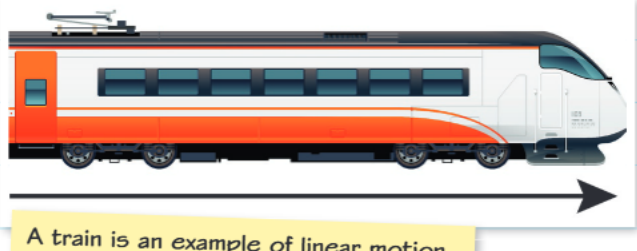 Common examples of linear motion include:
- Trains travelling along railway tracks
- Lifts moving up and down in buildings
- Sliding doors opening and closing
- Conveyor belts carrying products
Linear motion is often used in manufacturing processes where products need to be moved from one workstation to another in a straight line.
Note
Linear motion is the most efficient way to transport objects when you need them to travel directly from point A to point B without changing direction.
Reciprocating motion
Reciprocating motion involves movement that goes backwards and forwards along the same straight path. This type of motion repeats the same pattern continuously.
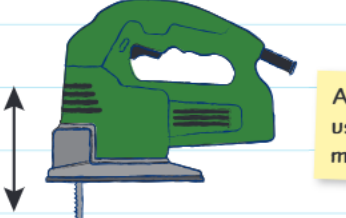 You can observe reciprocating motion in:
- Jigsaw blades cutting through materials
- Car engine pistons moving up and down
- Sewing machine needles piercing fabric
- Hand saws cutting wood
This motion is particularly useful in tools and machines that need to perform repetitive cutting or drilling actions.
Important
Don't confuse reciprocating motion with oscillating motion. Reciprocating motion moves back and forth in a straight line, while oscillating motion follows a curved arc.
Rotary motion
Rotary motion occurs when an object spins or turns around a central point or axis. This circular movement is one of the most common types found in mechanical devices.
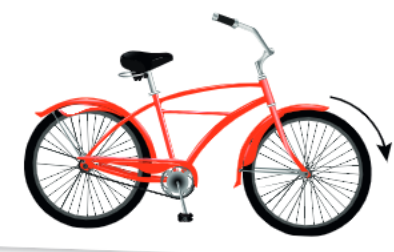 Examples of rotary motion include:
- Bicycle wheels turning as you pedal
- Electric fan blades spinning to create airflow
- Car wheels rotating to move the vehicle
- Drill bits spinning to create holes
Rotary motion is essential for converting energy into useful work, such as in motors and engines.
Note
Rotary motion is highly efficient because it can provide continuous movement without the need to change direction, making it ideal for motors and wheels.
Oscillating motion
Oscillating motion describes a swinging movement that travels back and forth in an arc from a central point. Unlike reciprocating motion, oscillating motion follows a curved path.
 Common examples of oscillating motion are:
- Clock pendulums swinging to keep time
- Children playing on swings
- Windscreen wipers cleaning car windows
- Metronomes helping musicians keep rhythm
This type of motion is often controlled and rhythmic, making it useful for timing mechanisms and repetitive tasks.
Human movement examples
Humans naturally demonstrate all four types of movement in everyday activities:
- Linear motion: Walking in a straight line down a corridor
- Reciprocating motion: Using a hand saw to cut wood
- Rotary motion: Performing a cartwheel or spinning around
- Oscillating motion: Waving your hand goodbye
Understanding these natural movements helps engineers design products that work well with human actions and feel comfortable to use.
Example
Worked Example: Analysing a Sewing Machine
Let's identify the different types of movement in a sewing machine:
Step 1: Identify the needle movement The needle moves up and down in a straight line repeatedly = Reciprocating motion
Step 2: Identify the wheel movement
The hand wheel or motor spins around its centre = Rotary motion
Step 3: Identify the fabric movement The fabric moves in a straight line under the needle = Linear motion
This shows how one machine can combine multiple movement types!
Identifying movement types
When analysing any mechanism or machine, ask yourself these questions:
Important
Key Questions for Movement Analysis:
- Does it move in a straight line? (Linear)
- Does it move back and forth along the same path? (Reciprocating)
- Does it spin around a central point? (Rotary)
- Does it swing in an arc from a fixed point? (Oscillating)
Many complex machines combine multiple types of movement. For example, a bicycle uses rotary motion for the wheels and pedals, but the rider's legs create reciprocating motion when pedalling.
Note
When examining complex machinery, look for each type of movement separately. Most machines will use a combination of movement types to achieve their function effectively.
Summary
Key Points to Remember:
- Linear motion travels in straight lines, like trains on tracks
- Reciprocating motion moves backwards and forwards repeatedly, like saw blades
- Rotary motion spins around a central point, like bicycle wheels
- Oscillating motion swings in arcs, like clock pendulums
- Most machines combine different types of movement to work effectively