8a, 8b & 8c – To Investigate Factors Affecting Rates of Osmosis Across Semi-Permeable Membranes (LC 2027) (Leaving Cert Biology): Revision Notes
📚Revision Notes
8a, 8b & 8c – To Investigate Factors Affecting Rates of Osmosis Across Semi-Permeable Membranes
Introduction to osmosis investigations
Osmosis is the movement of water molecules across a semi-permeable membrane from an area of high water concentration to an area of low water concentration. These investigations help us understand how different factors affect the rate at which osmosis occurs.
Visking tubing is a special type of semi-permeable membrane that allows water molecules to pass through freely but prevents larger molecules like sucrose from crossing. This makes it perfect for studying osmosis in the laboratory.
Note
Understanding osmosis is crucial for many biological processes, including how plant cells maintain their structure and how kidneys philtre blood. These controlled investigations allow us to isolate and study individual factors that would be difficult to observe in living systems.
Investigation 8a: Effect of temperature on osmosis rate
Aim
To investigate how temperature affects the rate of osmosis across semi-permeable membranes.
Materials needed
- Visking tubing (40 cm strips)
- Sucrose solution
- Distilled water
- Beakers
- Water baths at different temperatures (0°C, 20°C, 40°C)
- Ice cubes
- Tissue paper
- Balance
- Thread for tying
Method
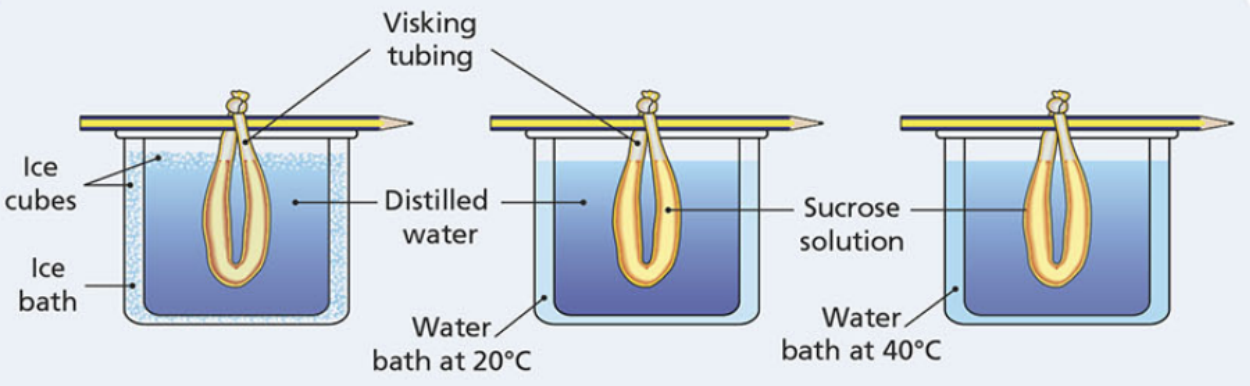
- Prepare the Visking tubing: Soak three 40 cm strips of Visking tubing in water to soften them. This makes them easier to work with and ensures they're fully hydrated.
- Create sucrose solution: Dissolve sucrose in warm water in a beaker to form a sucrose solution. Warm water helps the sucrose dissolve more easily than cold water.
- Fill the tubing: Using a syringe, add the same volume of sucrose solution to each of the three pieces of Visking tubing. Tie the ends securely with thread to seal the contents inside.
- Prepare for measurement: Gently pat each tube dry using tissue paper and record the initial mass. Note how firm or turgid each tube feels at the start.
- Set up temperature conditions: Place each tube in a beaker of distilled water at different temperatures:
- 0°C (ice bath with ice cubes)
- 20°C (room temperature)
- 40°C (heated water bath)
- Monitor the experiment: Leave the apparatus for 20 minutes to allow sufficient time for osmosis to occur.
- Record results: Remove each bag, dry them gently, and record their final mass and turgidity.
Important
Expected Results - Temperature Investigation
- Higher temperatures lead to faster rates of osmosis because molecules move more quickly when heated
- The bags at 40°C should show the greatest mass increase
- The bags at 0°C should show the smallest mass increase
- All bags should become more turgid as water enters by osmosis
Investigation 8b: Effect of concentration gradient on osmosis rate
Aim
To investigate how different concentration gradients affect the rate of osmosis.
Key concept
The concentration gradient is the difference in concentration between the sucrose solution inside the tubing and the distilled water outside. A steeper gradient creates a stronger driving force for osmosis.
Note
Think of concentration gradient like a slope - the steeper the slope, the faster water will "flow" down it. In osmosis, this "slope" is created by the difference in solute concentrations on either side of the membrane.
Method variation
- Use different concentrations of sucrose solution: 80%, 40%, and 20%
- Keep tube length and temperature constant
- Use the same basic procedure as Investigation 8a
Important
Expected Results - Concentration Investigation
- Higher concentrations (80% sucrose) create steeper gradients and faster osmosis rates
- The 80% sucrose solution should show the greatest mass increase
- The 20% sucrose solution should show the smallest mass increase
Investigation 8c: Effect of surface area on osmosis rate
Aim
To investigate how the surface area of the membrane affects the rate of osmosis.
Method variation
- Use different lengths of Visking tubing: 40 cm, 50 cm, and 60 cm
- Keep concentration and temperature constant
- Longer tubes provide greater surface area for osmosis
Important
Expected Results - Surface Area Investigation
- Larger surface areas allow more water molecules to cross the membrane simultaneously
- The 60 cm tube should show the greatest mass increase
- The 40 cm tube should show the smallest mass increase
Key factors affecting osmosis rate
The three main factors that influence how fast osmosis occurs are:
Temperature
Higher temperature increases molecular kinetic energy, causing molecules to move faster and collide more frequently with the membrane. This results in a faster rate of osmosis.
Note
However, very high temperatures can damage the membrane structure, potentially affecting results. This is why we use controlled temperatures like 40°C rather than boiling water.
Concentration gradient
Steeper gradients provide greater driving force for water movement. More concentrated solutions create larger differences in water potential, resulting in faster initial rates of osmosis.
Note
The gradient decreases over time as equilibrium approaches, which is why osmosis rates typically slow down during longer experiments.
Surface area
Larger surface areas provide more space for molecular movement, with more membrane pores available for water transport. This results in a faster overall rate of osmosis.
Controlling variables
To ensure fair testing, it's essential to keep certain variables constant:
Important
Variables That Must Be Controlled:
- Volume of sucrose solution in each tube
- Type and thickness of membrane used
- Time allowed for osmosis (usually 20 minutes)
- External water volume in beakers
- Handling procedures for measuring mass
Failing to control these variables will make it impossible to determine which factor is actually causing any observed differences in results.
Data collection and analysis
When recording results, measure:
- Initial mass of each tube
- Final mass after the time period
- Change in mass (final - initial)
- Turgidity or firmness of tubes
Example
Worked Example: Calculating Percentage Change in Mass
For easier comparison between different investigations, calculate percentage change in mass:
Formula: Percentage change = (change in mass ÷ initial mass) × 100
Step 1: Measure masses
- Initial mass = 15.2 g
- Final mass = 18.7 g
Step 2: Calculate change in mass
- Change in mass = 18.7 - 15.2 = 3.5 g
Step 3: Apply formula
- Percentage change = (3.5 ÷ 15.2) × 100 = 23.0%
Exam tips
Summary
Key Points for Exam Success:
- Always explain results in terms of water potential gradients
- Remember that water moves from high to low water potential
- Use scientific terminology correctly: semi-permeable, not selectively permeable
- Draw clear, labelled diagrams showing the experimental setup
- Explain why controls are necessary in biological investigations
- Show your working for any calculations involving percentage changes
Summary
Remember - The Three Key Factors:
- Temperature, concentration gradient, and surface area are the three main factors affecting osmosis rate
- Higher values of each factor generally lead to faster osmosis rates
- Visking tubing allows water through but blocks sucrose molecules
- Fair testing requires keeping other variables constant
- Molecular movement increases with temperature, explaining faster rates at higher temperatures