Effect of exercise on heart rate (LC 2026) (Leaving Cert Biology): Revision Notes
📚Revision Notes
Effect of exercise on heart rate
Background:
During exercise, carbon dioxide (CO₂) levels in the blood increase. High CO₂ levels signal the brain's medulla oblongata to make you breathe faster and deeper. The heart beats faster to bring more oxygen to the body and remove CO₂. Heart rate is measured by counting the pulse.
Note
Pulse is the alternate expansion and contraction of arteries.
Materials needed:
- Stopwatch
Method:
- Locate your pulse by placing two fingers on the inside of your wrist.
- Count the number of heartbeats for one minute while at rest.
- Perform intense exercise, such as running, for 5 minutes.
- After exercising, count and record the number of heartbeats for one minute.
- Rest for 5 minutes, then count the number of breaths for one minute.
- Record all results.
Results:
| Before exercise | Immediately after exercise | Period of rest after exercise | |
|---|---|---|---|
| Beats per minute (bpm) | 72 | 120 | 75 |
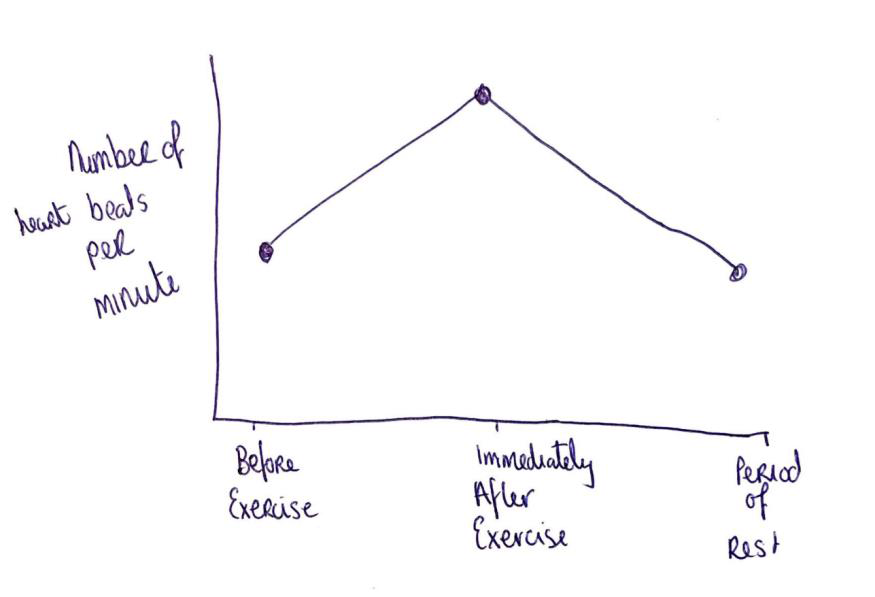
Recovery Rate:
The recovery rate after exercise refers to how quickly the body returns to its resting state, especially how fast the heart rate, breathing rate, and lactic acid levels return to normal.
- A fast recovery rate shows that the heart, lungs, and muscles are working efficiently. This is a sign of good fitness, as the body can deliver oxygen and remove waste products quickly.
- A slow recovery rate means the body takes longer to return to normal. This can indicate lower fitness levels or fatigue, and it may increase the risk of overtraining or injury.
- Measuring recovery rate is important in sports and fitness training, as it helps track improvements in cardiovascular fitness and endurance.