Investigate the effect of heat denaturation on the rate of enzyme activity (LC 2026) (Leaving Cert Biology): Revision Notes
📚Revision Notes
Investigate the effect of heat denaturation on the rate of enzyme activity
Materials needed:
- Hydrogen Peroxide (substrate)
- Celery (contains enzyme catalase)
- pH buffer 9/10 (keeps pH constant)
- Thermostatically controlled water bath (varying temperatures: 30°C, 100°C)
- Washing up liquid (measure the rate of activity by volume of foam produced and breaks down the cell wall)
- Graduated cylinders
- Plastic droppers
Method:
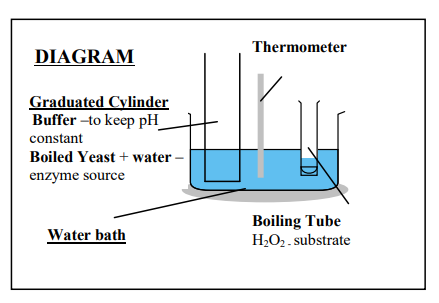
- Place 10 cm³ of celery, 1 drop of washing-up liquid, and 10 cm³ of pH buffer together in a graduated cylinder.
- In another graduated cylinder, add 5 cm³ of hydrogen peroxide.
- Place both graduated cylinders in a thermostatically controlled water bath set at 30°C for 2 minutes to allow all reagents to reach the exact temperature.
- After 2 minutes, add the hydrogen peroxide to the graduated cylinder containing the other reagents.
- Record the volume of foam produced after 1 to 2 minutes (the foam volume measures enzyme activity by indicating the amount of oxygen produced).
- Repeat the experiment at 100°C.
- Compare and comment on the volume of foam produced at each temperature.
Results:
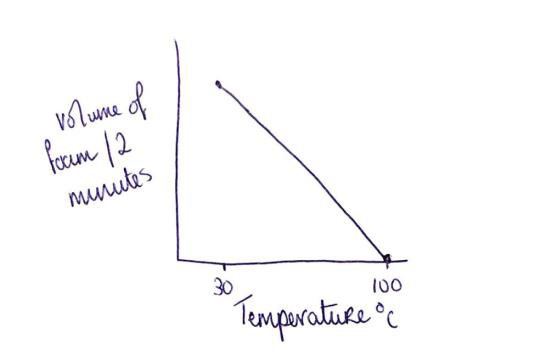
| Temperature | 30°C | 100°C |
|---|---|---|
| Volume of foam cm³ / 2 minutes | 40 cm³ | 0 cm³ |
A large volume of foam was produced at 30°C, as this is the optimum temperature for the enzyme catalase, resulting in the greatest enzyme activity. At 100°C, no foam was produced because the heat caused the enzyme to become denatured, meaning it lost its 3D, folded, globular shape and no longer functions.