Production of ethanol by fermentation (anaerobic respiration) (LC 2026) (Leaving Cert Biology): Revision Notes
📚Revision Notes
Production of ethanol by fermentation (anaerobic respiration)
Background:
- There are two types of respiration: aerobic and anaerobic.
- In the presence of yeast, anaerobic respiration produces ethanol (alcohol) and carbon dioxide.
- Animals produce lactic acid under anaerobic conditions.
- The production of ethanol through anaerobic respiration is known as fermentation.
- The following equation represents the production of alcohol:
Note
The following equation represents the production of alcohol: C₆H₁₂O₆ + Yeast → C₂H₅OH + CO₂
Glucose + Yeast → Ethanol (Alcohol) + Carbon Dioxide
Note
Aerobic respiration is the enzyme controlled release of energy from food using oxygen.
Note
Anaerobic respiration is the controlled release of energy from food without the use of oxygen. It is also called fermentation.
Materials needed:
- Glucose (7g)
- Cooled, boiled water
- Yeast
- Conical flask
- Oil
- Water bath (set at 30°C)
- Tube
- Beaker of limewater
- Potassium iodide
- Sodium hypochlorite
- Water bath (set at 35°C)
Method:
- Sterilise all apparatus to ensure no micro-organisms contaminate the experiment.
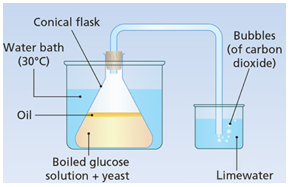
- Prepare the glucose solution by adding 7g of glucose to cooled, boiled water. The water is boiled to remove oxygen and ensure anaerobic conditions. Glucose is the substrate for this experiment.
- Add the glucose solution to a conical flask and then add yeast, which contains the enzyme for this experiment.
- Place a layer of oil on top of the solution to keep oxygen out.
- Place the experiment in a water bath at 30°C, the optimal temperature for yeast enzymes.
- Connect a tube to the conical flask to allow CO₂ to pass out and be collected in a beaker of limewater.
- Observe the limewater turning milky, confirming CO₂ production during the experiment.
- CO₂ is produced as bubbles, which will stop when the glucose or yeast is used up.
- Ethanol, also produced, remains in the conical flask.
- Confirm the presence of ethanol using the iodoform test with potassium iodide and sodium hypochlorite.
- Add these reagents to the ethanol and place in a water bath at 35°C for 15 minutes.
- A positive test will result in a colour change from colourless to yellow.
- Use a control setup without yeast to validate the experiment
Results:
| Test for ethanol | Colourless to yellow (crystals if heated) |
|---|---|
| Test for carbon dioxide | Colourless to milky |