12.2 – Verifying Hooke’s Law (Leaving Cert Physics): Revision Notes
📚Revision Notes
12.2 – Verifying Hooke's Law
What is this experiment about?
This experiment demonstrates one of the most important principles in physics - Hooke's Law. You'll be testing whether the restoring force in a spring is directly proportional to its extension. This relationship is fundamental to understanding how springs work in everything from car suspension systems to weighing scales.
Important
Understanding Hooke's Law is essential for comprehending elastic behaviour in materials and forms the foundation for many engineering applications involving springs and elastic materials.
Aim of the experiment
Important
Experimental Aim: To verify Hooke's law by showing that the restoring force is directly proportional to the extension for a helical spring. In other words, you want to prove that when you double the force, you double the extension.
Equipment you'll need
- Helical spring
- Metre stick
- Retort stand and two clamps
- Set of slotted weights with a holder
- Pointer
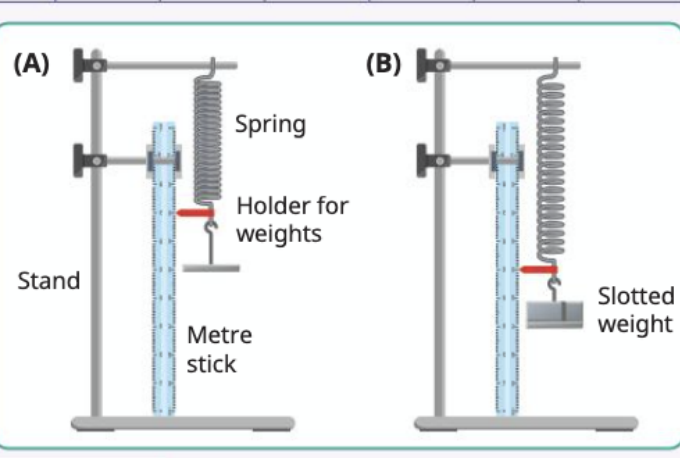
Method and procedure
Example
Worked Procedure: Setting up and conducting the Hooke's Law experiment
Step 1: Set up the equipment Mount your apparatus as shown in the diagram above. Make sure both clamps are tightened securely and allow the system to settle before taking any measurements.
Step 2: Record the natural length Take and record the reading of the pointer on the metre stick with no weights on the holder. This measurement () represents the natural length of the spring - its length when no external force is applied.
Step 3: Add the first weight Add a weight to the holder and allow the system to settle. Record the total weight on the holder and the new reading on the metre stick. The difference between this reading and the natural length gives you the extension.
Step 4: Continue adding weights Repeat this process several times, each time adding an extra weight to the holder. You should aim for at least 5-6 different measurements to get a good range of data.
Step 5: Calculate extensions For each measurement, calculate the extension using the formula:
Extension:
Where = extension, = current length, = natural length
Data collection and handling
Note
Data Organisation Tips Copy and complete a data table to organise your measurements systematically. This helps ensure accuracy and makes it easier to spot any unusual readings that might indicate experimental errors.
| Restoring force, F (N) | Length of spring, l (cm) | Extension of spring, s (cm) |
|---|---|---|
| 0 | = | 0 |
The restoring force equals the weight of the masses (remember to convert to Newtons if needed).
Graph analysis
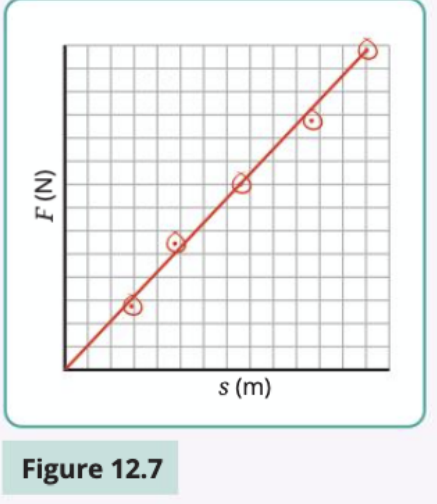
Once you've collected your data, plot a graph with:
- X-axis: Extension (s) in metres or centimetres
- Y-axis: Restoring force (F) in Newtons
Important
Key Graph Analysis Points:
If Hooke's Law is valid, your points should lie very close to a straight line that passes through the origin. This straight line demonstrates that force is directly proportional to extension ().
The slope of your graph represents the spring constant (), which tells you how stiff your spring is. A steeper slope means a stiffer spring.
Sources of error
Be aware of these potential sources of error that could affect your results:
Note
1. Pointer positioning Make sure the pointer remains horizontal and doesn't start pointing upwards or downwards as the spring stretches. Any change in angle will affect your readings.
Note
2. Parallax error
Always read the metre stick at eye level to avoid parallax error. Looking from above or below the pointer will give you incorrect measurements.
Note
3. Mass discrepancies The slotted weights may not actually have the exact weight written on them. Check with a weighing scale if high accuracy is needed for your analysis.
Key physics concepts
Important
Hooke's Law states that the extension of a spring is directly proportional to the applied force, provided the elastic limit is not exceeded.
Mathematical expression:
Where:
- = restoring force (N)
- = spring constant (N/m)
- = extension (m)
The experiment verifies this relationship by showing that doubling the force doubles the extension, tripling the force triples the extension, and so on.
Exam tips
- Always state that Hooke's Law only applies within the elastic limit of the spring
- Remember that the graph should pass through the origin - if it doesn't, check your natural length measurement
- Be able to calculate the spring constant from the gradient of your vs graph
- Understand that this relationship breaks down if you stretch the spring too far
Summary
Key Points to Remember:
- Hooke's Law: Extension is directly proportional to applied force ()
- Key formula: (extension equals current length minus natural length)
- Graph: Should show a straight line through the origin when plotting against
- Spring constant: Found from the gradient of the vs graph
- Elastic limit: Hooke's Law only applies when the spring returns to its original length after the force is removed