22.2 – Investigating Resistance in Series and Parallel (Leaving Cert Physics): Revision Notes
📚Revision Notes
22.2 – Investigating Resistance in Series and Parallel
Experiment overview
This practical investigation allows you to explore how resistors behave when connected in different configurations. You'll discover the fundamental principles that govern resistance in series and parallel circuits through hands-on experimentation and measurement.
The main goal is to understand how combining resistors affects the total resistance of a circuit. This knowledge is essential for analysing more complex electrical circuits and forms the foundation for circuit design and analysis.
Note
This experiment builds the foundation for understanding more complex electrical circuits. Take time to make accurate measurements and compare them with your predictions - this comparison is key to developing your understanding of electrical principles.
Equipment needed
Note
Required Equipment:
- Several individual resistors of different values
- An ohmmeter (for measuring resistance)
- Connecting leads or wires
- A breadboard or similar setup for making connections
Method
Part A: Investigating resistors in series
Example
Investigation Steps: Series Resistance
Step 1: Baseline measurements Begin by examining how resistors behave when connected one after another in a single path. Start by measuring the individual resistance values of two or three separate resistors using your ohmmeter. Record these baseline measurements carefully, as you'll use them for comparison later.
Step 2: Series connection and prediction Next, connect your resistors in series by linking them end-to-end so that current must flow through each resistor in turn. Before measuring the total resistance, make a prediction: will the combined resistance be less than, equal to, or greater than any individual resistor? Also consider whether it will be less than, equal to, or greater than the sum of all individual resistances.
Step 3: Measurement and verification Measure the actual resistance of your series combination using the ohmmeter. Then calculate what you would expect the total resistance to be using the relevant formula for series circuits. Compare your measured result with both your prediction and your calculated expectation.
Step 4: Repeat for verification Repeat this process using different combinations of resistors to verify your findings and build confidence in the pattern you observe.
Part B: Investigating resistors in parallel
Example
Investigation Steps: Parallel Resistance
Step 1: Identical resistors Now explore what happens when resistors are connected side-by-side, creating multiple paths for current flow. Begin with two identical resistors. Measure their individual resistances, then connect them in parallel so current can flow through both simultaneously. Before taking measurements, predict whether the combined resistance will be less than, equal to, or greater than the resistance of either individual resistor.
Step 2: Measurement and calculation Use your ohmmeter to measure the actual resistance of the parallel combination. Calculate the expected value using the appropriate parallel resistance formula, then compare all your results - prediction, measurement, and calculation.
Step 3: Different resistor values Extend your investigation by repeating these steps with two or three resistors of different values. This will help you understand how parallel resistance behaves regardless of whether the individual resistors are identical or different.
Important
Critical Observation Point: Pay special attention to how the total resistance in parallel circuits compares to individual resistor values. This relationship is often counterintuitive at first but is fundamental to understanding electrical circuits.
Part C: Combined series-parallel circuits
Example
Investigation Steps: Combined Circuits
Step 1: Individual measurements The final part investigates more complex circuits that combine both series and parallel elements. Take three individual resistors and measure their separate resistance values.
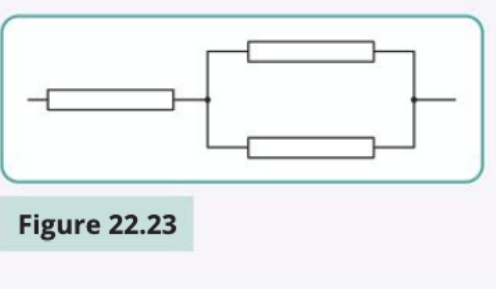
Step 2: Circuit configuration Connect them according to the configuration shown in Figure 22.23, which demonstrates a practical combination of series and parallel connections.
Step 3: Prediction and analysis Before measuring, consider which individual resistor value the total combination resistance will always be greater than. This thinking helps develop your understanding of how series and parallel sections interact within the same circuit.
Step 4: Final verification Measure the combined resistance using your ohmmeter, then calculate the expected result using the relevant formulas applied step-by-step to the series and parallel sections. Compare your experimental results with your calculations to verify your understanding.
Key concepts to understand
When resistors are connected in series, the total resistance equals the sum of individual resistances. This means the combined resistance is always greater than any single resistor in the chain. Current must flow through each resistor in turn, so each one adds its resistance to the total.
Important
Series Resistance Formula:
The total resistance in series is simply the sum of all individual resistances.
In parallel connections, resistors provide alternative paths for current flow. The total resistance is always less than the smallest individual resistor. This happens because multiple paths reduce the overall opposition to current flow.
Important
Parallel Resistance Formula:
Notice how this reciprocal relationship results in a total resistance that's smaller than any individual resistor.
For combined circuits, you must analyse the parallel sections first to find their equivalent resistance, then treat this equivalent resistance as a single resistor in series with other components.
Understanding these principles allows you to predict circuit behaviour before making measurements, which is a crucial skill in electrical analysis and troubleshooting.
Summary
Key Points to Remember:
- Series circuits: Total resistance = sum of individual resistances (always greater than any single resistor)
- Parallel circuits: Total resistance is always less than the smallest individual resistor value
- Combined circuits: Calculate parallel sections first, then treat as series components
- Practical tip: Always measure individual resistor values before connecting them, as actual values may differ from stated ratings
- Verification: Compare experimental measurements with calculated predictions to confirm your understanding of resistance laws