Identifying Chiral Centres (AQA A-Level Chemistry): Revision Notes
📚Revision Notes
7.1.2 Identifying Chiral Centres
Note
A chiral centre (sometimes known as an asymmetric carbon) is a carbon atom with 4 different groups attached to it.
Note
Example:
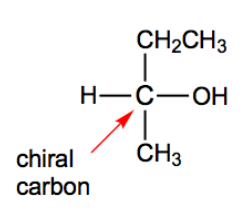
The carbon in the middle is the chiral centre as it has 4 different groups attached to it: a hydrogen, a , an and a group.
Identifying Chiral Centres
To identify a chiral centre in a molecule, one effective strategy is to focus on carbon atoms bonded to four distinct groups.
Note
A useful tip is to check for carbon atoms that have a hydrogen attached, as in most cases, chiral centres will have a hydrogen as one of their four groups. While this is not universally true for every molecule, it is a reliable guideline in many examples.
When working with skeletal formulas, look for carbon atoms that form a "Y" shape or an upside-down "Y" shape as an indicator of a potential chiral centre. It is also important to ignore double bonds, benzene rings, and symmetrical cyclic molecules, as these structures typically do not exhibit chirality due to their symmetry or lack of four distinct groups attached to the carbon.
Note
If a molecule is cyclic and not symmetrical, it will contain a chiral centre. This is because the lack of symmetry in a cyclic structure allows for four distinct groups to be attached to the carbon atom, fulfilling the requirement for chirality.
Simple chiral centre identification:
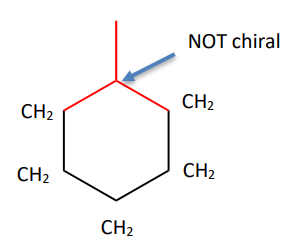
In the first example, the carbon atom indicated forms an "upside-down Y" shape, highlighted in red. This shape is a reliable indicator of a chiral centre, especially since one of the attached groups is a hydrogen, which is common in many chiral molecules. The presence of four distinct groups, including the hydrogen, confirms that this carbon is chiral.
Chiral centre in more complex molecules:
For more complicated molecules, such as the second example, the same principle applies. Here, the benzene ring can be ignored as it does not contribute to the chirality of the specific carbon we are examining. Additionally, the nitrogen atom can be disregarded because we are focusing solely on carbon atoms. The carbon atom attached to the group forms a chiral centre since it is connected to four different groups. However, the group on the right-hand side () is composed of three identical methyl groups, making it non-chiral.
Cyclic molecules and chiral centres:
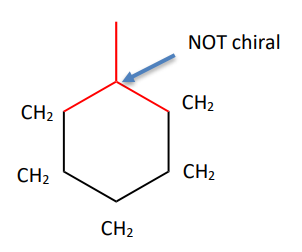
Cyclic molecules can be tricky because the ends are "joined up," giving the appearance of fewer than four distinct groups. However, the carbon at the indicated chiral centre is still bonded to four different groups. Here, Group 1 is the , and Group 2 is the hydrogen. To identify the other two groups, it is important to observe the rest of the molecule. Moving to the right from the , you find a group, and moving left, you find a group. These differences confirm that the groups attached to the chiral carbon are distinct, thus making the carbon atom chiral.
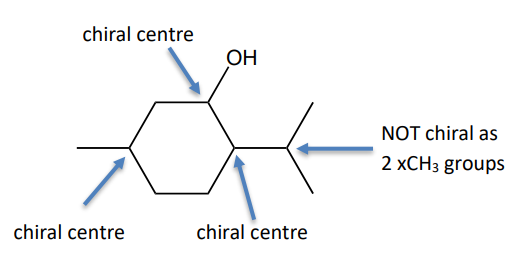
Identifying Chiral Centres in Complex Molecules
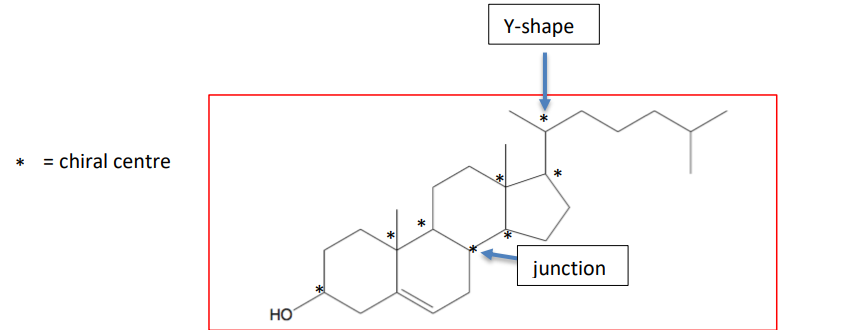
In the example shown, there are 8 chiral centres. This molecule is more challenging to analyse because it contains multiple rings.
To identify chiral centres in such molecules:
- Focus on the junctions, which are the points where two rings meet. These are likely chiral centres, especially when the molecule is asymmetrical.
- Use the same technique of looking for Y-shaped structures, as mentioned in simpler cases. In this specific molecule, all the junctions are chiral centres, except for those associated with double bonds. Double bonds prevent the carbon from being attached to four distinct groups, and thus, such carbons are not chiral.