Structure of Benzene (AQA A-Level Chemistry): Revision Notes
📚Revision Notes
7.4.1 Structure of Benzene
The Kekulé Structure of Benzene
- In 1865, Friedrich August Kekulé proposed a structure for benzene
- He knew ONLY it's MR and that it was a hydrocarbon
- So he said that the structure of benzene (C6H6) was a hexagonal ring structure of 6 C atoms. (right)
- He said each C was bonded to a single H atom and there was alternating double / single bonds.
- This theoretical model of benzene was, understandably, called cyclohexa-1,3,5-triene.
- However, there are problems with the theoretical 'Kekulé' structure of benzene (cyclohexa-1,3,5-triene) that show it to be inaccurate...
Benzene is a cyclic hydrocarbon composed of six carbon atoms and six hydrogen atoms. Initially, it was believed to consist of a ring structure with six carbon atoms arranged in alternating single and double bonds, as shown below:
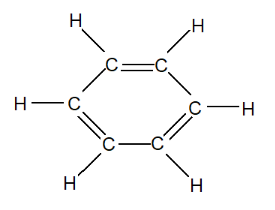
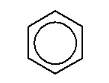
The IUPAC name for this molecule is cyclohexa-1,3,5-triene. Its molecular formula is , but it is typically shown in its skeletal formula form.
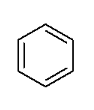
This arrangement is commonly referred to as the Kekulé structure.
Single and double bonds differ in length; in double bonds, the additional overlap of π-orbitals pulls the atoms closer together, resulting in a shorter bond.
| Bond | Length (nm) |
|---|---|
| 0.154 | |
| 0.134 |
This table shows the bond lengths for single () and double () carbon bonds.
In cyclohexa-1,3,5-triene, the double bonds would typically be shorter than the single bonds.
However, analysis of the molecule reveals that all bonds are actually 0.142 nm in length, an intermediate distance between single and double bonds. This led to the proposal that the structure does not contain alternating single and double bonds but instead has delocalized electrons spread across six overlapping orbitals:
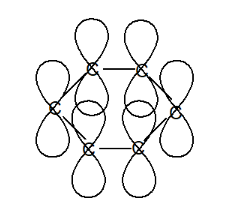
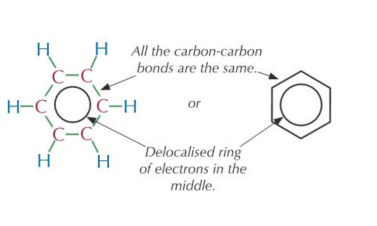
The delocalized electrons can be represented as a circle within the hexagonal ring:
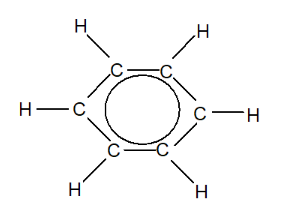
This molecule is known as benzene. It is usually represented by its skeletal formula:
Structure and Stability of Benzene
Benzene () is a cyclic, planar molecule with unique properties due to its delocalized electrons.
1. Key Structural Features of Benzene
- Delocalized Electrons: In benzene, all six π-electrons are completely delocalized over the six carbon atoms, creating a ring of electron density above and below the plane of the molecule. This delocalization is a defining feature of benzene.
- Equal Bond Lengths: All bonds in benzene have the same length, approximately 0.142 nm, which is intermediate between typical single (0.154 nm) and double (0.134 nm) carbon-carbon bond lengths. This uniform bond length is due to the delocalized nature of the electrons.
- Bond Angles and Planarity: Each carbon atom in benzene forms three covalent bonds (two bonds and one bond), creating bond angles of 120°. This arrangement makes benzene a planar (flat) molecule.
- Aromaticity: Molecules containing a benzene ring, or similar electron delocalization, are described as aromatic. Aromatic compounds share the stability that comes from electron delocalization.
2. Stability of Benzene
The delocalized electron cloud in benzene contributes significantly to its stability, making it more stable than expected for a molecule with alternating single and double bonds. This stability can be observed in benzene's reluctance to undergo typical addition reactions seen in alkenes.
- Resonance Energy: The stability of benzene is due to resonance energy, which is the energy difference between benzene's actual structure and a theoretical structure with alternating double bonds. This resonance energy stabilises benzene and makes it less reactive in addition reactions.
- Reactivity Comparison with Alkenes: Although benzene contains π-electrons like alkenes, it does not readily react with bromine or hydrogen in addition reactions, as alkenes do. Instead, benzene tends to undergo substitution reactions, which preserve the delocalized electron structure.
3. Illustrating Benzene's Stability through Hydrogenation
The stability of benzene can be quantitatively illustrated by comparing its hydrogenation energy to that of other similar compounds.
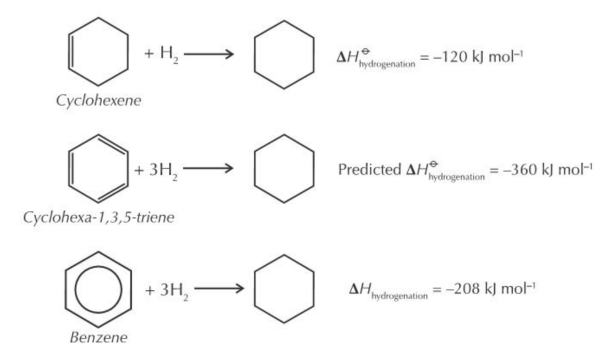
- Cyclohexene Hydrogenation: When cyclohexene () undergoes hydrogenation (addition of hydrogen), one double bond is broken, one H-H bond is broken, and a single bond and two C-H bonds are formed.
- The energy released in this reaction is approximately 120 kJ/mol.
- Expected vs. Actual Hydrogenation of Benzene:
- If benzene were to have three isolated double bonds, it would be expected to release 360 kJ/mol (3 × -120 kJ/mol) when hydrogenated.
- However, the actual hydrogenation of benzene releases only 208 kJ/mol, significantly less than expected. This difference (152 kJ/mol) is known as the resonance energy and represents the additional stability benzene gains from its delocalized electrons.
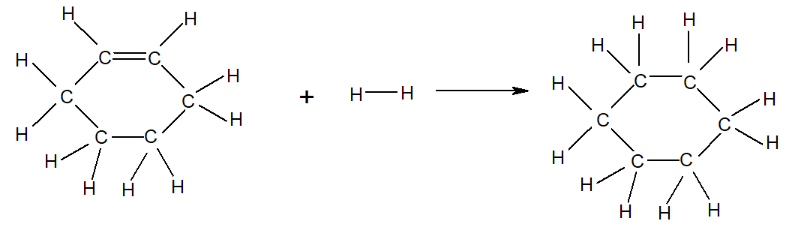
The enthalpy change for this reaction is -120 kJmol-1.
Hydrogenating benzene requires breaking three double bonds and three bonds, followed by the formation of three single bonds and six bonds:
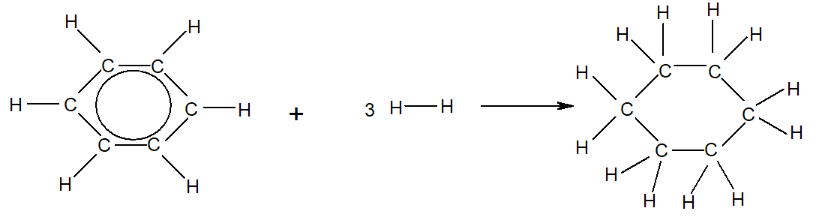
The enthalpy change of this reaction should therefore be exactly three times the hydrogenation of cyclohexene, i.e. 3 x -120 kJmol-1 = -360 kJmol-1.
However, the enthalpy change for this reaction is only -209 kJ mol⁻¹, which is less exothermic than expected. This indicates that the benzene molecule has significantly lower energy than it would if the electrons were not delocalized:
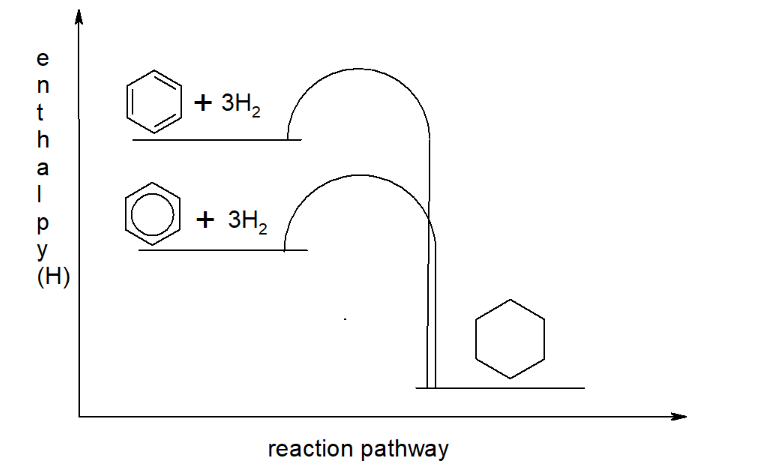
- The enthalpy of hydrogenation of benzene is considerably lower than three times the enthalpy of hydrogenation of a typical alkene. This strongly supports the idea that delocalization provides additional stability to the molecule.
The Delocalised Structure of Benzene
Today's accepted structure for benzene is a delocalised model which has the following features:
- It is a planar hexagonal molecule of 6 C atoms.
- All bond lengths are intermediate in length between that of a single + double .
- Each C uses 3 of its outer electrons to form 3 σ bonds to 2 other C atoms, and 1 H atom. This leaves each C atom with one electron in a p orbital.
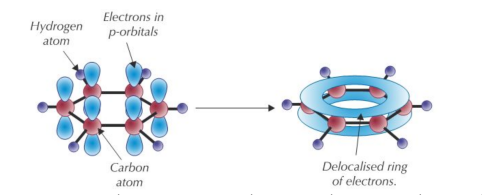
- The lobes of the p orbitals overlap sideways with the neighbouring p orbitals to form a π bond.
- The overall result is a ring of -ve charge ("electron cloud") above and below the plane of the molecule. (see that diagram on the right).
- The 6 p electrons in the π system are delocalised (i.e. they are free to move throughout the π system).
- This delocalised cloud of π electrons is present in substances called aromatic compounds; as such, benzene and its derivatives (the arenas, are aromatic.)
- A circle is used to represent the ring of delocalised electrons.
Thermochemical Evidence for Stability - Enthalpies of Hydrogenation
- Benzene is more stable than the Kekulé compound cyclohexa-1,3,5-triene
- This is thanks to the delocalised electron ring.
- One piece of evidence for this is by comparing some enthalpies of hydrogenation:
-
The hydrogenation of cyclo-1,3,5-triene releases 360kJmol-1 (= 3 x 120), the hydrogenation of benzene releases 208kJmol-1. This is 152kJmol-1 less than expected!
-
Energy is taken in to break bonds and released making bonds.
-
So more energy must have been taken in to break the bonds in benzene than the bonds in Kekulé's made up cyclohexa-1,3,5-triene.
-
This means that the actual structure of benzene is more stable than the Kekulé structure.
-
In terms of energy, it is more stable by 152kJmol-1 (this is referred to as the delocalisation energy)
Benzene and Addition and Substitution Reactions
- Alkenes' double bond and benzenes' delocalised ring of electrons are areas of high electron density.
- As a result, they both reacts with electrophiles (things that like electrons)
- Alkenes undergo addition reactions but, thanks to its higher relative stability, benzene is fairly resistant to addition reactions instead substitution reactions tend to occur.
Nomenclature
Now, this is a bit of a headache: learn the rules but don't stress it; this has been worth less than 2 marks on every A-Level since 2017.
- Compounds which are derivatives of benzene
- If an alkyl branch or functional group is attached directly to the benzene ring, in place of a hydrogen atom, benzene forms the root of the name.
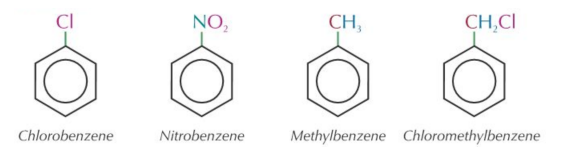
- Compounds where the benzene ring is a substituent on another molecule
- In some compounds the benzene ring forms a branch from another molecule and should be treated in a similar way to an alkyl group branching from a molecule.
- A benzene ring branch, , is called a phenyl group.
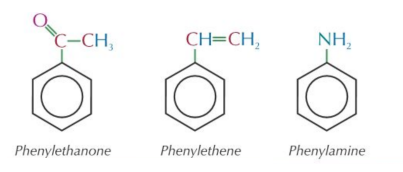
- Some other compounds • An - group attached directly to benzene forms the compound phenol.
Numbering the Benzene Ring
- If 2 or more alkyl branches or functional groups are attached to the benzene ring, indicate their position by the use of numbers, using the lowest possible numbers.
- If there are 2 or more different substituents, list them alphabetically.
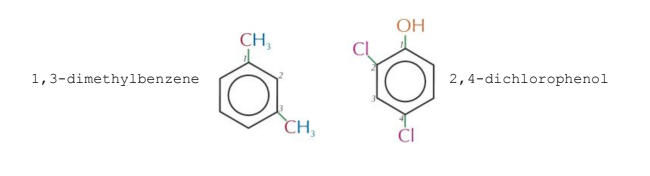
Electrophilic Substitution
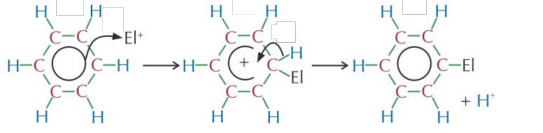
- The region of high electron density above and below the plane of the molecule results in benzene being attacked by electrophiles.
- Substitution reactions occur rather than addition reactions as this preserves the stability of the benzene ring. The mechanism is described as electrophilic substitution.
The mechanism for electrophilic substitution is shown below: