Preparation of Amines (AQA A-Level Chemistry): Revision Notes
📚Revision Notes
7.5.1 Preparation of Amines
Amines are organic compounds derived from ammonia () where one or more hydrogen atoms are replaced by alkyl or aryl groups. There is some H-bonding between molecules, but weaker than in alcohols.
- The presence of the lone pair of electrons on the N atom is the centre. of most amine chemistry
- This means they act as nucleophiles and bases to greater or less extents.They are classified based on the number of alkyl or aryl groups attached to the nitrogen: Primary Amines: One hydrogen replaced (e.g., methylamine, ).
Primary aliphatic amines function as Brønsted-Lowry bases because the lone pair of electrons on the nitrogen atom can readily form a dative covalent bond with an H⁺ ion, allowing the amine to accept a proton. They are considered weak bases since they produce only a low concentration of hydroxide ions in solution.
Secondary Amines: Two hydrogens replaced (e.g., dimethylamine, ()).
Tertiary Amines: Three hydrogens replaced (e.g., trimethylamine, ()).
Quaternary Ammonium Salts: All four hydrogen atoms are replaced by alkyl groups, resulting in a positively charged nitrogen (e.g., tetraethylammonium bromide, ()).
Ammonia can be regarded as the simplest amine. Quaternary ammonium ions are not amines and they do not possess alone pair of electrons on the N.
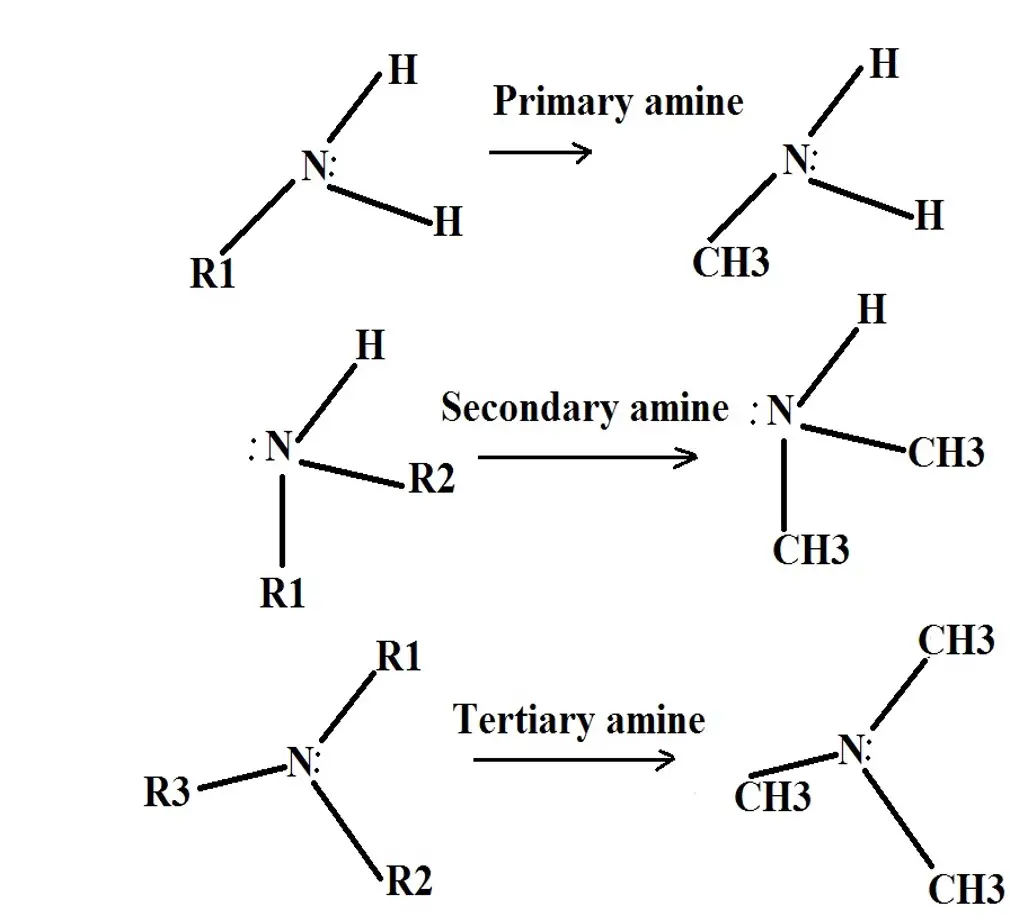
They are named after the alkyl group(s) attached to the N atom, with the ending -amine. For example:
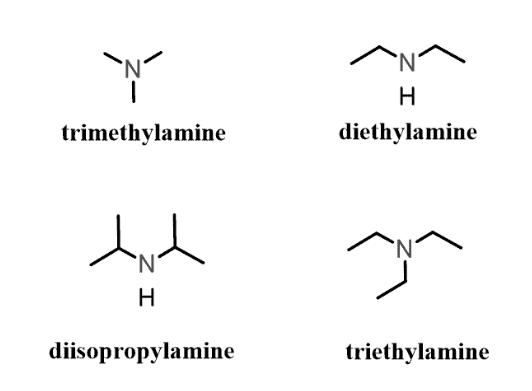
Preparation of Primary Aliphatic Amines
Primary aliphatic amines can be synthesised through:
- Nucleophilic substitution of halogenoalkanes with ammonia
- Reduction of nitriles
Reaction of Halogenoalkanes with Ammonia
This method involves a nucleophilic substitution reaction where ammonia () acts as a nucleophile. The lone pair of electrons on the nitrogen atom allows ammonia to attack the carbon attached to the halogen in the halogenoalkane, replacing the halogen atom and forming an amine.
Reaction Conditions:
- The halogenoalkane is heated with excess ammonia in ethanol under pressure.
- This reaction produces a primary amine along with ammonium halide.
Note
Example Reaction:
- When 1-bromoethane reacts with ammonia, it forms ethylamine:
Limitations:
- A mixture of products (primary, secondary, tertiary amines, and quaternary ammonium salts) is often formed because the primary amine produced can further react with the halogenoalkane.
- Using excess ammonia helps maximise the formation of the primary amine by minimising further substitutions.
Formation of a Primary Amine
The formation of a primary amine occurs in two steps.
- Step 1: A salt is produced—in this example, ethylammonium bromide. This compound is similar to ammonium bromide, but one hydrogen in the ammonium ion is replaced by an ethyl group.
- Step 2: The ethylammonium bromide can undergo a reversible reaction with excess ammonia present in the mixture.
Ammonia removes a hydrogen ion from the ethylammonium ion, resulting in the formation of a primary amine, ethylamine.
Increasing the concentration of ammonia in the mixture helps to drive the reaction forwards, favouring the production of the primary amine.
Reduction of Nitriles
Nitriles () can be reduced to primary amines by breaking the triple bond between carbon and nitrogen.
Methods for Reducing Nitriles:
- Using Lithium Aluminium Hydride ():
- LiAlH₄ is a strong reducing agent used in dry ether.
- After reduction, the intermediate is treated with dilute acid to produce the amine.
Note
Example:
- Ethanenitrile () reduced by forms ethylamine:
- Catalytic Hydrogenation:
- Nitriles can also be reduced by hydrogen gas (H₂) in the presence of a metal catalyst like palladium, platinum, or nickel.
- This reaction is carried out under elevated temperature and pressure.
Note
Example:
- Ethanenitrile can be reduced with and a nickel catalyst to produce ethylamine:
Formation of a Secondary Amine
The reaction sequence does not stop at the primary amine. Ethylamine can further react with bromoethane in the same two-step process:
Step 1: This forms a salt known as diethylammonium bromide. This salt is similar to ammonium bromide, but with two hydrogens replaced by ethyl groups.
Step 2: There is a reversible reaction between diethylammonium bromide and excess ammonia in the mixture.
The ammonia removes a hydrogen ion from the diethylammonium ion, yielding a secondary amine, diethylamine, which has two alkyl groups attached to the nitrogen.
Formation of a Tertiary Amine
The reaction can proceed further, as diethylamine can react with bromoethane in a similar manner:
Step 1: This produces triethylammonium bromide.
Step 2: In the presence of excess ammonia, a reversible reaction occurs in which ammonia removes a hydrogen ion from the triethylammonium ion, resulting in a tertiary amine, triethylamine, which has three alkyl groups attached to the nitrogen.
Formation of a Quaternary Ammonium Salt
In the final stage, triethylamine reacts with another molecule of bromoethane, producing tetraethylammonium bromide, a quaternary ammonium salt where all four hydrogens have been replaced by ethyl groups.
At this point, the reaction sequence stops, as the nitrogen has no hydrogen atoms left to be removed.
Note: This entire reaction sequence can be complex to memorise, but understanding the mechanisms behind each step can make it easier to follow the progression from primary amine to quaternary ammonium salt.
Preparation of Aromatic Amines
Aromatic amines, such as phenylamine (aniline), can be synthesised through the reduction of nitro compounds. This process is especially significant in the production of dyes and other aromatic compounds.
Process for Preparing Aromatic Amines:
- Nitration of Benzene:
- Benzene is nitrated by reacting it with concentrated nitric acid () and concentrated sulfuric acid () at temperatures between 50-55°C, forming nitrobenzene ().
- Reduction of Nitrobenzene:
- Nitrobenzene is then reduced using tin () and concentrated hydrochloric acid () under reflux conditions, resulting in the formation of phenylammonium ions ().
- Formation of Phenylamine:
- Finally, sodium hydroxide () is added to the reaction mixture, which removes a proton from the phenylammonium ion, producing phenylamine (). Overall Reaction:
Note
Summary
- Primary Aliphatic Amines:
- Preparation via halogenoalkanes: Uses nucleophilic substitution with ammonia.
- Preparation via nitriles: Involves reduction with or catalytic hydrogenation with
- Aromatic Amines:
- Preparation via reduction of nitro compounds: Nitrobenzene is reduced to phenylamine, an essential process for dye manufacture.