Biodegradability & Disposal of Polymers (AQA A-Level Chemistry): Revision Notes
📚Revision Notes
7.6.2 Biodegradability & Disposal of Polymers
Polyesters and polyamides can be broken down by hydrolysis. This means they are biodegradable.
The biodegradability of polymers depends on the types of intermolecular forces within the polymer chains.
- If a polymer has no polar bonds, it is non-biodegradable.
- If a polymer contains polar bonds, it can undergo hydrolysis by acid or base, allowing it to break down.
- The products formed during hydrolysis vary depending on whether an acid or a base is used.
- Photodegradable polymers are newly developed synthetic polymers that break down when exposed to UV light.
Types of Polymers and Their Biodegradability
Polyalkenes
Note
Polymers formed through addition polymerisation are known as polyalkenes.
- Formation: Addition polymers are produced when alkene molecules combine through an addition reaction.
- Structure: The main chain of a polyalkene consists of carbon atoms connected by strong covalent bonds.
- Properties: Since addition polymers lack polar bonds, they are inert and non-biodegradable, making them resistant to breakdown in natural environments.
Polyesters
- Structure: Polyesters contain a polar C=O bond within the ester linkage.
- Hydrolysis: Like other esters, polyesters can be broken down (hydrolysed) by acid or alkali.
- Acid Hydrolysis: When treated with dilute acids, polyesters revert to their original dicarboxylic acids and diols.
- Base Hydrolysis: With dilute alkalis, polyesters break down to produce dicarboxylic acid salts and diols.
Note
Example: Terylene, a common polyester, produces specific breakdown products during base hydrolysis.
Polyamides
- Structure: Polyamides also contain a polar C=O bond within the amide linkage, similar to polyesters.
- Hydrolysis:
- Acid Hydrolysis: When polyamides are hydrolysed with dilute acids, they yield dicarboxylic acid and diamine salts.
- Base Hydrolysis: With dilute alkalis, polyamides break down into dicarboxylic acid salts and diamines.
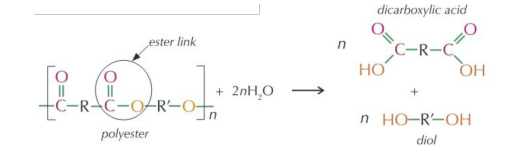
Hydrolysis of Polyesters
- Polyesters are hydrolysed when a strong acid or a specific enzyme is in contact with them.
- The products of the hydrolysis are the di-acids and diols they're made from.
- The bond in the ester link - which is polar - is broken.
- The fact they can be broken down 'naturally' (in water) means they are biodegradable.
Hydrolysis of Polyamides
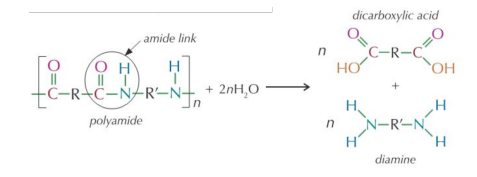
- Polyamides are hydrolysed, again, by a strong acid or specific enzyme to form the dicarboxylic acids and diamines they're made from.
- The C-N bond in the amide link - which is polar - is broken.
- This (as before) means they're biodegradable.
Disposal of Non-biodegradable Polymers
- Polyalkenes are chemically inert and NON-biodegradable (they cannot be hydrolysed)
- This is because they're saturated and have no bond polarity.
- This means their disposal is a considerable problem, they remain in the environment almost forever.
- This is the stuff a lot of plastic bags are made from.
Comparing the methods used to recycle
| Method of Disposal | Advantages | Disadvantages |
|---|---|---|
| Disposal in landfill | • Does not produce toxic gases. • Most cost-effective. | • Limited space in landfills. • Toxins from decomposing waste can contaminate water supplies. • Releases methane (). |
| Incineration | • Saves money on transport costs. • Reduces the amount of waste sent to landfill. | • Produces toxic gases (, , ). • Contributes to global warming. • More expensive than landfill. |
| Recycling | • Conserves crude oil supplies. • Reduces the amount of waste sent to landfill. • Produces less CO₂ than incineration. | • Collecting, sorting, and processing plastic is more expensive than landfill or incineration. • Plastic can be contaminated during recycling. |