Enzymes (AQA A-Level Chemistry): Revision Notes
📚Revision Notes
7.7.3 Enzymes
Enzymes are specialised proteins that function as catalysts, accelerating specific biochemical reactions within the body.
Most enzymes have a globular structure. Within each globule lies a distinct active site, a small crevice or pocket that plays a crucial role in the enzyme's function. This active site has an exact three-dimensional shape tailored to bind with specific molecules, known as substrates. The substrate fits precisely into this site, enabling the enzyme to facilitate the reaction.
Due to the three-dimensional nature of the active site, enzymes can typically catalyse reactions involving only one particular enantiomer of a chiral substrate. This property of enzymes is referred to as stereospecificity.
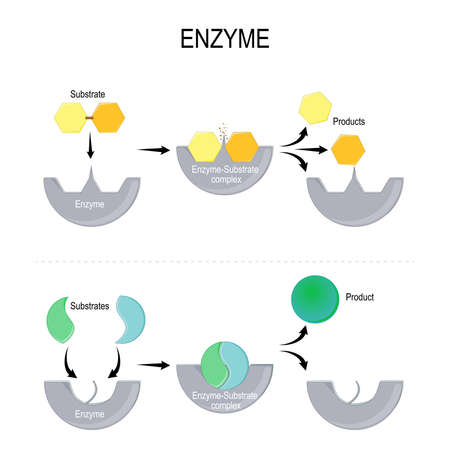
Enzymes are proteins they speed up reactions and are naturally occurring so they're biological catalysts.
- For a reaction to occur, that an enzyme catalyses, the substrate must collide with the enzyme, and fit into its active site to form an enzyme-substrate complex.
- An active site is a 3D shape specific to the molecule that the enzyme in question breaks down.
- Active sites are stereospecific, this means only one enantiomer of a racemate will fit.
- You can think of active sites and substrates like a lock and key respectively (a lock and key to a door, let's say).
- You need to have the key orientated the correct way (I.e. the substrate) and it has to be the right key for the given lock (I.e. the correct substrate for this enzyme)
- If both those conditions are satisfied, you can open the door (I.e. speed up the reaction
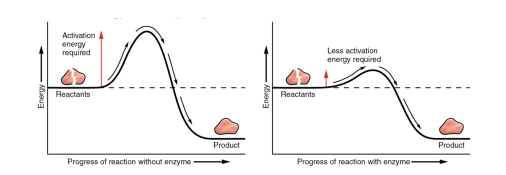
- Once the enzyme-substrate complex forms, the reaction will happen more easily, • the enzyme lowers the activation energy of the reaction it catalyses by providing an alternative pathway. • Just like any other inorganic catalyst does Activation energy: the minimum amount of energy which the reacting particles require for a successful reaction.
Inhibitors as Drugs
- Molecules can be designed that can fit into the active site of an enzym and block it (so no substrate can fit into it)
- This stops (or slows down) the reaction in question
- These molecules are called inhibitors and are useful as drugs in diseases where blocking a given enzyme's activity fixes the problem.
- Computer modelling of the enzyme and its active site can be used to help design enzyme inhibitors, but it takes ages and is a trial and error process.
How enzyme-inhibiting drugs work
Drugs can be engineered to inhibit a harmful enzyme, preventing it from catalysing a detrimental reaction.
To achieve this, molecules are developed to closely resemble the shape of the enzyme's natural substrate. These drugs mimic the substrate, binding to the enzyme's active site in its place. By occupying the active site, the drug blocks the actual substrate from binding, effectively preventing the enzyme from catalysing the reaction. This mechanism is known as enzyme inhibition.
With advances in computer modelling techniques, scientists can now predict the three-dimensional structure of enzymes and other proteins. By understanding the enzyme's shape, they can also deduce the necessary shape of its substrate. This allows for the precise design of inhibitors tailored to the enzyme's specific structure.