Papers and boards (AQA GCSE Design and Technology): Revision Notes
📚Revision Notes
Papers and boards
Papers and boards are essential materials in design and technology, created from fine cellulose fibres and categorised based on their weight and construction methods. Understanding the different types and their specific properties helps you choose the right material for each project.
Note
The choice of paper or board can significantly impact the success of your design project. Each material has been developed for specific applications, so understanding their properties is crucial for making informed decisions.
Understanding paper
Paper manufacturing begins with wood chips that undergo chemical processing to create a pulp. This mixture is then filtered and passed through rollers to remove excess water and create a flat surface. Most paper types can be recycled, making them environmentally sustainable options.
Paper thickness and quality are measured using a system called grams per square metre (gsm). This measurement tells you how much one square metre of the paper weighs, which directly relates to its thickness and durability. Standard paper sizes range from A10 (the smallest) up to A0 (the largest), with A5 being exactly half the size of the familiar A4.
Important
GSM is the key measurement system for paper selection
GSM directly indicates both the thickness and quality of paper. Higher GSM values mean thicker, more durable paper, but also higher costs. Always consider your project requirements when selecting GSM values.
Example
Understanding GSM in Practice
- Layout paper: 50 gsm - Very thin, translucent, budget-friendly
- Standard cartridge paper: 120-150 gsm - Medium thickness, good durability
- Heavy board: 220+ gsm - Thick, rigid, premium quality
The GSM value helps you predict how the material will perform in your project.
Types of paper
Different papers serve specific purposes based on their surface texture, weight, and special properties. Here are the main types you should know:
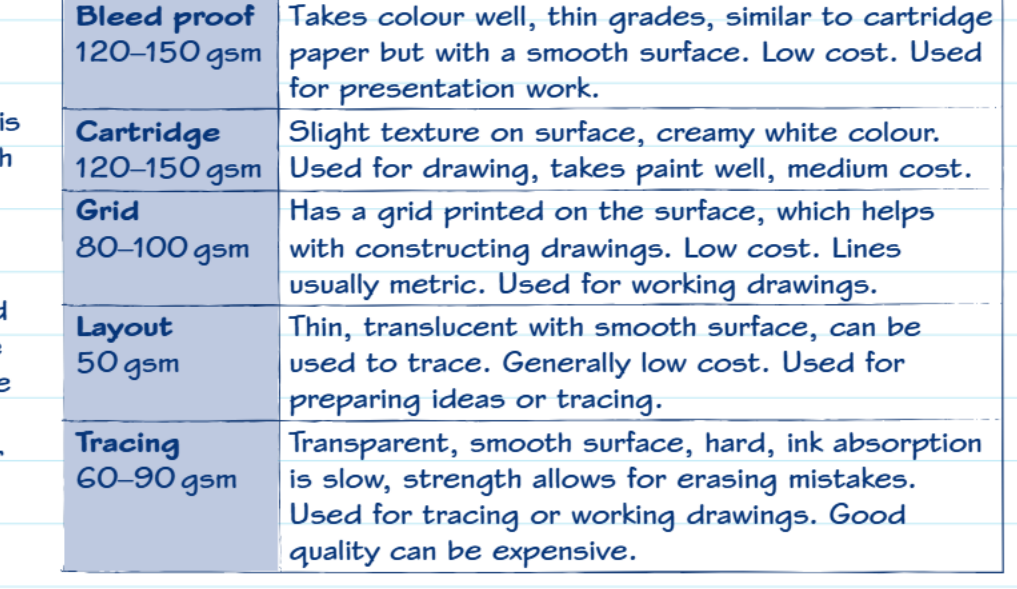 Bleed proof paper (120-150 gsm) offers excellent colour absorption with a smooth finish similar to cartridge paper. Its special coating prevents ink from bleeding through, making it ideal for presentation work where crisp, clean results matter.
Cartridge paper (120-150 gsm) provides a slightly textured, creamy white surface that works exceptionally well with paint and drawing materials. This versatile paper strikes a good balance between quality and cost for general drawing purposes.
Note
Cartridge paper versatility
Cartridge paper is often considered the "workhorse" of design materials due to its balanced properties. Its slight texture helps with paint adhesion while remaining smooth enough for detailed work.
Grid paper (80-100 gsm) features printed grid lines on its surface, typically using metric measurements. This makes it invaluable for technical drawings where accuracy and proportion are crucial, while remaining budget-friendly.
Layout paper (50 gsm) is thin and translucent with an extremely smooth surface, making it perfect for tracing over existing designs or preparing initial sketches and ideas. Its lightweight nature keeps costs low.
Tracing paper (60-90 gsm) offers transparency and a smooth, hard surface with slow ink absorption properties. This allows for easy correction of mistakes and produces high-quality traced drawings, though premium versions can be more expensive.
Understanding board
Board materials are generally much thicker and heavier than standard paper, typically weighing more than 220 gsm or consisting of multiple layers bonded together. Board thickness uses a different measurement system called microns, where one micron equals one thousandth of a millimetre.
Important
Critical Measurement Difference
Paper uses GSM (grammes per square metre) while board uses microns (thousandths of millimetres). This change in measurement system reflects the different properties and applications of these materials. Never confuse these two systems when specifying materials.
Many boards can be laminated with other materials to create enhanced properties for specific applications. While most board types can be recycled, laminated versions may need special separation processes.
Note
Lamination and environmental considerations
Laminated boards offer superior performance characteristics but create recycling challenges. Consider whether the enhanced properties justify the environmental impact for your specific application.
Types of board
Each board type offers unique characteristics designed for particular applications:
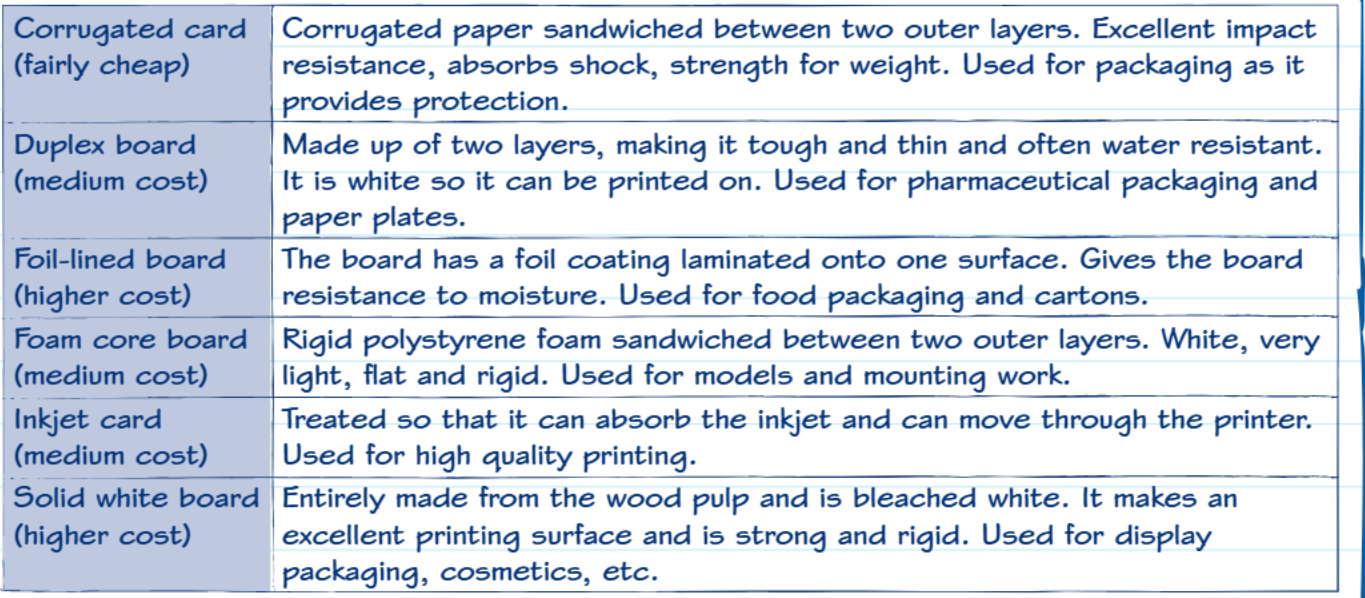 Corrugated card consists of corrugated paper sandwiched between two outer layers, creating excellent impact resistance while absorbing shock and providing strength without excessive weight. This makes it perfect for protective packaging applications.
Duplex board combines two layers to create a tough, thin material that often includes water-resistant properties. Its white surface accepts printing well, making it suitable for pharmaceutical packaging and quality paper plates.
Foil-lined board features a foil coating laminated to one surface, providing excellent moisture resistance. This specialised coating makes it ideal for food packaging and carton applications where freshness matters.
Note
Foil-lined board applications
The foil layer acts as a complete moisture barrier, making this board type essential for products that must maintain freshness or prevent contamination. The laminated construction does impact recyclability.
Foam core board uses rigid polystyrene foam sandwiched between two outer layers, resulting in a white, lightweight, and completely rigid material. These properties make it excellent for architectural models and mounting display work.
Inkjet card receives special treatment to absorb inkjet ink effectively while allowing smooth movement through printer mechanisms. This specialised surface treatment enables high-quality printing results.
Solid white board is manufactured entirely from wood pulp and bleached to achieve a pure white colour. This creates an excellent printing surface that's both strong and rigid, perfect for display packaging and cosmetic applications.
Summary
Key Points to Remember:
- Papers and boards are made from cellulose fibres and classified by weight (gsm) or construction methods
- Paper thickness is measured in grammes per square metre (gsm), while board thickness uses microns
- Different paper types serve specific purposes - choose based on your project's requirements for texture, transparency, and durability
- Boards are generally thicker than 220 gsm and offer enhanced properties like impact resistance and moisture protection
- Many materials can be recycled, but laminated boards may require special processing