Polymers (AQA GCSE Design and Technology): Revision Notes
📚Revision Notes
Polymers
What are polymers?
Polymers are large molecules created from oil-based petrochemicals, coal, or gas. In recent years, scientists have developed more environmentally-friendly options made from plants. All plastics are created from polymers, and understanding their properties helps us choose the right material for different applications.
Note
The shift towards plant-based polymers represents an important development in sustainable materials science, as traditional petroleum-based polymers contribute to environmental concerns.
There are two main categories of plastics, each with very different characteristics and uses.
Thermoforming polymers
Thermoforming polymers are plastics that can be heated up and reshaped multiple times. This makes them incredibly useful because they can be recycled and reformed when heat is applied. These materials are typically lightweight, cost-effective, and available in many different colours.
The molecular structure of thermoforming polymers consists of long chains of connected molecules (monomers) that can slide past each other when heated.
Note
Understanding the Structure
Think of it like cooked spaghetti - the strands can move around each other. This analogy helps explain why these polymers can be reshaped when heated, as the molecular chains become more flexible and can move past one another.
Common thermoforming polymers and their uses
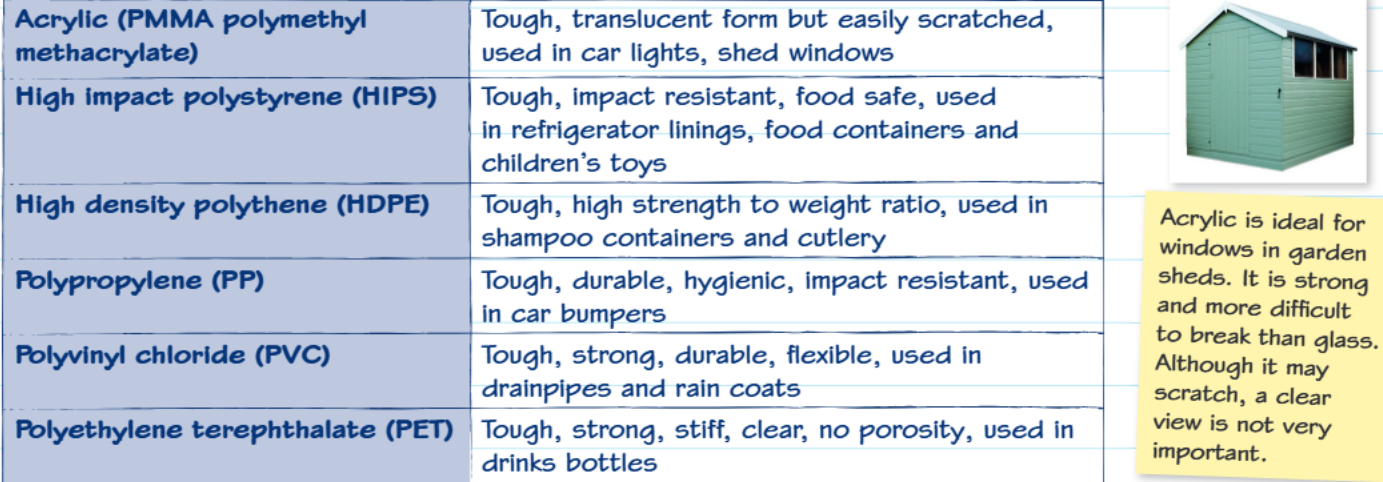 Different types of thermoforming polymers have been developed for specific purposes:
Acrylic (PMMA) is tough and translucent but scratches easily. You'll find it used in car lights and shed windows. It's particularly good for garden shed windows because it's much stronger and harder to break than glass, even though it may scratch more easily.
High Impact Polystyrene (HIPS) is tough and impact-resistant, making it perfect for food applications. It's used in refrigerator linings, food containers, and children's toys because it's food-safe.
High Density Polythene (HDPE) offers excellent strength-to-weight ratio. You'll commonly see it in shampoo containers and cutlery because it's durable yet lightweight.
Polypropylene (PP) is tough, durable, and hygienic while being impact-resistant. This makes it ideal for car bumpers where it needs to withstand impacts.
Polyvinyl Chloride (PVC) is tough, strong, durable, and flexible. These properties make it perfect for drainpipes and rain coats where flexibility and weather resistance are important.
Polyethylene Terephthalate (PET) is tough, strong, stiff, clear, and non-porous. These qualities make it the go-to choice for drinks bottles.
Example
Application Example: Material Selection for Food Containers
When designing a food container, manufacturers choose HIPS because:
- Step 1: Identify requirements - food safety, impact resistance, cost-effectiveness
- Step 2: Match properties - HIPS is food-safe and tough
- Step 3: Consider manufacturing - thermoforming allows easy moulding into container shapes
- Result: Safe, durable, and recyclable food containers
Thermosetting polymers
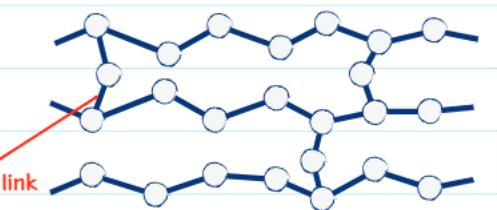
Thermosetting polymers work very differently from thermoforming plastics. Once they have been formed into shape, they cannot be reformed using heat. This is because their molecular structure contains cross-links between the polymer chains, creating a rigid network.
Important
Critical Difference: Cross-Linking
The cross-linked structure makes these materials hard and rigid, though they can be brittle. This cross-linking is permanent and cannot be undone, which is why thermosetting polymers cannot be recycled in the same way as thermoforming polymers.
The cross-linked structure makes these materials resistant to electricity, heat, and chemicals, which makes them useful for specific applications. However, because of their cross-linked structure, they cannot be recycled in the same way as thermoforming polymers.
Types of thermosetting polymers
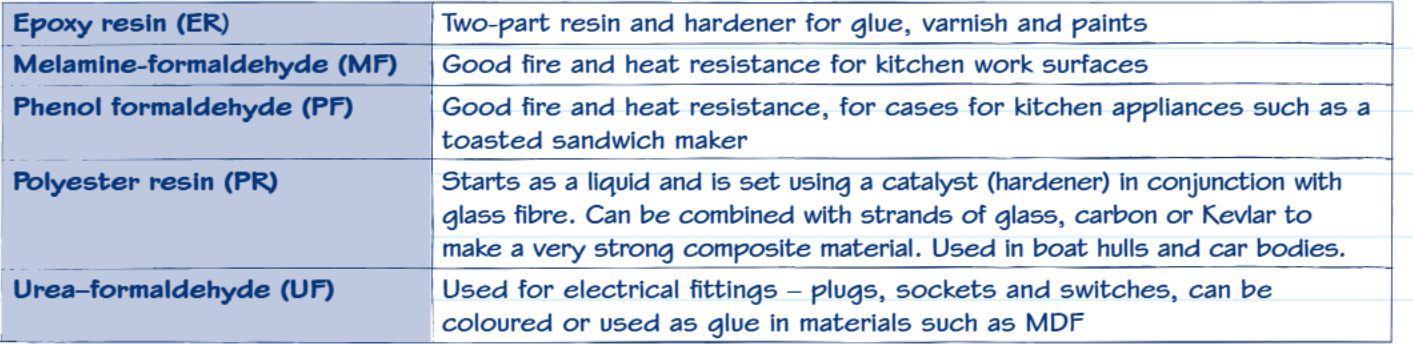 Epoxy resin (ER) is a two-part system combining resin and hardener. It's commonly used for glues, varnishes, and paints where strong adhesion is needed.
Melamine-formaldehyde (MF) has excellent fire and heat resistance, making it ideal for kitchen work surfaces where hot pans might be placed.
Phenol formaldehyde (PF) offers good fire and heat resistance and is often used in cases for kitchen appliances like toasted sandwich makers.
Polyester resin (PR) starts as a liquid and sets using a catalyst (hardener) combined with glass fibre. This creates very strong composite materials used in boat hulls and car bodies where strength and water resistance are crucial.
Urea-formaldehyde (UF) is commonly used for electrical fittings like plugs, sockets, and switches. It can also be coloured or used as glue in materials such as MDF.
Key differences between polymer types
The main difference lies in their molecular structure. Thermoforming polymers have long chains that can move past each other when heated, allowing them to be reshaped. Thermosetting polymers have cross-linked chains that lock the structure in place permanently.
Note
Molecular Structure Impact
Understanding the molecular structure is essential for predicting how these materials will behave in different applications. The ability of molecules to move determines whether a material can be reshaped or will maintain its form permanently.
This structural difference affects their properties:
- Recyclability: Thermoforming can be recycled, thermosetting cannot
- Heat response: Thermoforming softens with heat, thermosetting doesn't change
- Strength: Thermosetting is generally harder and more heat-resistant
- Applications: Each type suits different uses based on these properties
Important
Environmental Consideration
The inability to recycle thermosetting polymers presents environmental challenges. Once these materials reach the end of their useful life, they cannot be reprocessed like thermoforming polymers, making proper disposal and waste management crucial.
Real-world applications
Understanding these differences helps explain why specific polymers are chosen for particular jobs. For example, HIPS is chosen for children's toys because it's impact-resistant and food-safe, while epoxy resin is selected for strong adhesives because of its excellent bonding properties and chemical resistance.
Example
Application Example: Kitchen Worktop Selection
Why melamine-formaldehyde is chosen for kitchen worktops:
- Heat requirement: Must withstand hot pans and cooking equipment
- Durability: Needs to resist daily wear and cleaning chemicals
- Safety: Must be food-safe and hygienic
- Solution: MF's excellent heat and fire resistance makes it ideal for this application
Summary
Key Points to Remember:
-
Thermoforming polymers can be heated and reshaped multiple times, making them recyclable and versatile for many applications
-
Thermosetting polymers have cross-linked structures that cannot be reformed once set, but offer superior heat and chemical resistance
-
Material selection depends on matching polymer properties to the specific requirements of each application
-
Environmental impact varies - thermoforming polymers can be recycled while thermosetting polymers cannot
-
Molecular structure determines behaviour - long chains allow reshaping, cross-links prevent it