Simple gear trains (AQA GCSE Design and Technology): Revision Notes
📚Revision Notes
Simple gear trains
What are gears?
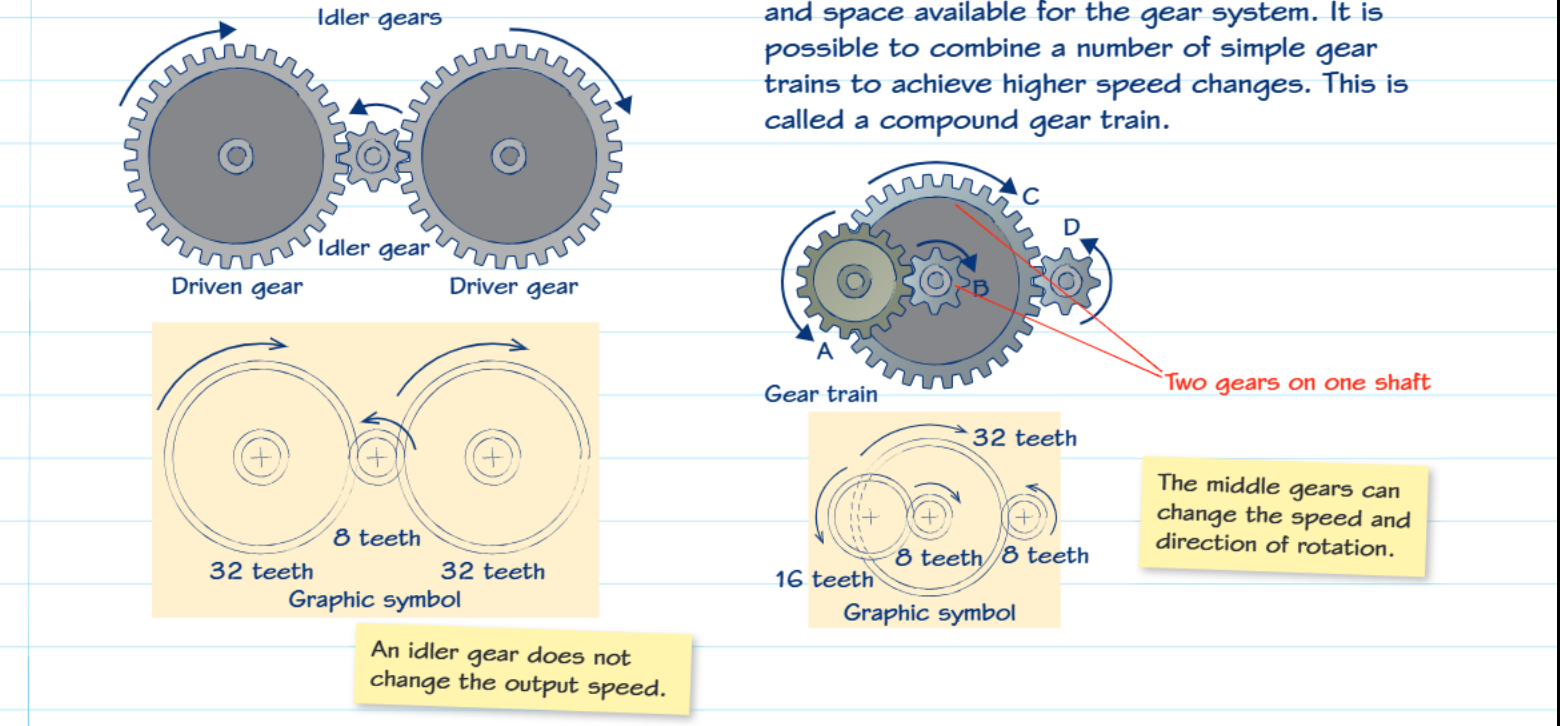
A gear is essentially a toothed wheel that connects to a shaft and can link up with other gears to change how fast something moves. Think of them as the building blocks of many mechanical systems - from bicycles to printers to car engines.
When we talk about gears, there are some important terms to understand:
- Spur gear: This is a rotating wheel with teeth around its edge that can connect with another spur gear
- Driver gear: The gear that receives the original power input and starts the movement
- Driven gear: The gear that receives power from the driver gear and produces the output movement
Note
These three types of gears form the foundation of understanding how mechanical systems transfer power and motion from one component to another.
Simple gear trains
A simple gear train happens when you have just two spur gears connected together on parallel shafts. The driver gear provides the input movement, which gets transmitted to the driven gear to create the output movement.
Note
Direction of Rotation
Here's something interesting: when two gears are connected, they rotate in opposite directions. This is because as one gear's teeth push against the other gear's teeth, they naturally turn the opposite way.
Important
Gears have a big advantage over pulley systems - the meshing teeth prevent any slipping, which means you can apply much greater forces without losing power.
Idler gears
Sometimes you need the driven gear to rotate in the same direction as the driver gear. This is where idler gears come in handy.
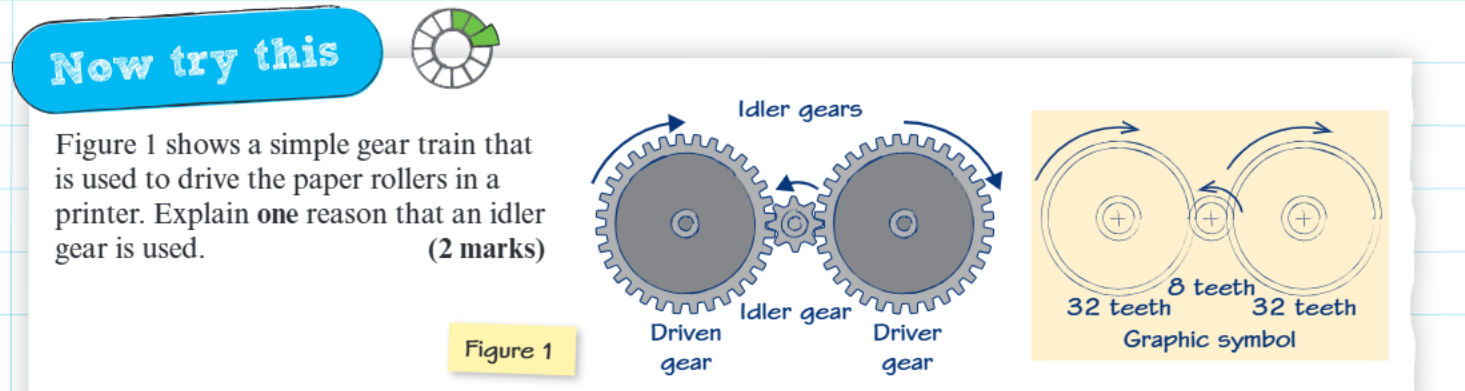
An idler gear sits between the driver and driven gears. Its main job is to change the direction of rotation - it doesn't actually change the output speed at all. The idler gear simply passes the rotation along while reversing the direction twice (which brings it back to the original direction).
Note
In the printer example shown, the idler gear ensures both paper rollers turn inward to grip and feed the paper through properly. This demonstrates how idler gears solve practical engineering problems.
Compound gear trains
When you need bigger speed changes than a simple gear train can provide, you can combine multiple simple gear trains together. This creates what's called a compound gear train.
The key feature of compound gear trains is having two gears fixed on the same shaft. This allows you to chain together multiple speed changes for much greater overall effects. The middle gears in these systems can change both the speed and direction of rotation.
Velocity ratio and calculations
Different sized gears will rotate at different speeds when connected. This relationship is called the velocity ratio (VR).
This tells you how the speeds compare between the two gears. For example, if the velocity ratio is 4:1, it means the driver gear turns 4 times for every 1 turn of the driven gear.
To find the actual output speed, you use:
Note
Speed is usually measured in RPM (revolutions per minute) - how many complete turns happen in one minute.
Working with compound gear trains
For compound gear trains, you calculate the velocity ratio for each simple gear train separately, then multiply them together to get the total velocity ratio.
Example
Worked Example: Compound Gear Train Calculation
If you have:
- First gear train with VR of 1:2
- Second gear train with VR of 1:3
- Total VR = 1:2 × 1:3 = 1:6
This means for every turn of the driver gear, the final driven gear will turn 6 times.
Key principles to remember
The relationship between gear size and speed is crucial to understand:
- Larger gears (more teeth) rotate slower
- Smaller gears (fewer teeth) rotate faster
- Same size gears rotate at the same speed
Important
Speed vs Force Trade-off
When a small gear drives a large gear, you get slower output speed but higher force (torque). When a large gear drives a small gear, you get faster output speed but lower force.
Summary
Key Points to Remember:
- Gears are toothed wheels that mesh together to transmit motion and change speeds
- Simple gear trains have two gears that rotate in opposite directions
- Idler gears change rotation direction without affecting speed
- Compound gear trains combine multiple simple trains for greater speed changes
- Velocity ratio = driven teeth ÷ driver teeth, and determines the speed relationship
- More teeth means slower rotation, fewer teeth means faster rotation