Smart materials (AQA GCSE Design and Technology): Revision Notes
📚Revision Notes
Smart materials
What are smart materials?
Smart materials are innovative substances that possess the remarkable ability to respond to external stimuli and change their properties in a controlled, predictable way. These materials can detect changes in their environment and react accordingly, making them incredibly useful in modern technology and design applications.
The key characteristic that makes these materials "smart" is their responsiveness to various environmental triggers such as temperature, light, pressure, or electrical signals. When exposed to these stimuli, smart materials can change their shape, colour, or other physical properties, and often return to their original state when the stimulus is removed.
Note
The term "smart" in smart materials refers to their ability to sense environmental changes and respond automatically without human intervention. This makes them particularly valuable in applications where automatic responses are needed.
Types of smart materials
Shape memory alloys
Shape memory alloys are metallic materials that demonstrate an extraordinary ability to "remember" and return to their original shape when heated. The most common example is Nitinol, an alloy made from nickel and titanium.
Here's how they work: when these alloys are deformed at room temperature, they maintain their new shape until heated to a specific trigger temperature. Once heated above this temperature (typically around 70°C for many applications), the metal springs back to its pre-programmed original form. Different alloys have different trigger temperatures depending on their composition, allowing engineers to customise their behaviour for specific applications.
Example
Worked Example: Shape Memory Alloy in Action
Step 1: At room temperature (20°C), a Nitinol wire is bent into a spiral shape Step 2: The wire maintains this spiral shape until heated Step 3: When heated to 70°C, the wire returns to its original straight form Step 4: When cooled back to room temperature, it can be deformed again
Key properties and benefits:
- Space-saving design as they require fewer mechanical parts
- Can provide constant force applications
- Useful in medical devices like dental braces where gentle, continuous pressure is needed
Important
Limitations to Consider:
- Expensive to manufacture and purchase
- Limited lifespan due to metal fatigue over repeated cycles
- Can be slow to respond to temperature changes
Applications: Shape memory alloy tubes are commonly used in medical devices, where they can be compressed and inserted into arteries, then expand to their original shape to keep blood vessels open.
Thermochromic pigments
Thermochromic pigments are specialised powder materials that change colour when exposed to different temperatures. These pigments are typically mixed into other materials such as polymers, paints, or plastics to create temperature-responsive products.
The colour change occurs because the molecular structure of the pigment alters when it reaches specific temperatures. This change can be designed to be either reversible (returning to the original colour when cooled) or permanent (maintaining the new colour indefinitely). The specific temperature at which the change occurs can be engineered to meet different application requirements.

Note
The colour change in thermochromic materials is not just for novelty - it serves as a visual indicator that can provide important safety information or functional feedback about temperature conditions.
Key benefits:
- Excellent safety indicators for temperature monitoring
- Can detect and visually indicate dangerous temperature levels
- Useful for creating interactive and educational products
Limitations:
- Pigments may degrade over time with repeated temperature cycling
- Colour changes might not be immediately visible in all lighting conditions
Applications: These pigments are commonly used in thermometers for fish tanks, baby bottles that change colour when contents are too hot, and safety equipment that warns of dangerous temperatures.
Photochromic pigments or particles
Photochromic materials contain special compounds that change colour when exposed to ultraviolet light. Unlike thermochromic materials that respond to heat, these smart materials react specifically to UV radiation, making them particularly useful for sun-protection applications.
The colour change mechanism works by UV light causing molecules in the pigment to rearrange their structure, which alters how they absorb and reflect visible light. When the UV stimulus is removed (such as moving indoors), the molecules return to their original arrangement and the material returns to its initial colour.
Example
Worked Example: Photochromic Glasses in Action
Step 1: Indoors with no UV light - lenses remain clear Step 2: Person walks outside into sunlight containing UV rays Step 3: Within seconds, the lenses begin to darken automatically Step 4: After 30-60 seconds, lenses reach full dark tint Step 5: When returning indoors, lenses gradually return to clear state
Key advantages:
- Enable creation of multi-functional products that serve different purposes in different lighting conditions
- Provide automatic UV protection that activates only when needed
- Can be incorporated into various materials including plastics, fabrics, and glass
Limitations:
- Response time can be slower compared to other smart materials
- Materials can be expensive to develop and manufacture
- May have reduced effectiveness over time with prolonged UV exposure
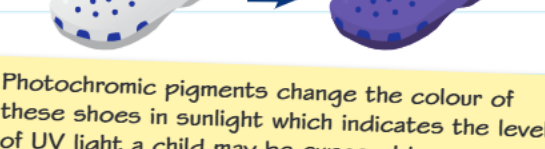
Applications: Photochromic technology is widely used in transition lenses for eyeglasses that darken in sunlight, UV-indicating wristbands that show sun exposure levels, and children's shoes that change colour to indicate UV exposure levels for safety.
Real-world applications
Smart materials have revolutionised numerous industries by providing innovative solutions to complex problems. In healthcare, shape memory alloys enable minimally invasive surgical procedures and create more comfortable orthodontic treatments. The automotive industry uses thermochromic materials for temperature indicators and photochromic materials for automatic-dimming mirrors.
Consumer products benefit greatly from smart materials technology. Mood rings use thermochromic pigments to respond to body temperature, while photochromic materials make outdoor activities safer by providing automatic UV protection in clothing and accessories.
Note
The versatility of smart materials means they can be found in everything from high-tech medical devices to everyday consumer products, making our lives safer and more convenient.
Summary
Key Points to Remember:
- Smart materials respond to external stimuli like temperature, light, or pressure and change their properties in a controlled manner
- Shape memory alloys "remember" their original shape and return to it when heated to their trigger temperature
- Thermochromic pigments change colour based on temperature changes, making them ideal for safety and monitoring applications
- Photochromic materials change colour when exposed to UV light, providing automatic sun protection
- All smart materials offer unique benefits but can be expensive and may have limited lifespans depending on usage