Sustainability (AQA GCSE Design and Technology): Revision Notes
📚Revision Notes
Sustainability
What is sustainability?
Sustainability means meeting the needs of people today without compromising the ability of future generations to meet their own needs. This concept is becoming increasingly important as we face environmental challenges and resource scarcity. New and emerging technologies play a crucial role in helping us protect our environment and develop alternatives to finite resources.
Note
The integration of new and emerging technologies is essential for achieving sustainability goals, as these innovations help us develop cleaner alternatives and more efficient resource management systems.
Finite resources
Finite resources are materials that cannot be renewed or replaced at a rate fast enough to meet our current demand. These resources will eventually run out completely, which poses a significant challenge for future generations.
Examples of finite resources
- Fossil fuels - used in the production of plastics and for energy generation
- Metal ores and minerals - extracted from within the Earth's crust for manufacturing
The depletion of these resources varies significantly depending on current consumption rates and available reserves.
Note
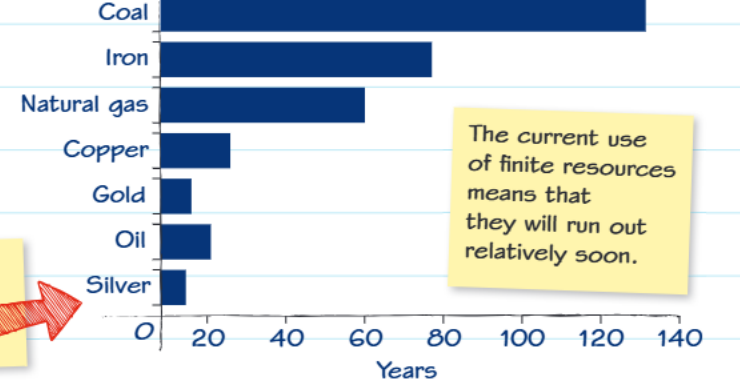
Resource Depletion Timeline Analysis
This chart shows how quickly we might exhaust different finite resources at current consumption rates. Coal has the longest projected lifespan at over 130 years, while precious metals like silver and gold may be depleted within 15-20 years. Oil, which is crucial for many industries and transportation, is estimated to last only about 20 years at current usage levels.
Why finite resource depletion matters
New and emerging technologies are critical in developing alternative materials to reduce our consumption of finite resources. As these materials become scarcer, they become more expensive and difficult to extract, making sustainable alternatives increasingly important for economic and environmental reasons.
Important
Critical Challenge: As finite resources become harder to extract and more expensive, the development of sustainable alternatives becomes not just an environmental necessity, but an economic imperative for long-term prosperity.
Non-finite resources
Non-finite resources can be replenished through natural processes and can potentially sustain our level of demand indefinitely when managed properly. These renewable resources offer hope for a more sustainable future.
Examples of non-finite resources
- Plants or algae - can be cultivated to manufacture fuels such as biodiesel
- Plant-based oils - used to produce environmentally-friendly plastics
- Managed timber - sustainably harvested for building and furniture construction
The key advantage of non-finite resources is that they can be renewed within human timescales, making them a cornerstone of sustainable development strategies.
Understanding resource limitations
Important
Important Distinction: Even though finite resources took millions of years to form, we cannot replenish them within a timescale that would be useful for human society. Additionally, as deposits become harder to reach or are too expensive to extract, the effective availability of these resources decreases even before they are completely exhausted.
Disposal of waste
Manufacturing processes generate waste that is expensive to dispose of properly. Poor waste management can lead to pollution of rivers, harm to natural habitats, and contribute to global warming. This makes effective waste management a critical component of sustainability.
Life cycle assessment
Note
Life Cycle Assessment (LCA) is a comprehensive method used to measure and analyse the environmental impacts of a product throughout every stage of its existence, from initial production (cradle) to final disposal (grave). Companies use LCA to make more responsible decisions about product design and manufacturing processes.
The waste disposal hierarchy
The most effective approach to waste management follows a clear hierarchy, ranked from most desirable to least desirable:
Important
The Waste Hierarchy (Most to Least Desirable):
- Reduce - Decrease the amount of waste produced in the first place
- Reuse - Find new purposes for products or materials that would otherwise become waste
- Recycle - Process materials to create new products
- Dispose/Landfill - The least desirable option, used only when other methods aren't viable
Strategies to minimise waste disposal
Manufacturers can implement several strategies to reduce their environmental impact:
- Reduce waste production by minimising packaging, reducing product sizes, improving quality control, and using emails instead of physical letters
- Reuse materials by finding new applications for products that would otherwise become waste, such as using refillable ink cartridges
- Recycle materials to reduce the need for new raw materials, such as recycling plastic and glass bottles
- Recover energy from waste generated in factories, for example by using waste heat to provide heating for the facility
Note
These strategies not only help the environment but can also reduce costs for manufacturers by decreasing waste disposal fees and raw material purchases, creating a win-win situation for both business and environmental sustainability.
Summary
Key Points to Remember:
- Sustainability means meeting today's needs without compromising future generations' ability to meet theirs
- Finite resources like fossil fuels and metal ores will eventually run out and cannot be renewed quickly enough for human use
- Non-finite resources like plants and managed timber can be replenished naturally and offer sustainable alternatives
- The waste hierarchy prioritises reducing, reusing, and recycling over disposal to minimise environmental impact
- Life Cycle Assessment helps companies understand and reduce the environmental impact of their products throughout their entire lifespan