Monoclonal antibodies (Edexcel GCSE Biology): Revision Notes
📚Revision Notes
Monoclonal antibodies
Note
Monoclonal antibodies are identical antibodies, that have been produced from the same immune cell. As a result of their ability to bind to only one protein antigen, they can be used to target chemicals and cells in the body and so have many different medical uses, e.g. in pregnancy testing.
Note
How are they produced:
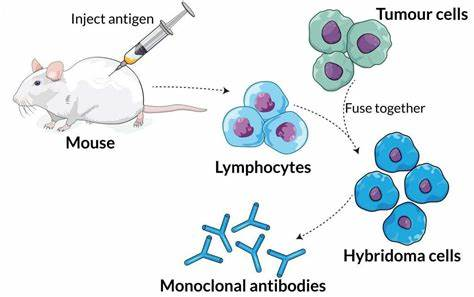
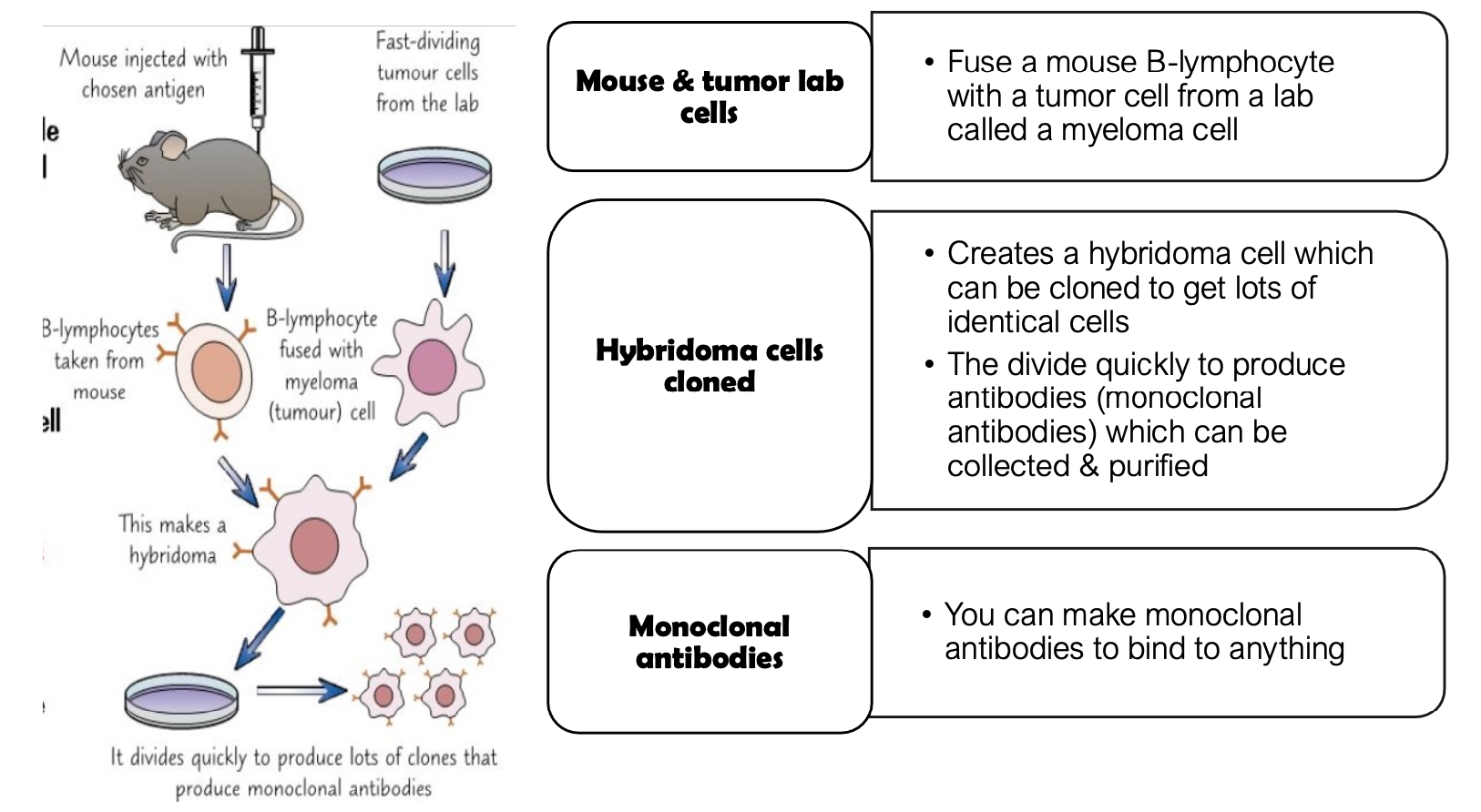
- Scientists obtain mice lymphocytes (a type of white blood cell that make antibodies but cannot divide), which have been stimulated to produce a specific antibody.
- They are combined with tumour cells (do not make antibodies but divide rapidly), to form a cell called a hybridoma.
- The hybridoma can divide to produce clones of itself, which all produce the same antibody.
- The antibodies are collected and purified.
These are produced from lots of clones of a single B- lymphocyte (which produce antibodies).
So all the antibodies produced are identical and will target one specific protein antigen
Why they are useful…
They will only bind to target specific cell/ chemical in body
Used to find blood clots
When the blood clots, proteins in the blood join together to form solid mesh. Monoclonal antibodies have been developed to bind these proteins
- Attach radioactive element to these antibodies
- Inject into body & take picture which picks up radiation
Note
You can easily find potential harmful blood clots.
In laboratories to measure and monitor
-
They can be used to measure and monitor levels of hormones or chemicals in the blood.
-
The monoclonal antibodies are modified so that they will bind to the molecule you are looking for.
-
The antibodies are also bound to a fluorescent dye.
-
If the molecules are in the sample then the antibodies bind to it, and the dye can be observed.
-
An example is screening donated blood for HIV infections. In research to find or identify certain molecules on a cell or tissue
- The same method as above is applied, and scientists look for a build up of the fluorescence.