Redshift (Edexcel GCSE Physics): Revision Notes
📚Revision Notes
Redshift
Note
Red Shift occurs when light from distant galaxies appears to be stretched towards the red end of the visible spectrum. This effect is observed when galaxies are moving away from Earth.
Note
The amount of redshift increases with the distance of the galaxy, which provides evidence that the universe is expanding.
Note
This can be visualised using the analogy of a balloon:
- Imagine the start of the Big Bang as an uninflated balloon, with galaxies represented as dots on its surface.
- As the balloon (universe) inflates, the dots (galaxies) move further apart from each other.
- Similarly, as the universe expands, the distance between galaxies also increases.
- Light from a galaxy travelling through this expanding space gets stretched, resulting in a "red shift" — the wavelengths of light appear longer, shifting towards the red end of the spectrum.
- As the wavelength increases, the frequency of the light appears to decrease because each successive wave is emitted from a position further away from the observer.
Note
This observation of red shift across distant galaxies supports the idea that the universe has been expanding since the Big Bang.
Note
- Different elements absorb different frequencies (or wavelengths) of light.
- Each element produces a specific pattern of dark lines at the frequencies that it absorbs in the visible part of the EM spectrum.
- When we look at light from distant galaxies we see the same patterns but at slightly lower frequencies.
- There's an observed increase in the wavelengths of light coming from the galaxies & the patterns that have been shifted towards the red end of the spectrum.
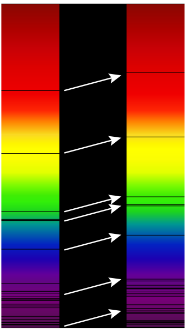
Note
- Measurements of redshift suggest that all galaxies are moving away from us quickly in every direction
- More distant galaxies have greater redshift, so the further away they are, the faster they are moving away from us.