10 – To Investigate Factors Affecting the Rate of Transpiration in Plants (LC 2027) (Leaving Cert Biology): Revision Notes
📚Revision Notes
10 – To Investigate Factors Affecting the Rate of Transpiration in Plants
What is a potometer?
A potometer is a scientific instrument used to measure the rate of water uptake by plants. Since plants lose water through transpiration, the rate at which they absorb water gives us a good indication of their transpiration rate. This makes potometers essential tools for studying how different environmental conditions affect plant water loss.
Note
The key principle is simple: as a plant loses water through its leaves, it must replace this water by absorbing more through its roots and stem. By measuring how quickly water moves through the apparatus, we can determine the plant's transpiration rate.
Equipment setup
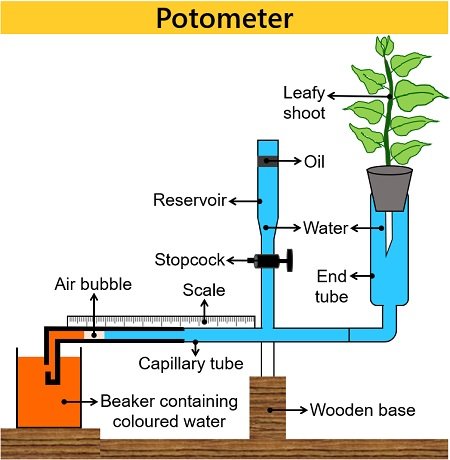
The potometer consists of several key components that work together to measure water movement:
- Plant shoot: A leafy branch (such as beech or birch) cut at an angle underwater
- Rubber stopper: Seals the plant shoot to the glass tube
- Glass tube: Main body of the apparatus, clamped to a stand
- Rubber tubing: Connects different parts of the system
- Capillary tube: Narrow tube where the air bubble movement is measured
- Ruler: For measuring bubble displacement
- Water reservoir: Container holding water for the system
The apparatus allows water to flow from the reservoir through the capillary tube to replace water lost by the plant through transpiration.
Method
Follow these steps carefully to set up and conduct the transpiration investigation:
- Prepare the plant shoot: Cut a non-glossy leafed plant shoot (like beech or birch) underwater at an angle about one centimetre from the end. Cutting underwater prevents air from entering the xylem, which would block water flow. The angled cut increases the surface area for better water absorption.
- Assemble the potometer: Place the apparatus underwater and attach the plant shoot to the rubber stopper while everything remains submerged.
- Seal the system: Apply petroleum jelly (Vaseline) to the junction between the shoot and stopper to create an airtight seal.
Important
Critical Steps for Success:
- Always cut the plant shoot underwater to prevent air bubbles entering the xylem
- Ensure all joints are properly sealed with petroleum jelly to maintain system integrity
- Handle the delicate capillary tube carefully to avoid breakage
- Position in water: Place the capillary tubing end in a beaker of water as shown in the diagram.
- Dry the leaves: Pat the plant leaves dry using tissue paper to remove surface water and allow normal transpiration to begin.
- Introduce air bubble: Remove the capillary tube from the water briefly to allow an air bubble to enter the tubing. Adding dye to the water makes the bubble easier to see.
- Replace tubing: Return the capillary tubing to the water beaker.
- Record movement: Measure the distance travelled by the air bubble over a set time period (e.g., 1 minute) in a bright laboratory location. This serves as your control measurement.
- Reset the system: Squeeze the rubber tubing to push the air bubble back to the start position and introduce a fresh bubble.
- Repeat measurements: Conduct steps 8 and 9 three times and calculate the average distance travelled for reliable results.
- Test different factors: Investigate various environmental conditions by measuring bubble movement under each condition for 1 minute intervals.
Variables you can investigate
The following factors can be tested by changing conditions around the plant shoot:
Environmental factors
- Air movement: Use a fan to create air currents around the plant
- Temperature: Place the apparatus in different temperatures or use heating/cooling devices
- Light intensity: Position the setup in bright or dark locations, or vary distance from a light source
- CO₂ concentration: Enclose the plant in a transparent bag with sodium hydroxide (absorbs CO₂) compared to a bag with just water
Plant factors
- Surface area: Remove some leaves to reduce the total leaf surface area
- Cuticle thickness: Compare plants with glossy leaves (thick cuticles) to those with non-glossy leaves (thin cuticles)
Recording your results
Note
Use a results table to record your measurements systematically. Include columns for different trial runs and calculate averages to improve accuracy. Record the distance travelled by the air bubble under each condition tested.
How factors affect transpiration rate
Understanding why different factors influence transpiration helps explain your experimental results:
Factors that increase transpiration rate
Note
Why These Factors Speed Up Transpiration:
Air movement speeds up transpiration because moving air removes water vapour from around leaf surfaces more quickly. This maintains a steep concentration gradient, encouraging more water to evaporate from the leaves.
Higher temperature increases the kinetic energy of water molecules, causing them to evaporate more readily from leaf surfaces. Warm air can also hold more water vapour than cold air.
Increased surface area provides more stomata and leaf surface for water evaporation. More leaves mean more sites for transpiration to occur.
Higher light intensity causes stomata to open wider to allow gas exchange for photosynthesis. Open stomata provide pathways for water vapour to escape from the leaf interior.
Factors that decrease transpiration rate
Note
Why These Factors Slow Down Transpiration:
Thicker cuticles create a waxy barrier that reduces water loss from leaf surfaces. Plants in dry environments often have thick cuticles as an adaptation.
Higher CO₂ concentration allows stomata to close more because the plant can still obtain sufficient carbon dioxide for photosynthesis. Closed stomata reduce water loss.
Exam tips
Important
Essential Exam Points:
- Always cut plant shoots underwater to prevent air bubbles in the xylem
- Ensure all joints are properly sealed with petroleum jelly
- Take multiple readings and calculate averages for accuracy
- Only change one variable at a time when testing different factors
- Explain results in terms of stomatal behaviour and evaporation rates
Summary
Key Points to Remember:
- Potometers measure water uptake, which indicates the rate of transpiration in plants
- Cut shoots underwater at an angle to prevent air entering the xylem and increase absorption surface area
- Environmental factors like temperature, light, and air movement generally increase transpiration rates
- Plant adaptations like thick cuticles and fewer leaves reduce transpiration rates
- Multiple trials and averages improve the reliability of your experimental results