3 – To Investigate Quantitatively the Level of Reducing Sugars in a Range of Food Samples (LC 2027) (Leaving Cert Biology): Revision Notes
📚Revision Notes
3 – To Investigate Quantitatively the Level of Reducing Sugars in a Range of Food Samples
Understanding quantitative testing
A quantitative test is a scientific method that measures the exact amount, level or concentration of a substance in a sample. This is much more useful than qualitative tests, which only tell you whether something is present or absent. With quantitative testing, you can determine precisely how much reducing sugar is in different food samples.
Note
The key advantage of quantitative testing over qualitative testing is precision. While qualitative tests simply show presence or absence, quantitative tests provide exact measurements that allow for meaningful comparisons between different samples.
What is Benedict's test for reducing sugars?
Benedict's test (also called Fehling's test) is a reliable chemical test used to detect and measure the concentration of reducing sugars in food samples. The test uses a special blue solution called Benedict's reagent that changes colour when heated with reducing sugars. The amount of colour change tells you exactly how much reducing sugar is present.
This test is particularly valuable because it provides a simple colour scale that corresponds to different concentration ranges, making it easy to compare sugar levels between different food samples.
Equipment and materials required
For this investigation, you will need:
- Test tubes
- Benedict's quantitative solution (blue reagent)
- Food samples for testing
- Distilled water (for the control)
- Water bath or heating apparatus
- Measuring equipment (pipettes or measuring cylinders)
- Timer
- Results table for recording observations
Step-by-step procedure
Example
Worked Example: Complete Benedict's Test Procedure
Step 1: Sample preparation Start by dissolving your food sample in water inside a test tube. This creates a uniform solution that can be accurately tested.
Step 2: Adding Benedict's reagent Add an equal volume of Benedict's quantitative solution to your sample. The mixture should appear blue initially, as this is the natural colour of the reagent.
Step 3: Setting up the control Prepare a second test tube containing equal volumes of water and Benedict's quantitative solution. This control helps you identify what happens when no reducing sugar is present, ensuring your test results are reliable.
Step 4: Heating process Place both test tubes in a very hot water bath and heat for exactly 5 minutes. This heating step is essential because it provides the energy needed for the chemical reaction between Benedict's reagent and reducing sugars.
Step 5: Recording observations After heating, observe and record the colour changes in both the test sample and control tube.
Interpreting the colour changes
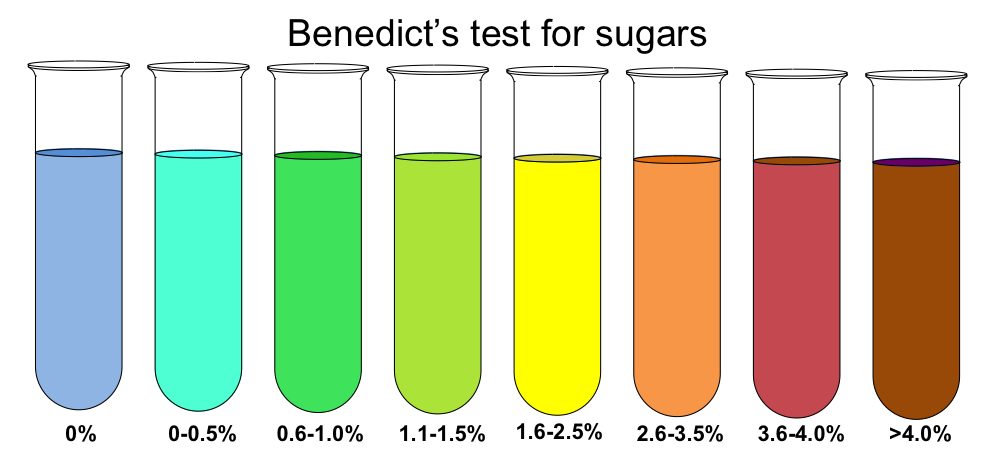
The colour that appears after heating directly indicates the concentration of reducing sugars present:
Important
Color Scale for Reducing Sugar Concentration:
Blue colour (0% reducing sugar): The solution remains unchanged, indicating no reducing sugars are present in the sample.
Green colour (0.5 to 1% reducing sugar): A very low concentration of reducing sugars is present. This represents the minimal detectable level.
Yellow colour (1 to 1.5% reducing sugar): A low concentration of reducing sugars is present. The colour change is becoming more noticeable.
Orange colour (1.5 to 2% reducing sugar): A medium concentration of reducing sugars is present. This shows a significant amount of sugar in the sample.
Red or brick red colour (greater than 2% reducing sugar): A high concentration of reducing sugars is present. This indicates the sample is rich in reducing sugars.
The colour progression from blue through green, yellow, orange, to red provides a clear visual scale for determining sugar concentration ranges.
Recording your results
Organise your findings in a systematic table format:
| Sample tested | Final colour obtained | Conclusion |
|---|---|---|
| Very dilute glucose solution | Green | 0.5 to 1% reducing sugar |
| Water | Blue | No reducing sugar |
Note
This table format allows you to compare different samples easily and draw meaningful conclusions about their relative sugar content. Always include multiple samples and your control for the most reliable results.
Importance of using controls
Important
The water control is crucial for this investigation because it demonstrates what happens when no reducing sugar is present. By comparing your test samples with the control, you can be confident that any colour changes are specifically due to reducing sugars rather than other factors. The control should always remain blue throughout the heating process.
Key applications and benefits
This quantitative approach provides much more detailed information than simple presence/absence tests. You can rank different food samples according to their reducing sugar content, which is valuable for:
- Comparing nutritional content of foods
- Understanding how food processing affects sugar levels
- Making informed dietary choices
- Scientific research into food composition
The test is highly reliable when performed correctly and provides clear, interpretable results without requiring expensive laboratory equipment.
Summary
Key Points to Remember:
-
Quantitative testing measures exact concentration levels, giving you precise information about sugar content rather than just presence or absence
-
The colour scale progresses systematically: blue (no sugar) → green → yellow → orange → red (highest sugar concentration)
-
Always include a water control to verify your test is working correctly and provide a reliable comparison
-
Heat samples for exactly 5 minutes in very hot water to ensure accurate and consistent results
-
Record all observations in a clear table format to make it easy to compare different food samples and draw conclusions