Investigation of the effect of temperature on enzyme activity (LC 2026) (Leaving Cert Biology): Revision Notes
📚Revision Notes
Investigation of the effect of temperature on enzyme activity
Background:
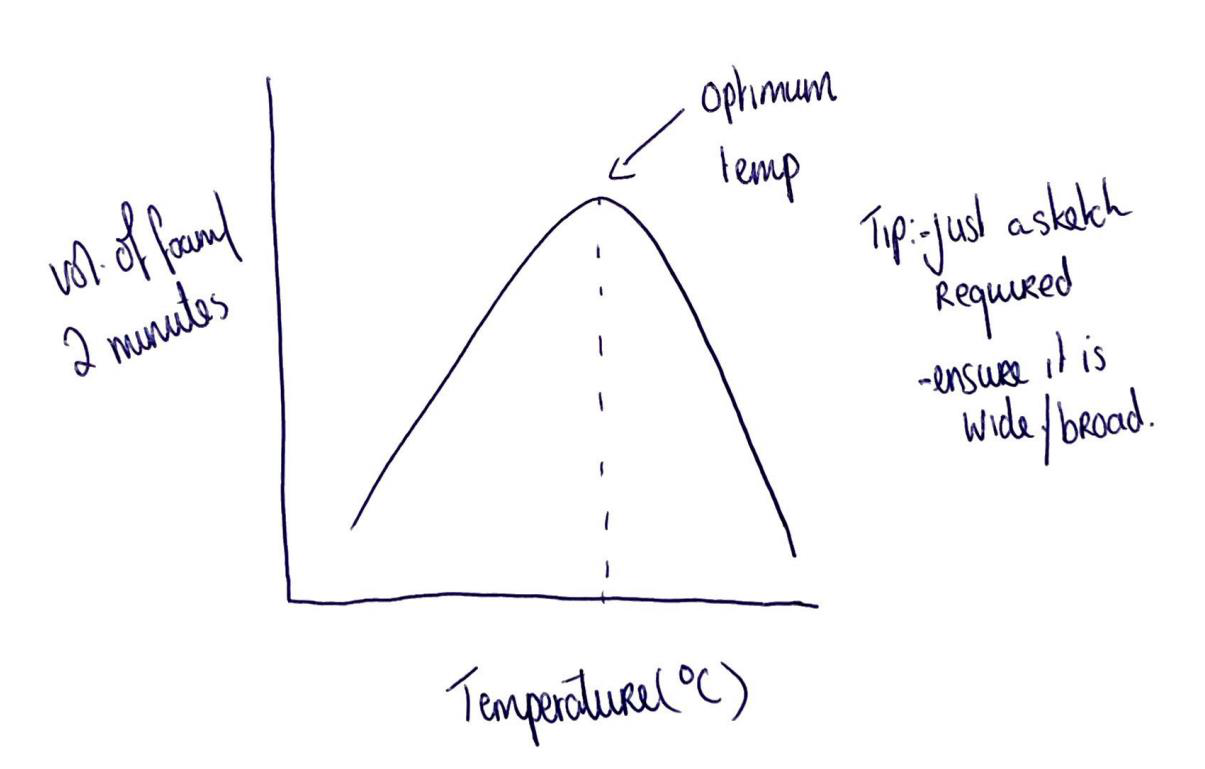
Enzymes are affected by temperature. Plant enzymes work best at 30°C, known as their optimum temperature. At other temperatures, the enzyme's activity decreases because temperature changes can alter its shape, leading to denaturation.
Note
Denatured: the active site of an enzyme has been destroyed. The enzyme can no longer act on the substrate.
Materials needed:
- Hydrogen Peroxide (substrate)
- Celery (contains enzyme catalase)
- pH buffer 9/10 (keeps pH constant)
- Temperature-controlled water bath (varying temperatures: 0°C, 20°C, 30°C, 60°C)
- Washing up liquid
- Graduated cylinders
- Plastic droppers
Method:
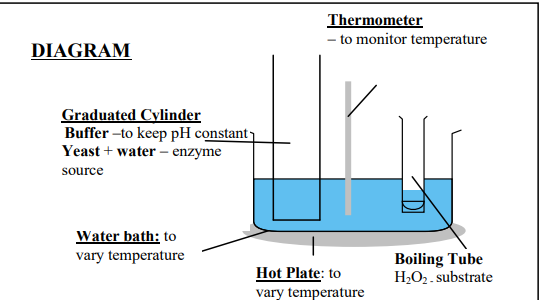
- Place celery, washing-up liquid, and pH buffer in a graduated cylinder.
- In another graduated cylinder, add 5 cm³ of hydrogen peroxide.
- Place both graduated cylinders in a thermostatically controlled water bath set at 0°C for 2 minutes to allow all reagents to reach the exact temperature.
- After 2 minutes, add the hydrogen peroxide to the graduated cylinder containing the other reagents.
- Record the volume of foam produced after 2 minutes. The foam volume measures enzyme activity by indicating the amount of oxygen produced.
- Repeat the experiment at 20°C, 30°C, and 60°C.
- Record the results and plot a graph with temperature on the x-axis (horizontal) and volume of foam (cm³) on the y-axis (vertical).
Results:
| Temperature | 0°C | 20°C | 30°C | 60°C |
|---|---|---|---|---|
| Volume of foam cm³/ 2 minutes | 0 cm³ | 5 cm³ | 15 cm³ | 5 cm³ |
Graph of Results: