14.1 – Determining the Specific Heat Capacity of a Liquid (Leaving Cert Physics): Revision Notes
📚Revision Notes
14.1 – Determining the Specific Heat Capacity of a Liquid
Aim of the experiment
The purpose of this experiment is to find the specific heat capacity of water using an electrical heating method. This approach allows us to precisely measure the electrical energy supplied and relate it to the temperature change of the water.
Summary of method
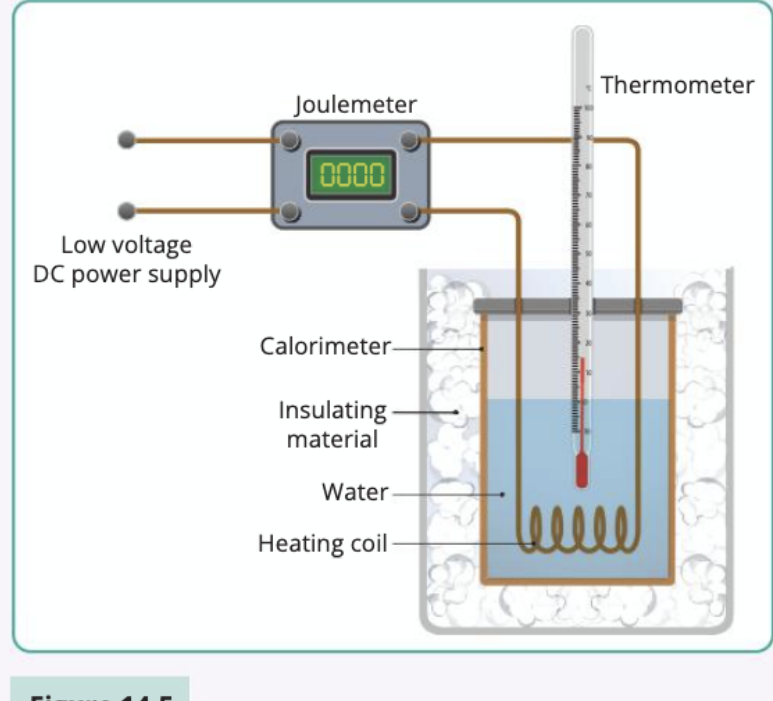
In this experiment, you will pass an electric current through a heating coil immersed in water within a copper calorimeter. The electrical energy supplied is measured using a joulemeter, whilst the temperature change is recorded with a thermometer. By applying the principle of conservation of energy and knowing the mass of water and calorimeter, you can calculate the specific heat capacity of water.
Note
This method is based on the fundamental principle that electrical energy can be measured accurately and converted to thermal energy, though some energy losses may still occur.
Equipment required
The following apparatus is needed for this experiment:
- A copper calorimeter with stirrer and insulating lid
- Insulating material (such as cotton wool or polystyrene beads)
- A container (like a large beaker) to hold the calorimeter and insulating material
- A heating coil rated for low voltage operation
- A thermometer capable of reading to 0.1°C precision
- A DC power supply unit with connecting leads
- A joulemeter to measure electrical energy
- A weighing scale for mass measurements
Note
Equipment Selection Tips:
- Choose a copper calorimeter for its low specific heat capacity
- Ensure the thermometer has sufficient precision (0.1°C) for accurate measurements
- The joulemeter is essential for precise energy measurements
Experimental procedure
Follow these steps carefully to obtain accurate results:
1. Preparation and initial measurements Determine the mass of the empty calorimeter using the weighing scale. Record this value as mc.
2. Adding water and measuring mass Fill the calorimeter with sufficient water to completely cover the heating coil when it is placed inside. Find the combined mass of the calorimeter and water, then calculate the mass of water (mw) by subtraction.
3. Setting up the apparatus Place the calorimeter containing water into the insulating material and set up the equipment as shown in the diagram. The insulation helps minimise heat loss to the surroundings during the experiment.
Important
Critical Setup Point: Ensure the heating coil is completely immersed in water to prevent burning and ensure even heating throughout the liquid.
4. Initial temperature measurement Allow the system to reach thermal equilibrium (wait until the temperature is steady), then measure and record the initial temperature of the cold water and calorimeter as θ1.
5. Electrical heating phase Switch on the joulemeter and electric current simultaneously. Allow the current to flow until the temperature rises by approximately 15°C. Stir the water continuously throughout this heating period to ensure even temperature distribution.
Note
Why Continuous Stirring? Stirring ensures uniform temperature throughout the water, preventing hot spots and giving accurate thermometer readings.
6. Final measurements Switch off both the current and joulemeter. Record the final reading on the joulemeter (Q) and continue stirring until the temperature stops rising (this accounts for residual heat in the heating coil). Record this highest temperature as θ2.
7. Data recording Complete your data table with all measured values.
| Measurement | Symbol | Your Value |
|---|---|---|
| Mass of empty calorimeter | mc | = |
| Mass of calorimeter and water | m2 | = |
| Mass of water | mw | = |
| Temperature of cold water and calorimeter | θ1 | = |
| Reading on joulemeter | Q | = |
| Final temperature of water and calorimeter | θ2 | = |
Calculations
The calculation is based on the assumption that no heat is lost to or gained from the surroundings. Therefore:
Electrical energy supplied = Heat gained by water + Heat gained by calorimeter
This gives us the equation:
Where:
- Q = electrical energy from joulemeter (J)
- mw = mass of water (kg)
- mc = mass of calorimeter (kg)
- cw = specific heat capacity of water (J kg⁻¹ K⁻¹)
- cc = specific heat capacity of copper (J kg⁻¹ K⁻¹)
- θ2 - θ1 = temperature rise (K or °C)
In this experiment, the known values of cw and cc can be used to compare your experimental result and assess accuracy.
Example
Worked Example: Comparing Experimental Result
Given data:
- Mass of water: mw = 0.200 kg
- Mass of calorimeter: mc = 0.050 kg
- Temperature rise: θ2 - θ1 = 15.0°C
- Electrical energy: Q = 12,600 J
- Specific heat capacity of copper: cc = 390 J kg⁻¹ K⁻¹
Step 1: Apply the energy equation
Step 2: Substitute known values
Step 3: Simplify
Step 4: Solve for cw
This value is close to the accepted value of 4180 J kg⁻¹ K⁻¹.
Sources of error and improvements
Understanding potential errors helps you interpret results and suggest improvements:
Important
Major Source of Error: Heat Loss
The most significant error in this experiment is heat loss to the surroundings from the calorimeter and water. This is a systematic error that causes the calculated specific heat capacity to be too high, because not all the electrical energy supplied heats the water and calorimeter.
Ways to reduce heat loss:
- Insulate the sides and bottom of the calorimeter thoroughly
- Use a polished calorimeter to reduce heat loss by radiation
- Place a lid on the calorimeter during heating
- Ensure the temperature rise is not much higher than 15°C
- Complete the experiment in less than 10 minutes
Note
Temperature Compensation Technique: Pre-cool the water to about 7°C below room temperature to compensate for heat flowing in during the early stages of the experiment.
Other important considerations:
- Use an appropriate current that doesn't cause the water to boil or create steam
- Ensure the heating coil is completely immersed to prevent burning
- Use a sensitive thermometer with 0.1°C precision and small heat capacity
- Stir the water continuously to ensure uniform temperature throughout
Key experimental points
Note
Why is stirring essential? Stirring ensures that the temperature is uniform throughout the water, giving an accurate reading on the thermometer.
Note
Why use a copper calorimeter? Copper has a relatively low specific heat capacity, so it absorbs less heat energy for a given temperature rise compared to other materials.
Note
Why measure the calorimeter mass? The calorimeter also gains heat during the experiment, so its contribution must be included in the energy balance calculation.
Note
Why insulate the apparatus? Insulation minimises heat loss to the surroundings, making the assumption that all electrical energy goes into heating the water and calorimeter more valid.
Summary
Key Points to Remember:
-
Energy conservation principle: All electrical energy supplied goes into heating the water and calorimeter (assuming no heat loss)
-
Heat loss is the main error: This systematic error makes your calculated specific heat capacity too high
-
Proper insulation and stirring are crucial: These reduce errors and ensure uniform heating
-
The formula balances energy: Electrical energy in = Heat gained by water + Heat gained by calorimeter
-
Temperature measurements must be precise: Use a sensitive thermometer and allow time for thermal equilibrium