14.2 – Determining the Latent Heat of Fusion and Vaporisation (Leaving Cert Physics): Revision Notes
📚Revision Notes
14.2 – Determining the Latent Heat of Fusion and Vaporisation
Introduction
Latent heat experiments allow us to measure the energy required for phase changes in substances. These experiments use calorimetry principles to determine two key values: the latent heat of fusion (energy needed to melt ice) and the latent heat of vaporisation (energy needed to convert water to steam). Both experiments rely on measuring temperature changes when substances at different phases interact in an insulated container.
Note
Calorimetry is based on the principle of conservation of energy - the total amount of heat energy lost by one substance must equal the total amount of heat energy gained by another substance when they reach thermal equilibrium.
Experiment 14.2(A): Determining latent heat of fusion
Theory and principle
The latent heat of fusion is the energy required to change one kilogramme of ice at 0°C to water at 0°C without any temperature change. In this experiment, ice at 0°C is added to warm water in a calorimeter. The ice melts using heat energy from the warm water, causing the water's temperature to decrease. By measuring this temperature change and applying conservation of energy principles, we can calculate the latent heat of fusion.
Note
The term "latent" means hidden - during the phase change from ice to water, energy is absorbed but there is no temperature change. All the energy goes into breaking the molecular bonds that hold the ice structure together.
Equipment required
The following equipment is needed for this experiment:
- Ice cubes and a clean cloth
- Thermometer reading 0-50°C in 0.1°C steps
- Bunsen burner with tripod and gauze
- Insulating material such as cotton wool or polystyrene beads
- Copper calorimeter
- Beaker (250 cm³)
- Heavy object for crushing ice
- Container to hold the calorimeter
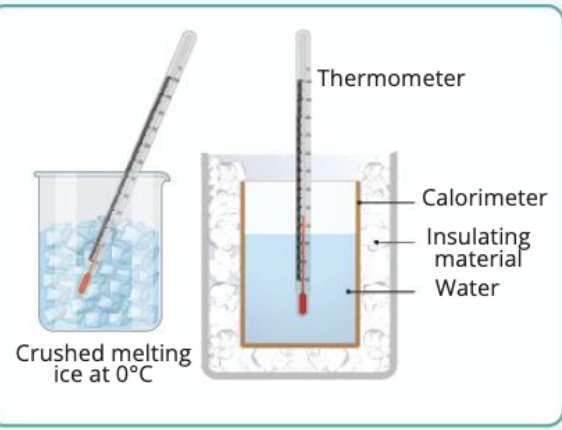
Method
The experimental procedure involves several careful steps to ensure accurate measurements:
First, crush the ice and place it in a beaker, leaving it for several minutes until it reaches a stable temperature of 0°C. Use a thermometer to confirm the ice temperature.
Next, find the mass of the empty calorimeter and record this value. Heat approximately 50 cm³ of water in a beaker using the Bunsen burner until it reaches about two-thirds full. Measure the combined mass of the calorimeter and warm water.
Place the calorimeter at room temperature, then add the thermometer to the calorimeter of hot water, ensuring it doesn't touch the sides occasionally to ensure even temperature distribution throughout the water.
Dry the crushed ice thoroughly using the cloth, then place the calorimeter within the container of insulating material. Measure the temperature of the water in the calorimeter.
Add pieces of the dried ice to the water one at a time, stirring gently with the thermometer until the ice completely melts. Continue adding small amounts of ice until the water temperature drops to approximately 5°C below room temperature.
Record the lowest temperature reached, then find the combined mass of the calorimeter, water, and melted ice.
Important
The final temperature should not fall more than 5°C below room temperature to minimise heat transfer errors with the surroundings. If the temperature drops too low, water vapour from the air may condense and affect your measurements.
Measurements and calculations
The experimental data should be recorded systematically in a table format:
| Variable | Symbol | Value |
|---|---|---|
| Mass of empty calorimeter | = | |
| Mass of calorimeter and warm water | = | |
| Mass of calorimeter, water and melted ice | = | |
| Mass of water | = | |
| Mass of melted ice | = | |
| Temperature of water and calorimeter before ice is added | = | |
| Final temperature of calorimeter, water and melted ice | = | |
| Fall in temperature |
Example
Worked Example: Calculating Latent Heat of Fusion
The calculation uses the principle that heat lost equals heat gained.
Step 1: Identify the energy transfers
- Heat lost by water =
- Heat lost by calorimeter =
- Heat gained by ice = Heat to melt ice + Heat to warm melted ice
- Heat gained by ice =
Step 2: Apply conservation of energy Heat lost by water and calorimeter = Heat gained by ice
Step 3: Solve for
This can be simplified to:
Experiment 14.2(B): Determining latent heat of vaporisation
Theory and principle
The latent heat of vaporisation represents the energy required to convert one kilogramme of water at 100°C to steam at 100°C. This experiment involves passing steam at 100°C into cold water within a calorimeter. The steam condenses, releasing its latent heat energy, which increases the temperature of the cold water. By measuring the temperature rise and the mass of steam condensed, we can calculate the latent heat of vaporisation.
Note
Steam at 100°C contains much more energy than water at 100°C due to the latent heat energy stored within it. When steam condenses back to water, this energy is released, which is why steam burns are much more severe than burns from boiling water.
Equipment required
This experiment requires more complex apparatus due to the steam generation:
- Round-bottomed flask with stopper and glass tubing
- Two retort stands and two clamps
- Steam trap (if available)
- Copper calorimeter with stirrer and insulating lid
- Insulating material
- Container to hold the calorimeter
- Thermometer
- Hotplate for heating
Important
SAFETY WARNING! The steam emerging from the delivery tube is extremely hot and will scald you. Exercise extreme caution to avoid contact with the steam or anywhere near it. Always wear safety equipment and ensure proper ventilation.
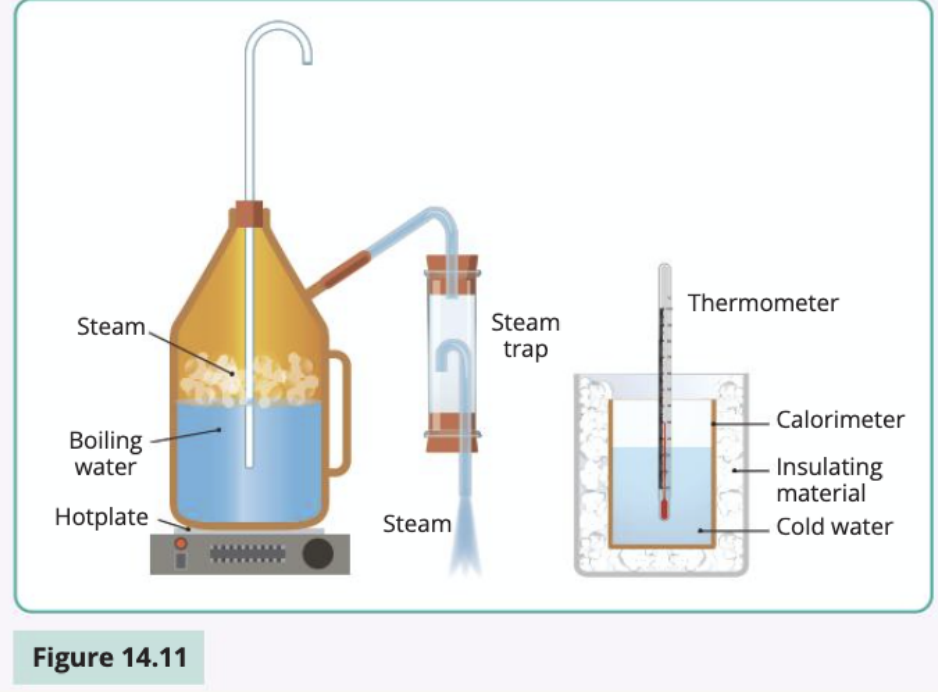
Method
Begin by finding the mass of the empty calorimeter. Place about 100-150 cm³ of water at approximately 5°C below room temperature in the calorimeter. Find the mass of the calorimeter and cold water.
Set up the round-bottomed flask as shown in the diagram. Connect the steam trap to fill the flask about one-third full with water and heat using the hotplate. Adjust the hotplate setting so steam emerges from the trap at a steady rate.
Note the temperature of the cold water in the calorimeter. Dry the exit tube from the steam trap with a cloth and place it deep into the cold water.
Allow steam to bubble through the water until the temperature rises by about 12°C as shown on the thermometer. Turn off the hotplate and immediately remove the delivery tube from the calorimeter.
Stir the water in the calorimeter with the thermometer, then record the highest temperature reached. Find the combined mass of the calorimeter, water, and condensed steam. By subtraction, determine the mass of the condensed steam.
Note
The steam trap is essential for this experiment as it ensures that only steam (not water droplets) enters the calorimeter. Water droplets would not have undergone the phase change and would affect the accuracy of the latent heat calculation.
Measurements and calculations
The experimental data should be recorded systematically:
| Variable | Symbol | Value |
|---|---|---|
| Mass of empty calorimeter | = | |
| Mass of calorimeter and cold water | = | |
| Mass of cold water | = | |
| Temperature of cold water | = | |
| Final temperature of water and calorimeter | = | |
| Mass of calorimeter, water and steam | = | |
| Mass of condensed steam | = |
Example
Worked Example: Calculating Latent Heat of Vaporisation
Step 1: Identify the energy transfers
- Heat gained by cold water =
- Heat gained by calorimeter =
- Heat lost by steam = Heat from condensation + Heat from cooling condensed water
- Heat lost by steam =
Step 2: Apply conservation of energy Heat gained by water and calorimeter = Heat lost by steam
Step 3: Solve for
Sources of error
Both experiments can be affected by several sources of error that reduce accuracy:
Systematic errors
Heat loss to surroundings occurs when the calorimeter and water temperatures exceed room temperature. This can be minimised through:
- Insulating the calorimeter to reduce conduction losses
- Polishing the calorimeter to reduce radiation losses
- Placing a lid on the calorimeter to reduce convection and conduction losses
Temperature-related errors
The calorimeter should not be allowed to reach temperatures more than 5°C below room temperature. If temperatures get too extreme, water vapour may condense, affecting final measurements.
For accurate temperature measurement, use a sensitive thermometer reading to 0.1°C intervals. The thermometer should have a small heat capacity to minimise heat absorption from the system.
Important
Common mistakes that introduce significant errors include:
- Not allowing ice to reach 0°C before use
- Failing to dry ice thoroughly before adding to calorimeter
- Using a thermometer with too large a heat capacity
- Inadequate stirring leading to non-uniform temperatures
- Allowing excessive heat loss to surroundings
Procedural considerations
Ice must be crushed to ensure it's at the same temperature throughout and to allow it to reach 0°C before use. The ice should also be dried before adding to remove surface water that hasn't undergone the phase change.
In the steam experiment, pre-cooling water allows a greater mass of steam to condense, reducing measurement errors in the mass determination.
The steam trap ensures only steam (not water) enters the calorimeter, preventing contamination that would affect heat transfer calculations.
Water in the calorimeter must be stirred continuously during experiments to ensure uniform temperature distribution and accurate temperature readings.
Summary
Key Points to Remember:
-
Latent heat of fusion is the energy needed to melt ice at 0°C, while latent heat of vaporisation is the energy needed to convert water to steam at 100°C
-
Both experiments use calorimetry principles - measuring temperature changes to calculate energy transfers during phase changes
-
Heat always flows from hot to cold - in the ice experiment from warm water to ice, in the steam experiment from hot steam to cold water
-
Minimising heat loss is crucial for accurate results - use insulation, appropriate temperature ranges, and sensitive thermometers
-
Safety is paramount when working with steam - always exercise extreme caution around hot steam and boiling water to prevent serious burns