3.2 – Measuring the Critical Angle and Refractive Index (Leaving Cert Physics): Revision Notes
📚Revision Notes
3.2 – Measuring the Critical Angle and Refractive Index
Introduction
This experiment allows you to measure the critical angle of a transparent material (such as glass) and verify the important relationship between critical angle and refractive index. The critical angle is a fundamental concept in optics that occurs when light travels from a denser medium to a less dense medium and marks the beginning of total internal reflexion.
Note
The critical angle is a unique property of each material and forms the basis for many optical technologies, including fibre optic cables and prisms used in optical instruments.
Aims of the experiment
Important
Experimental Objectives:
This practical investigation has two main objectives:
- To measure the critical angle (C) for a transparent material like glass
- To confirm the relationship between refractive index and critical angle, specifically that n = 1/sin C
Theory behind the experiment
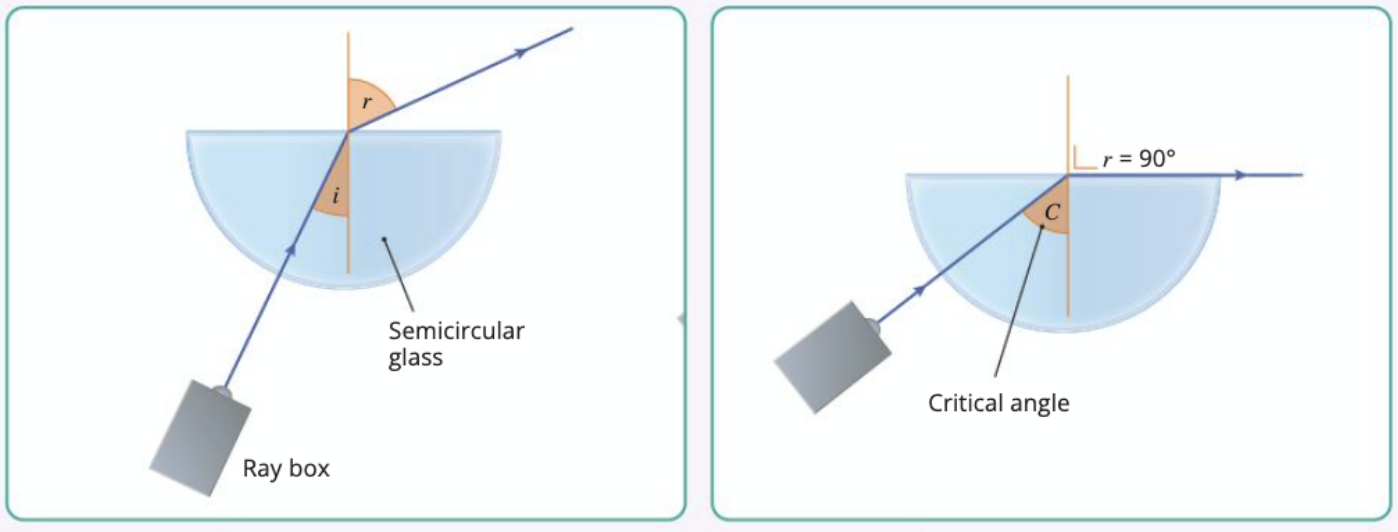
When light travels from a denser medium (like glass) into a less dense medium (like air), it bends away from the normal. As you increase the angle of incidence, the refracted ray eventually emerges at 90° to the normal - this specific angle of incidence is called the critical angle.
The refractive index of a material is related to its critical angle by the formula:
Where:
- n = refractive index of the material
- C = critical angle in degrees
Note
This relationship shows that materials with higher refractive indices will have smaller critical angles. This inverse relationship is fundamental to understanding how different materials behave optically.
Equipment required
Note
Required Materials:
For this experiment, you will need:
- Ray box - to produce a narrow beam of light
- Semicircular glass block - the transparent material being tested
- Sheet of paper - for drawing and marking
- Pencil - finely sharpened for accurate marking
- Protractor - for measuring angles precisely
- Ruler - for drawing straight lines
Experimental method
Setup and preparation
Begin by placing the semicircular glass block on a sheet of paper and carefully draw around its outline with a finely sharpened pencil. Mark the centre of the straight edge of the block clearly on the paper, as this will be your reference point for measuring angles.
Example
Setup Procedure:
Step 1: Place the semicircular glass block flat-side down on white paper
Step 2: Use a sharp pencil to trace around the curved edge accurately
Step 3: Mark the exact centre point of the straight edge
Step 4: Draw a normal line perpendicular to the straight edge at this centre point
Finding the critical angle
Start by shining a ray of light from the ray box towards the centre of the straight edge, beginning with a small angle of incidence. At this stage, you should observe both reflexion and refraction occurring - the light ray will split, with some light reflecting back into the glass and some emerging into the air.
Gradually increase the angle of incidence by slowly rotating either the ray box or adjusting the position of the light beam. Continue this process carefully, watching the refracted ray closely. You'll notice that as the angle of incidence increases, the refracted ray bends further away from the normal.
Identifying the critical point
Keep increasing the angle until you reach a crucial point where the refracted ray emerges parallel to the glass surface (at 90° to the normal). This is your critical angle. At this point, mark where the incident ray enters the glass block - this shows you the exact angle at which total internal reflexion begins.
Recording measurements
Remove the ray box and glass block from the paper, leaving your marked points. Using a ruler, draw the path of the incident ray that produced the critical angle. With a protractor, measure the angle between this incident ray and the normal line. This measurement is your critical angle C.
Calculating refractive index
Use the critical angle measurement to calculate the refractive index using the formula:
Example
Sample Calculation:
If your measured critical angle is C = 42°:
Step 1: Find sin(42°) = 0.669
Step 2: Calculate n = 1/sin(42°) = 1/0.669 = 1.49
Step 3: Compare with known refractive index of glass (typically ~1.5)
Improving accuracy
Repeat the entire experiment three or four times to improve the reliability of your results. Calculate the average value of your critical angle measurements, then use this average to determine the refractive index of the glass.
Sources of error and how to avoid them
Several factors can affect the accuracy of your measurements:
Important
Positioning Errors
Problem: Moving the glass block accidentally after marking its outline can lead to misaligned measurements.
Solution: Make sure the glass block remains fixed in position once you've drawn its outline and marked its centre.
Important
Drawing and Measurement Precision
Problem: Using thick lines or blunt pencils reduces measurement accuracy.
Solution: Always use a ruler for straight lines and ensure your pencil is finely sharpened for precise marking.
Important
Parallax Error
Problem: Reading the protractor from an angle rather than directly above can give incorrect angle measurements.
Solution: Always read the protractor from directly above to avoid parallax errors. Position your eye perpendicular to the protractor scale.
Relationship between refractive index and critical angle
The experiment demonstrates that materials with higher refractive indices have smaller critical angles. This relationship is inverse - as the refractive index increases, the critical angle decreases. This makes physical sense because denser optical materials (higher n values) more readily undergo total internal reflexion.
Note
Understanding this relationship is crucial for many optical applications, from fibre optic cables to prisms and optical instruments. The ability to predict when total internal reflexion will occur allows engineers to design efficient light-guiding systems.
Remember!
Summary
Key Points to Remember:
- The critical angle is the angle of incidence at which the refracted ray emerges at 90° to the normal
- The relationship n = 1/sin C connects refractive index directly to critical angle
- Total internal reflexion occurs when the angle of incidence exceeds the critical angle
- Accurate measurements require careful setup, precise drawing, and avoiding parallax errors when reading the protractor
- Higher refractive index materials have smaller critical angles - this inverse relationship is fundamental to optical design