8.2 – Investigating Conservation of Momentum (Leaving Cert Physics): Revision Notes
📚Revision Notes
8.2 – Investigating Conservation of Momentum
Introduction and aim
This experiment investigates one of the most fundamental principles in physics - the conservation of momentum. You will measure the velocity of a trolley before and after it collides with another trolley, then calculate the momentum values to verify that the total momentum remains constant during the collision.
The principle states that in any collision where no external forces act on the system, the total momentum before the collision equals the total momentum after the collision.
Note
This experiment demonstrates a perfect example of how theoretical physics principles can be observed and measured in practice. Understanding momentum conservation is essential for analysing all types of collisions, from car crashes to atomic particle interactions.
Equipment required
To carry out this investigation, you will need:
- A runway with two trolleys of known masses (e.g. 250g, 500g, and 1000g)
- A ticker timer with ticker tape and power supply
- Two magnets that can be mounted on the fronts of the trolleys
- A box for safe trolley collection
- A balance for measuring masses accurately
Important
Safety Warning: Place a box containing a cushion or crumpled paper on the floor by the bench under the end of the runway so that if the trolleys fall, they cannot land on your feet.
Experimental method
Follow these steps carefully to ensure accurate results:
Setup procedure
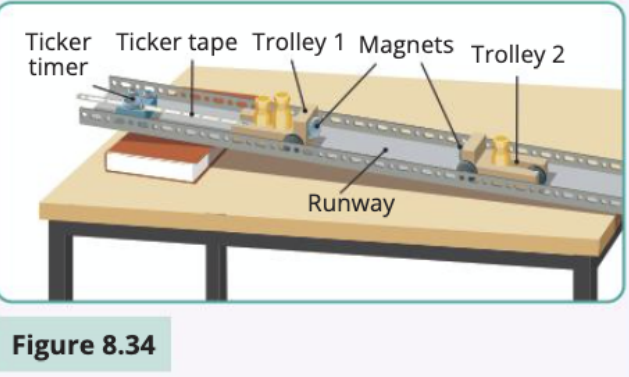
- Use the equipment as shown in the diagram above
- Raise one end of the runway so that trolley 1 (with ticker tape attached) will move down the runway at constant speed when given a gentle push and released
- Place trolley 1 at the upper end of the runway and trolley 2 about halfway down
- Turn on the ticker timer and give trolley 1 a gentle push so it moves down the runway and collides with trolley 2
Data collection
- Stop the timer at the end of the runway and remove the ticker tape
- The tape should show dots before the collision and dots after the collision, similar to the pattern shown below:
Velocity before ••••••••••• Velocity after
- Repeat the experiment with different masses on each trolley and with the trolleys travelling at different speeds
- Record all results in a data table
Note
The spacing between dots on the ticker tape is directly proportional to velocity - wider spacing indicates higher speed, while closer dots show slower movement. This visual representation makes it easy to identify when the collision occurred.
Measurements and calculations
- Calculate the velocity of trolley 1 before (u) and after (v) the collision using the ticker tape method
- Use a balance to find the mass of trolley 1 (m₁) and trolley 2 (m₂)
- Calculate the momentum before the collision (m₁u) and the momentum after the collision ((m₁ + m₂)v)
Data collection and calculations
Use the following table structure to record your measurements:
| Before collision | After collision | ||||
|---|---|---|---|---|---|
| Velocity from ticker tape | Mass | Momentum | Velocity from ticker tape | Mass | Momentum |
| S₁ = number of spaces (n) in length S₁ | m₁ | m₁u | S₂ = number of spaces (n) in length S₂ | m₂ | (m₁ + m₂)v |
| u = S₁/(n/50) | v = S₂/(n/50) |
Key formulas
- Velocity calculation: and
- Momentum before collision:
- Momentum after collision:
Example
Worked Example: Calculating Momentum
Step 1: Measure from ticker tape
- Before collision: 10 spaces in 2cm, so u = 2cm ÷ (10/50) = 2 ÷ 0.2 = 10 cm/s
- After collision: 8 spaces in 1.2cm, so v = 1.2cm ÷ (8/50) = 1.2 ÷ 0.16 = 7.5 cm/s
Step 2: Use measured masses
- m₁ = 250g, m₂ = 500g
Step 3: Calculate momentum
- Before: p = 250g × 10 cm/s = 2500 g⋅cm/s
- After: p = (250g + 500g) × 7.5 cm/s = 750g × 7.5 cm/s = 5625 g⋅cm/s
Note: In practice, these values should be equal within experimental error
Expected results
The momentum before the collision should equal the momentum after the collision:
This demonstrates the conservation of momentum principle - the total momentum of the system remains constant when no external forces act upon it.
Note
In real experiments, you may find small differences between the calculated values due to measurement errors and friction. The key is that the values should be very close to each other, demonstrating that momentum is conserved within experimental uncertainty.
Sources of error
To ensure accurate results, be aware of these potential sources of error:
Systematic errors
- Friction: Both air resistance and rolling friction can affect the trolleys, which is why you must ensure no net external force acts on the bodies
- Runway alignment: Ensure the trolleys can roll freely and the runway is properly levelled
- Measurement precision: Select as large a distance as possible when measuring velocities to improve accuracy
Random errors
- Ticker tape measurements: Avoid parallax errors when measuring distances on the tape
- Timing variations: Ensure consistent ticker timer frequency (50Hz)
- Mass measurements: Use an accurate balance and record masses precisely
Important
Common Mistake to Avoid: Do not assume that all the kinetic energy is conserved in this collision. This is an inelastic collision where the trolleys stick together after impact, so kinetic energy is not conserved - only momentum is conserved.
Important considerations
Understanding why certain aspects of this experiment work is crucial for accurate results.
Why use magnets?
If magnets are used in this experiment, the forces they exert do not change the total momentum of the system because they are internal forces - one magnet pulls on the other with equal and opposite force, so the net external force acting on the trolley system is zero.
Precautions for accurate results
- Lubricate trolley wheels if necessary to minimise friction
- Ensure the runway surface is clean and level
- Take multiple readings and calculate average values
- Use appropriate scales when measuring distances and masses
Note
The concept of internal versus external forces is fundamental to understanding momentum conservation. Internal forces (like the magnetic attraction between trolleys) occur within the system and cancel out according to Newton's third law. Only external forces (like friction with the runway) can change the total momentum of the system.
Remember!
Summary
Key Points to Remember:
-
Conservation of momentum: Total momentum before collision = Total momentum after collision (when no external forces act)
-
Momentum formula: Momentum = mass × velocity (p = mv)
-
Ticker tape analysis: Wider spacing between dots indicates higher velocity
-
Safety first: Always use protective barriers to catch falling trolleys
-
Accuracy matters: Minimise friction, measure carefully, and repeat experiments for reliable results