Basic Orienteering (Grade 10 NSC Matric Life Orientation): Revision Notes
📚Revision Notes
Basic Orienteering
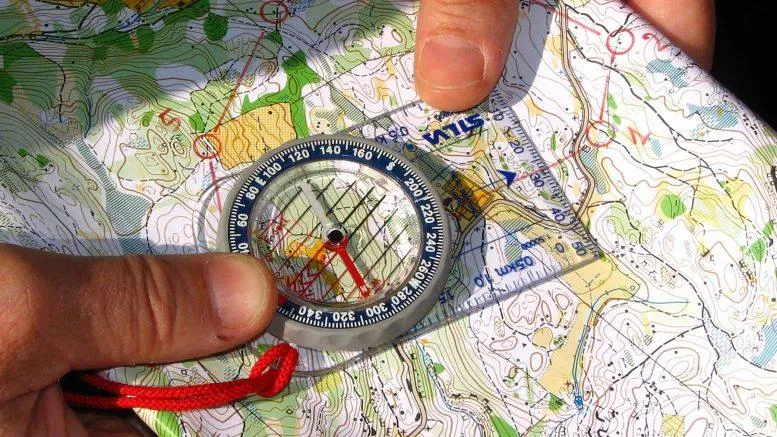
What is orienteering?
Orienteering is an exciting outdoor recreational sport that combines physical fitness with clever thinking and problem-solving skills. When you participate in orienteering, you need to complete several key tasks:
- Start at a designated point - This is your beginning location, marked clearly on your map
- Use a map to navigate - You'll rely on a special orienteering map to find your way around
- Find control points - These are specific stations you must reach to prove you've been there
- Plan your route strategically - You need to work out the fastest way to get to the end point
- Move between checkpoints - You can walk, jog, run or sprint depending on your fitness level and strategy
Note
Orienteering is unique because it challenges both your body and mind simultaneously. Unlike many sports that focus on just physical ability, orienteering requires you to make quick decisions about route planning while maintaining physical endurance.
Safety in orienteering
Safety should always be your top priority when orienteering. There are specific rules for different types of hazards you might encounter.
Water safety
Water can be particularly dangerous during orienteering activities. In South Africa, at least three people drown every single day in various water bodies including dams, rivers, pools, and stormwater drains. Learning proper water safety is a crucial survival skill.
Important
Essential water safety rules:
- Never jump into any river or dam without first checking how deep it is
- Never swim by yourself - always have someone with you
- Know how to recognise swimming signs - look for the symbols that show where swimming is permitted or prohibited
If you get caught in a strong current at sea:
- Stay calm and don't panic
- Swim parallel to the shore in a line, rather than fighting directly against the current
- As the current becomes weaker, you can then swim towards the shore
- If you try to swim straight to shore against a strong current, you'll become very tired
- If you're struggling, ride the waves, face the shore, wave your arms and shout for help
How to rescue someone in trouble in water:
- Use a stick with a long rope attached, which has a floating device on the end (like a tube or piece of foam)
- Throw the floating device to the person in trouble
- Lie flat on your stomach and pull the person to safety while they hold onto the floating device
General safety rules
Following these safety guidelines will help protect you during orienteering activities:
Important
Critical Safety Guidelines:
- Always travel in a group - Never go orienteering alone
- Inform an adult - Always tell a responsible adult where you're going and when you expect to return
- Follow the rules - Stick to orienteering regulations and guidelines
- Respect boundaries - Never enter areas marked as 'restricted' or 'out of bounds' - only follow marked routes
- Carry a whistle - This allows you to call for help if you're hurt, lost, or in danger
- Know emergency signals - The international distress signal is six long whistle blasts to show you need help, and the rescue reply is six short blows
Understanding orienteering
Types of orienteering
There are two main formats of orienteering competitions, each with different rules and strategies:
Example
Worked Example: Point-to-point orienteering
In this format:
- You must visit all control points within a set time limit (usually around three hours)
- The control points must be visited in a specific order as listed
- The person who completes all stations in the correct order in the fastest time wins
- This format tests your ability to follow precise routes efficiently
Example
Worked Example: Score-O orienteering
In this format:
- You have a fixed time limit, typically between 60-90 minutes
- You can visit as many control points as possible in any order you choose
- Different control points may have different point values
- The person who accumulates the most points within the time limit wins
- This format rewards strategic thinking about which controls to prioritise
Navigation skills
Using maps effectively
Orienteering maps are specially designed to show clear geographical features that help you navigate accurately.
Note
Key map symbols you need to know:
- The start point is shown by a triangle symbol
- The end point is marked with a double circle
- Contour lines show the shape and elevation of land features like hills, valleys, slopes and sand dunes
Understanding these symbols helps you interpret the terrain and plan the most efficient route between control points.
The thumbing technique
This navigation method is essential for staying oriented and moving efficiently. Here's how to thumb your map properly:
- Locate yourself - Find exactly where you are on the map
- Hold correctly - Keep your map in one hand with your thumb positioned close behind your current location, making sure it's not covered up
- Move your thumb - As you move forwards in real life, move your thumb along the map to match your progress
- Mark features - When you reach a feature on the ground that matches something on your map, move your thumb to mark your new position
- Use as reference - Keep your thumb on your map as an "I am here" marker throughout your journey
Note
This technique prevents you from getting lost and helps you move more quickly and confidently. The thumbing method is used by professional orienteers worldwide and is considered the foundation of good navigation.
Measuring distances
Working out how far you've travelled is an important skill for successful orienteering.
To measure distance accurately, you need to determine your pace length - this means the length of a single step you take. You can calculate this by:
- Counting your paces along a measured 100-metre course
- Using this information to estimate distances on your map
- Converting your pace count into kilometres to track your total distance covered
Example
Worked Example: Calculating Your Pace Length
Step 1: Walk along a measured 100m course, counting each step Let's say you count 120 steps for 100 metres
Step 2: Calculate your pace length Pace length =
Step 3: Use this to estimate distances If your map shows a 250m distance, you'll need approximately:
Adapted orienteering
Orienteering can be modified to include everyone and accommodate different abilities and needs:
Group variations:
- Work in teams to find control points together
- Set up relay races where each learner or group visits one control point before the next teammate can move
- Create different challenges at each control point, such as doing ten jumping jacks, arm pulls using a nearby tree, or a number of leaps across an obstacle
Inclusive adaptations:
- Use courses with markers that make noise (like stones in a tin) so that visually challenged learners can locate them
- Pair sighted and non-sighted learners to work together
- Set up wheelchair-accessible courses on level surfaces around school grounds
- Choose routes that accommodate different mobility levels
Location flexibility:
- School yard courses work well for beginners
- Small flat areas allow for controlled learning environments
- More challenging terrain can be introduced as skills develop
Note
Adapted orienteering ensures that everyone can participate regardless of physical ability or experience level. Many orienteering clubs actively promote inclusive practices and welcome participants of all abilities.
Orienteering in South Africa
South Africa has active orienteering communities that welcome new participants. If you're interested in getting more involved:
Finding local opportunities:
- Look for orienteering clubs in your area
- Team up with other schools to start a club together
- The South African Orienteering Federation provides contact details for clubs nationwide
- You can also connect with the South African Scouts Association, which often includes orienteering activities
These organisations can help you develop your skills further and participate in competitive events across the country.
Summary
Key Points to Remember:
- Safety first - Always orienteer in groups, tell adults where you're going, and follow water safety rules carefully
- Master the basics - Learn to read maps properly, use the thumbing technique, and measure your pace length
- Understand the formats - Point-to-point orienteering requires visiting controls in order, while Score-O lets you choose your own route strategy
- Practice navigation - The more you use maps and practise finding control points, the better you'll become at route planning
- Make it inclusive - Orienteering can be adapted for different abilities, making it a sport everyone can enjoy and benefit from