Optical Isomerism (AQA A-Level Chemistry): Revision Notes
📚Revision Notes
7.1.1 Optical Isomerism
Introduction to Isomerism
Note
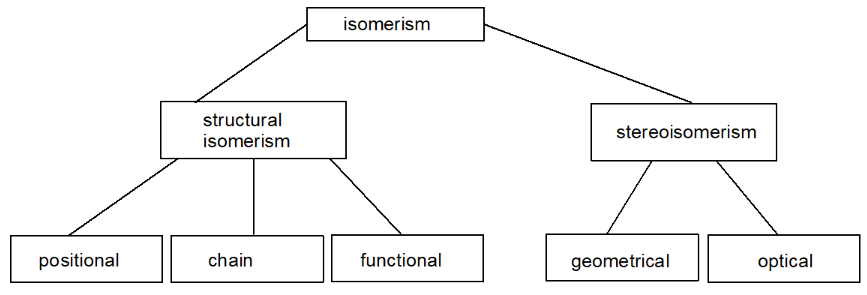
Isomerism occurs when compounds have the same molecular formula but different structures. There are two main types:
- Structural isomerism: Isomers differ in the connectivity of atoms. It includes positional, chain, and functional isomers.
- Stereoisomerism: Isomers differ in the spatial arrangement of atoms. It includes geometrical (cis-trans) and optical isomers. Structural isomerism can be classified into three types: positional isomerism, chain isomerism, and functional isomerism.
Stereoisomerism is divided into two types: geometrical isomerism and optical isomerism.
The diagram below provides a summary of the different types of isomerism:
Optical Isomerism Overview
Optical isomers are molecules that exist as non-superimposable mirror images and are not identical to one another.
-
Optical isomerism is a form of stereoisomerism that arises due to chirality. This type of isomerism occurs in molecules with a chiral carbon, also called an asymmetric carbon, which is a carbon atom bonded to four distinct functional groups.
-
Chirality occurs in molecules that have a chiral centre, typically a carbon atom bonded to four different groups.
-
Molecules with a single chiral centre will exist as optical isomers or enantiomers.
-
Enantiomers are non-superimposable mirror images of each other. They differ in their interaction with plane-polarised light but are chemically and physically identical in all other aspects.
Chirality and the Asymmetric Carbon
- A chiral centre is typically a carbon atom attached to four different groups. This makes the molecule asymmetric and unable to be superimposed on its mirror image.
- For example, consider a molecule with the following groups attached to carbon: W | X - C - Y | Z
Here, if W, X, Y, Z are all different, the carbon atom is chiral.
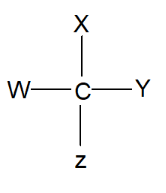
The two mirror-image forms of this molecule cannot be made to overlap perfectly, no matter how you rotate them. This property is what gives rise to optical isomerism.
Enantiomers and Plane-Polarised Light
Enantiomers rotate plane-polarised light in different directions:
- One enantiomer will rotate light in a clockwise direction, called dextrorotatory (denoted as (+)-isomer).
- The other enantiomer will rotate light in a counterclockwise direction, called laevorotatory (denoted as (-)-isomer).
- A polarimeter is used to measure the direction and degree of light rotation caused by a sample of an enantiomer.
Identifying and Drawing Enantiomers
To draw enantiomers:
- Identify the chiral centre.
- Arrange the four different groups around the chiral centre in a tetrahedral geometry.
- Draw a mirror image of this structure to represent the second enantiomer. Here's an example for 2-chlorobutane:
- One enantiomer will have a particular orientation of groups (e.g., Chlorine pointing upward).
- The mirror image will have chlorine pointing downward, with all other groups reversed.
Optical Activity in 2-Chlorobutane
Among the isomers of , 2-chlorobutane exhibits optical isomerism because it contains a chiral centre (the second carbon in the chain is attached to four distinct groups: ,, , and ).
The Importance of Optical Isomerism in Biochemistry
- Enzymes, drugs, and other biological molecules are often chiral and stereospecific.
- In many cases, only one enantiomer of a chiral molecule will be biologically active or will interact correctly with a target molecule in the body.
Note
Example:
- Thalidomide: One enantiomer was effective as a sedative, while the other caused birth defects. This highlights the biological significance of optical isomers, where different enantiomers can have very different effects.
Optical Activity
Optical isomers have the same chemical and physical properties as each other, except for their effect on plane polarised light.
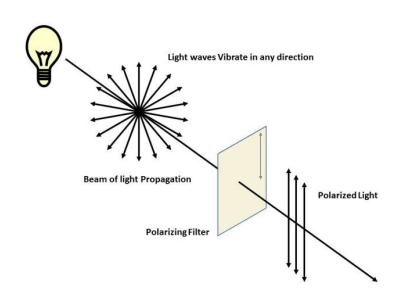
A light beam consists of waves that vibrate in all planes. Some substances have the ability to remove all the light waves except those vibrating in a certain plane - producing plane polarised light.
Plane polarised light: light in which all the waves vibrate in the same plane. This diagram shows you how:
Optical isomers can rotate plane polarised light. They are described, therefore, as being optically active. The 2 enantiomers of an optically active molecule will rotate the plane polarised light in opposite directions.One enantiomer rotates it in a clockwise direction, and the other rotates in an anticlockwise direction.