Racemic Mixtures (AQA A-Level Chemistry): Revision Notes
📚Revision Notes
7.1.3 Racemic Mixtures
Note
A common exam question involves racemic mixtures, so make sure to revise them!
These occur when a molecule contains a chiral centre, yet the mixture is optically inactive, which may seem contradictory to what we've just discussed about chirality and optical activity! A racemic mixture contains equal amounts of both enantiomers (50:50 mixture)
Since a racemic mixture contains equal amounts of both enantiomers, their optical activities cancel each other out. For instance, one enantiomer may rotate plane-polarised light by +10 degrees, while the other enantiomer rotates it by -10 degrees. The net result is 0 degrees, making it appear as if the substance is optically inactive or lacks a chiral centre.
You may be wondering why this happens, and it's a common exam question. The explanation lies in the way these molecules are formed.
Racemic mixtures are typically produced through:
- Nucleophilic addition to ketones or aldehydes
- Reactions involving a carbocation intermediate
Below is an example of nucleophilic attack on a carbonyl group, a reaction that often results in the formation of a racemic mixture.
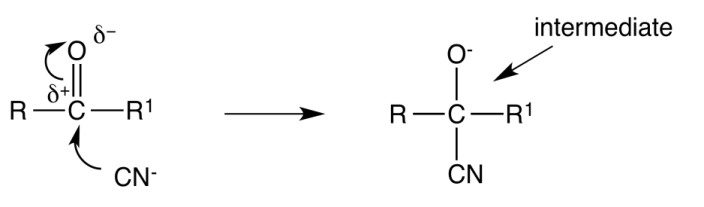
The crucial concept to understand is that the carbonyl group is planar (flat). Because of this, the nucleophile can attack the carbonyl carbon from either the top or the bottom of the plane. This leads to the production of two enantiomers.
The only way to distinguish between optical isomers is through their optical activity. However, a racemic mixture contains a 50:50 ratio of both enantiomers, meaning their opposite optical effects cancel each other out, making the mixture optically inactive.
Since the nucleophile has an equal probability of attacking from above or below the plane, a 50:50 mix of enantiomers is formed in the reaction, resulting in the racemic mixture.
Racemates in Pharmaceuticals
In drug manufacture, it is sometimes difficult or expensive to produce a single enantiomer. As a result, racemic mixtures may be used. However, if only one enantiomer is effective, the racemate might be optically inactive and may reduce drug efficacy or cause unwanted side effects.