DNA (AQA A-Level Chemistry): Revision Notes
📚Revision Notes
7.7.4 DNA
Overview of DNA Structure
DNA (deoxyribonucleic acid) is a long polymer made up of smaller units called nucleotides. DNA stores genetic information and plays a fundamental role in all cellular processes, determining the characteristics and functioning of living organisms.
Structure of Nucleotides
- A nucleotide is made up from:
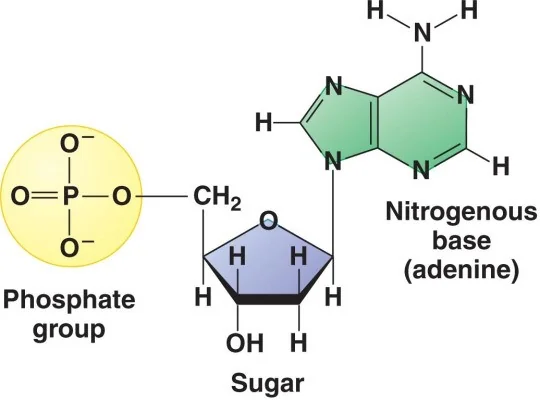
- A phosphate ion bonded to... • 2-deoxyribose which is in turn bonded to... • One of the 4 bases adenine, cytosine, guanine, or thymine. Each nucleotide consists of three key components:
- Phosphate Ion: A negatively charged group that contributes to the overall structure and backbone of DNA.
- 2-Deoxyribose: A five-carbon pentose sugar that lacks an oxygen atom at the second carbon (hence "deoxy").
- Nitrogenous Base: A molecule that varies among four possible bases:
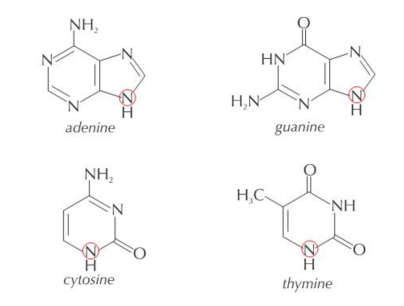
- Adenine (A) and Guanine (G) are purine bases (double-ring structures).
- Cytosine (C) and Thymine (T) are pyrimidine bases (single-ring structures). The specific combination of one phosphate group, one deoxyribose sugar, and one nitrogenous base forms a single nucleotide, the fundamental unit of DNA.
Below are the structures of A, C, G, and T - the circled nitrogen's are the atoms that bond w/ the 2-deoxyribose molecule.
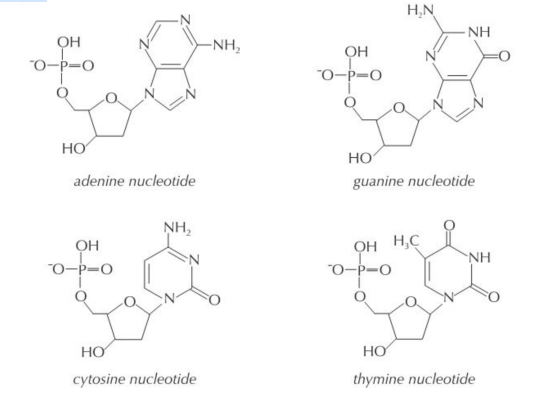
You can use the above knowledge and the structures in the data book to work out the structures of the 4 nucleotides in DNA. They are:
Polynucleotides
- A single strand of DNA is a polymer of nucleotides (a polynucleotide)
- These are linked by covalent bonds between the phosphate group of one nucleotide and the 2-deoxyribose of another nucleotide.
- This results in a sugar-phosphate-sugar-phosphate polymer chain with bases attached to the sugars in the chain.
- The covalent bonds between the phosphate groups and 2-deoxyribose sugars are called phosphodiester bonds.
- The sugar-phosphate backbone of DNA is formed by condensation polymerisation - a molecule of water is lost and a covalent (phosphodiester) bond is formed. - There are still groups at either ends of the chain, so further links can be made. - This allows the nucleotide to form a polymer made up of an alternating sugar-phosphate-sugar-phosphate chain:
Formation of DNA Polymers
DNA is a polynucleotide formed through the polymerization of nucleotides by condensation reactions. In this reaction:
- The -OH group on the phosphate of one nucleotide reacts with the group on the 3' carbon of the deoxyribose of another nucleotide.
- This reaction eliminates a water molecule (), forming a phosphodiester bond between the phosphate of one nucleotide and the sugar of the next. As more nucleotides join in this way, a long sugar-phosphate backbone is created, with nitrogenous bases attached to each sugar along the backbone. This structure results in a single strand of DNA.
Structure of the DNA Double Helix
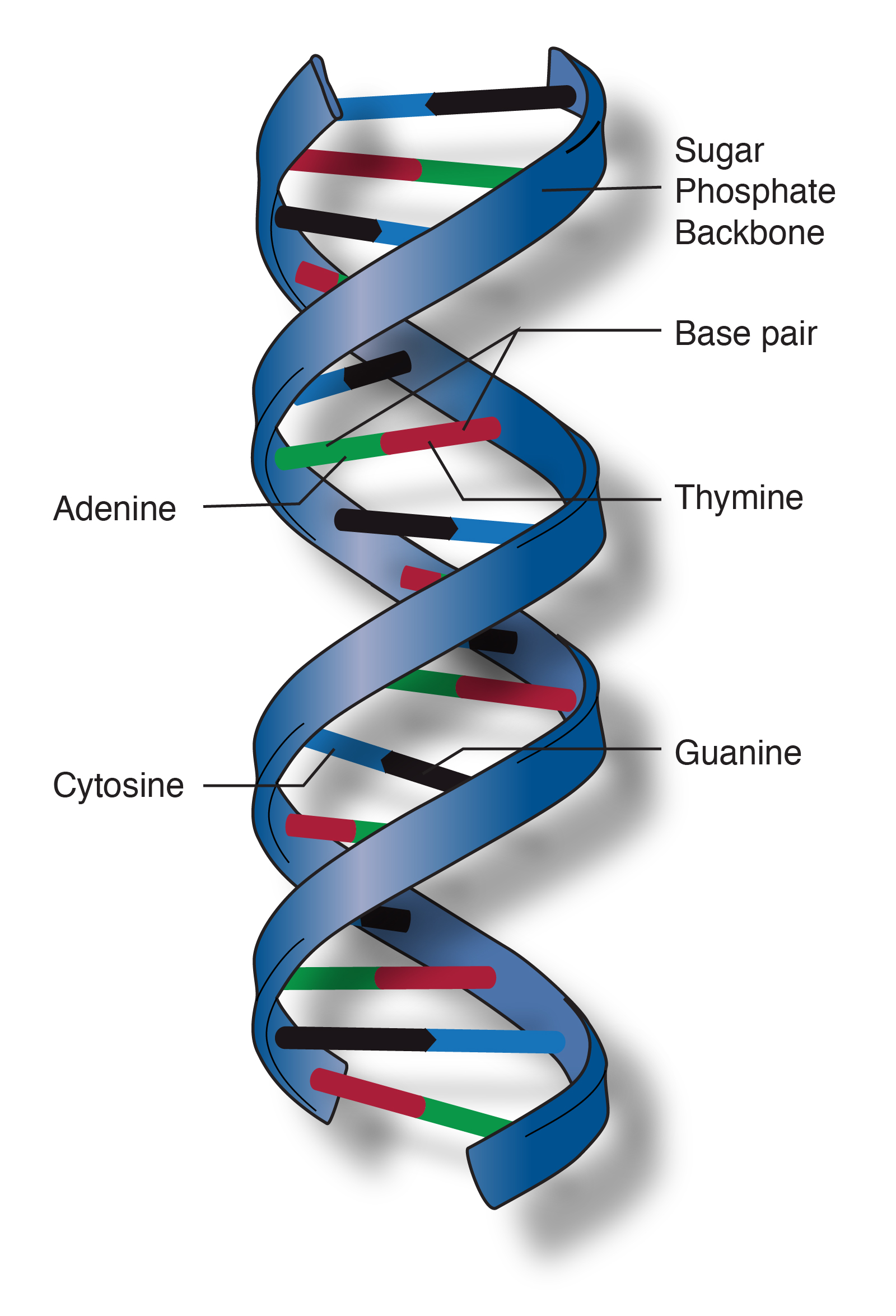
- DNA (deoxyribonucleic acid) carries your genetic code in chemical form. It is a double-stranded polymer. The monomers are nucleotides, these exists as 2 complementary strands arranged in the form of a double helix. DNA exists in cells as two complementary strands that twist around each other to form a double helix. Key aspects of this structure include:
-
Antiparallel Orientation: The two DNA strands run in opposite directions (antiparallel), meaning one strand runs in a 5' to 3' direction, and the other runs 3' to 5'.
-
Base Pairing and Hydrogen Bonding:
- The two strands are held together by hydrogen bonds between the nitrogenous bases.
- Complementary Base Pairing: The bases always pair in a specific way, with purines bonding to pyrimidines:
- Adenine (A) pairs with Thymine (T) via two hydrogen bonds.
- Guanine (G) pairs with Cytosine (C) via three hydrogen bonds. This pairing ensures that the strands align properly, with a constant distance between the two backbones.
-
Double Helix Formation: The hydrogen-bonded strands twist into a right-handed helical structure known as a double helix, creating a stable, compact structure that protects the genetic information within the bases.
-
Complementary Strand Replication: During DNA replication, the hydrogen bonds between bases can easily be broken, allowing the two strands to separate. Free nucleotides within the cell can then pair with the exposed bases on each strand, forming new DNA molecules.
Note
Exam Concepts and Student Skills:
-
Phosphate, 2-Deoxyribose, and Base Structures: Students should recognise the structures of the phosphate ion, 2-deoxyribose (pentose sugar), and each of the four nitrogenous bases as shown in the AQA Chemistry Data Booklet.
-
Polymerization of Nucleotides: Understand the formation of phosphodiester bonds through condensation reactions, which links nucleotides into a continuous sugar-phosphate backbone with bases attached to the sugars.
-
Complementary Base Pairing and Hydrogen Bonding: Explain how specific hydrogen bonding between complementary base pairs (A-T and G-C) stabilises the double helix structure of DNA.