Health & disease (Edexcel GCSE Biology): Revision Notes
📚Revision Notes
Health & disease
Health: 'state of complete physical, mental and social well-being, and not merely the absence of disease or infirmity'
This means that even if someone is physically fit they still may be unhealthy (eg. with mental health issues) as defined by the World Health Organisation (WHO)
Disease - A condition where part of an organism doesn't function properly If you are affected by disease it could make you more susceptible to others (your body may be weakened by the disease so it is less able to fight others off)
| Communicable disease | Uncommunicable disease |
|---|---|
| Diseases can be spread between individuals | Cant be spread between individuals (genetics etc) eg. Cancer & Heart Cancer |
Why the Presence of One Disease Can Lead to a Higher Susceptibility to Other Diseases
Weakened Immune System:
-
When a person is suffering from one disease, the immune system is often focused on fighting off the infection or illness.
-
This means the body's defence mechanisms (like white blood cells) are diverted or weakened, making it easier for other pathogens (e.g., bacteria, viruses) to invade and cause additional diseases.
-
Example: People with HIV/AIDS have weakened immune systems, making them more susceptible to infections like tuberculosis. Damage to Body Systems:
-
Certain diseases can damage key systems in the body, making it easier for other diseases to take hold.
-
For example, a disease like influenza can damage the respiratory system, increasing the risk of developing secondary bacterial infections like pneumonia. Malnutrition and Disease:
-
Some diseases can lead to malnutrition or other deficiencies in the body, weakening overall health.
-
Malnutrition makes the body more vulnerable to other diseases because the immune system lacks the nutrients needed to function properly.
-
For example, people suffering from prolonged illness (like cancer) may experience weight loss and malnutrition, making them more susceptible to infections. Chronic Illness and Opportunistic Infections:
-
Chronic diseases, such as diabetes, can weaken the body's immune system over time, making it easier for other diseases to invade.
-
In diabetes, high blood sugar levels can impair the immune system, increasing the risk of infections like skin infections and urinary tract infections (UTIs). Compromised Barriers to Infection:
-
Some diseases, like those that affect the skin (e.g., eczema or burns), can compromise the body's physical barriers to infection.
-
Once the skin barrier is weakened or broken, other pathogens can easily enter the body, leading to new infections.
Disease-Related Inflammation:
- Inflammation caused by certain diseases can make the body more susceptible to further infections.
- For instance, lung inflammation due to conditions like asthma can make a person more likely to contract respiratory infections such as bronchitis.
Pathogens
Note
Definition of Pathogen:
- A pathogen is a microorganism that causes disease.
- Pathogens can infect plants and animals, including humans.
- The four main types of pathogens are viruses, bacteria, fungi, and protists.
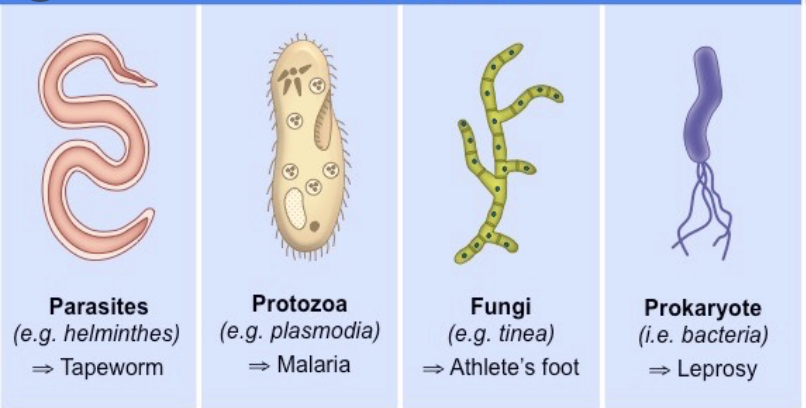
Types of Pathogens
Viruses:
Description: Viruses are tiny, non-living particles that can only reproduce inside a host cell.
How They Cause Disease: Viruses infect host cells and take control of the cell's machinery to replicate themselves, often killing the host cell in the process.
Examples:
- HIV (causes AIDS)
- Influenza virus (causes the flu)
- Coronavirus (causes COVID-19)
Bacteria:
Description: Bacteria are single-celled, living microorganisms. They are much larger than viruses but still microscopic.
- How They Cause Disease: Some bacteria release toxins that damage tissues or interfere with normal body functions.
- Examples:
- Salmonella (causes food poisoning)
- Mycobacterium tuberculosis (causes tuberculosis)
- Streptococcus (causes sore throat infections)
Fungi:
Description: Fungi can be single-celled or multicellular organisms. They can spread through spores and thrive in warm, damp environments.
How They Cause Disease: Fungi often infect the skin, lungs, or other surfaces of the body. They can break down tissues or trigger allergic reactions.
Examples:
- Athlete's foot (a fungal infection of the skin)
- Ringworm (a fungal infection of the skin and scalp)
- Candida (causes thrush)
Protists:
Description: Protists are single-celled organisms, larger than bacteria, and often found in water or as parasites.
How They Cause Disease: Some protists are parasites that live in or on a host organism and cause harm by taking nutrients or damaging cells.
Examples:
- Plasmodium (causes malaria)
- Amoeba (can cause amoebic dysentery)
Common Infections
| Disease | Pathogen | Symptoms/Effects | How it spreads | How to reduce/prevent transmission |
|---|---|---|---|---|
| Cholera | A bacterium called Vibrio cholerae | Diarrhoea | Via contaminated water sources | Making sure that people have access to clean water supplies |
| Tuberculosis | A bacterium called Mycobacterium tuberculosis | Coughing and lung damage | Through the air when infected individuals cough | Infected people should avoid crowded public spaces, practise good hygiene and sleep alone. Their homes should also be well-ventilated |
| Malaria | A protist | Damage to red blood cells and, in severe cases, to the liver | Mosquitoes act as animal vectors (carriers) — they pass on the protist to humans but don't get the disease themselves | Use of mosquito nets and insect repellent to prevent mosquitoes carrying the pathogen from biting people |
| Stomach ulcers | A bacterium called Helicobacter pylori | Stomach pain, nausea and vomiting | Oral transmission, e.g. swallowing contaminated water or food | Having clean water supplies and hygienic living conditions |
| Ebola | Ebola virus. | Haemorrhagic fever (a fever with bleeding) | Via bodily fluids | By isolating infected individuals and sterilising any areas where the virus may be present |
| Chalara ash dieback | A fungus that infects ash trees | Leaf loss and bark lesions (wounds) | Carried through the air by the wind. (It also spreads when diseased ash trees are moved between areas.) | Removing young, infected ash trees and replanting with different species. Restricting the import or movement of ash trees |