Discovery of the atom (Edexcel GCSE Physics): Revision Notes
📚Revision Notes
Discovery of the atom
Developing the Model of the Atom
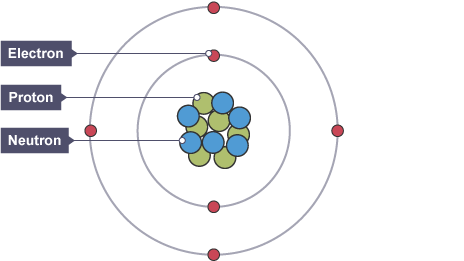
Historical Development
- Greeks:
- Atoms are tiny spheres which cannot be divided.
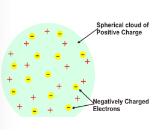
- Thomson's Plum Pudding Model:
- An atom is a ball of positive charge with negative electrons embedded in it.
1909 - Rutherford's Alpha Scattering Experiment
- Fired a beam of alpha particles (positively charged) at a thin sheet of gold foil.
- Most particles went straight through → Atom is mostly empty space.
- Some were deflected → The Centre of the atom must have a positive charge, repelling particles that come close to it.
- Some bounced straight back → Mass is concentrated in the centre.
- This research led to the development of the first nuclear model.
Bohr's Model
- Electrons orbit the nucleus at specific distances.
- Orbits are called energy levels or shells.
Updated Nuclear Model
- Positive Nucleus: Contains protons and neutrons.
- Electron Energy Levels: Electrons occupy energy levels or shells around the nucleus.
James Chadwick
- Proved the existence of the neutron which explained the imbalance between atomic and mass numbers.
Current Model of the Atom
- Nucleus: Contains protons and neutrons.
- Electrons: Occupy energy levels or shells around the nucleus.
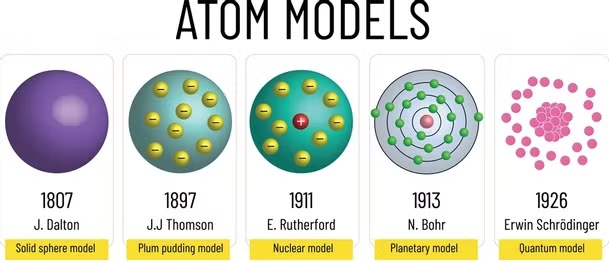
Summary of models


Jonny Dalton
1803
J.J Thomson
1897
E. Rutherford
1911



Believed matter was made from spheres
All matter is made from atoms which are indestructible & cant be broken
Plum pudding theory
Discovered atoms can be broken up as discovered electrons can be removed from atoms. Suggested atoms were spheres or positive charge with tiny electrons stuck in them
Atomic model
Discovered the model of the atom