Life Cycle of Stars (Edexcel GCSE Physics): Revision Notes
📚Revision Notes
Life Cycle of Stars
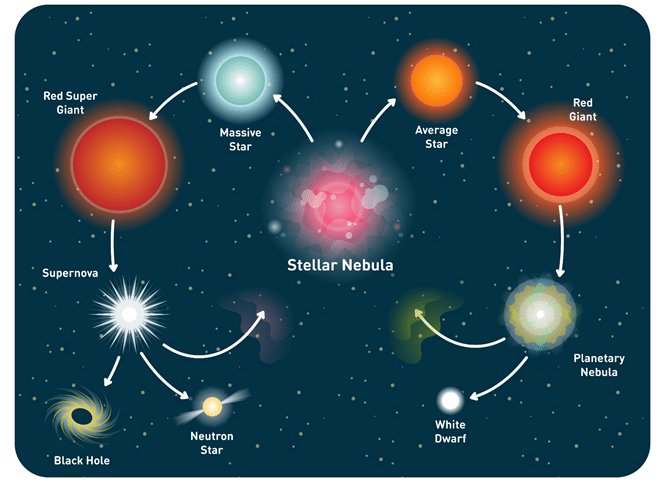
- Stars begin as a cloud of dust and gas, known as a nebula, which is primarily composed of hydrogen
- Gravity pulls the gas and dust together, forming a protostar. As the protostar grows, its gravity increases, drawing in more material and increasing its density and temperature.
- Once the core becomes hot enough, hydrogen nuclei start fusing into helium, releasing energy. This process, known as nuclear fusion, releases large amounts of energy.
- The star enters a long, stable period where the outward pressure from thermal expansion (caused by energy from nuclear fusion) balances the inward force of gravity. During this stable phase, called the main sequence, the star remains stable for billions of years. For an average-sized star like the Sun, this phase lasts around 7 billion years. More massive stars have shorter main sequence lifespans due to their higher fusion rates.
- For small- to medium-sized stars like the Sun, once they run out of fuel, they become unstable and eject their outer layers of dust and gas, forming a planetary nebula. The remaining core is a hot, dense white dwarf.
- Massive stars continue to fuse heavier elements in their core, expanding and contracting multiple times. Eventually, the star undergoes a massive explosion known as a supernova.
- After the supernova, the remaining core can form a neutron star (a dense core made mostly of neutrons). If the core is massive enough, it collapses further into a black hole, a point in space so dense that not even light can escape its gravity.