Solar system (Edexcel GCSE Physics): Revision Notes
📚Revision Notes
Solar system
Solar System
Note
Our solar system consists of one star, the Sun, along with eight planets and several dwarf planets that orbit around it. Natural satellites, such as moons that orbit planets, are also part of the solar system.
Key facts:
- The Sun is located at the centre of the solar system, making it heliocentric.
- Dwarf planets, including Pluto and Ceres, also orbit the Sun.
- There are also asteroids and comets in the solar system.
- The solar system is a small part of the Milky Way galaxy.
- The eight planets in order from the Sun are Mercury, Venus, Earth, Mars, Jupiter, Saturn, Uranus, and Neptune.
- The smaller, inner planets (Mercury, Venus, Earth, and Mars) are mainly composed of rock, while the larger, outer planets (Jupiter, Saturn, Uranus, and Neptune) are primarily composed of gas.
- All planets orbit the Sun on the same plane and all planets rotate, but at different speeds.
- Some planets rotate in the opposite direction or on a tilted axis, possibly due to past collisions that altered their axis.
- Larger planets have rings due to their strong gravitational fields, which attract debris.
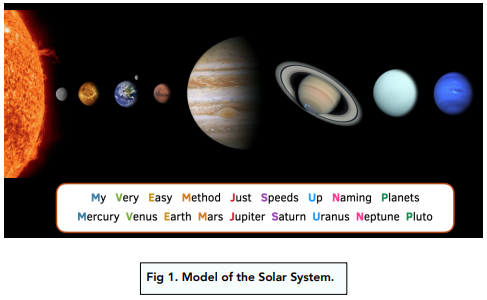
Solar System Model
- Initially, the geocentric model was believed to be correct, where Earth was at the centre of the universe, and the planets, the Moon, and the Sun orbited the Earth.
- In this model, everything orbited in perfect circles, with a fixed background of stars.
- About 600 years later, the heliocentric model was developed, placing the Sun at the centre of the solar system.
- One key piece of evidence for the heliocentric model was the observation of Mars' retrograde motion. This apparent backwards motion occurs because Earth orbits the Sun faster than Mars, causing Mars to appear to reverse direction in the sky.
- Galileo's observation of moons orbiting Jupiter provided further evidence that not everything orbits the Earth.
- Kepler later showed that the planets orbit in ellipses, not perfect circles.
Planetary Orbits
- As a planet orbits the Sun, the gravitational force causes the planet to change direction constantly, resulting in a circular or elliptical orbit around the Sun.
- This constant change in direction means the planet's velocity is always changing, which causes the planet to accelerate without an increase in speed.
Relationships
- For a stable orbit:
- If a planet moves closer to the Sun (i.e., its orbital radius decreases), the gravitational attraction to the Sun increases.
- This increased gravitational force results in greater acceleration.
- As a result, the planet's orbital speed must increase to maintain a stable orbit.