Telescopes - Looking into space (Edexcel GCSE Physics): Revision Notes
📚Revision Notes
Telescopes - Looking into space
Telescopes are essential for seeing distant objects clearly, especially those beyond the Earth's atmosphere. They help us explore the universe by detecting different types of electromagnetic (EM) radiation.
Optical Telescopes
Space Telescopes
Optical telescopes detect visible light and use refraction (bending of light) and reflexion (bouncing of light) to focus on distant objects like planets and stars.
To improve the quality of images:
-
Increase the aperture (the diameter of the objective lens or mirror). A larger aperture allows the telescope to gather more light, making distant objects appear brighter and clearer.
-
Use a higher-quality objective lens to improve image sharpness.
-
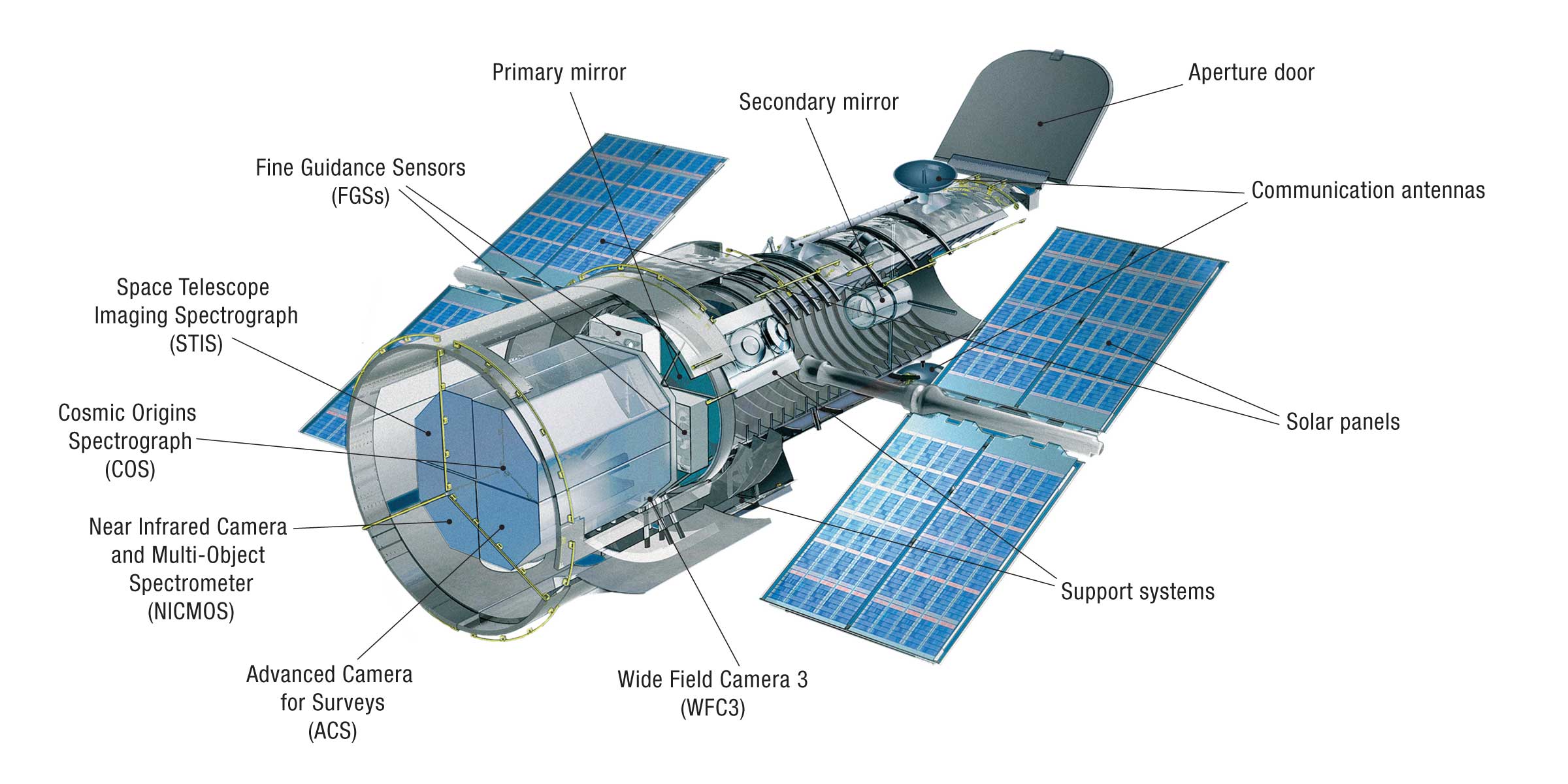
Why space telescopes? Earth's atmosphere absorbs much of the light coming from space, which affects our ability to detect it from the ground. Pollution and atmospheric interference can also reflect and absorb light, making it hard to see dim objects.
-
Best locations for ground-based telescopes:
-
Mountains (high altitude reduces atmospheric interference).
-
Dark places far from cities (reduces light pollution).
-
Space (above the atmosphere, giving the clearest view).
Different Types of Telescopes for the EM Spectrum
- Optical Telescopes (used since the early days of astronomy):
- Detect visible light.
- Useful for observing nearby objects like planets and stars or other galaxies.
- Limitation: Most objects in the universe don't emit much visible light, so we need other types of telescopes to detect different types of EM waves.
- Radio Telescopes:
- Detect radio waves.
- Discovered the cosmic microwave background radiation, providing crucial information about the origins of the universe.
- X-ray Telescopes:
- Detect X-rays.
- Useful for observing violent and high-temperature events in space, such as supernovas or black holes.
Technological Advancements in Telescopes
- Telescopes for the Entire EM Spectrum:
- Since the 1940s, telescopes have been developed to detect all parts of the EM spectrum (radio, infrared, X-rays, etc.), allowing us to observe previously invisible phenomena in space.
- Modern Telescopes & Computers:
- Computers are now used with telescopes to:
- Create clearer, sharper images.
- Store more data, reducing human error and allowing for more efficient data collection.
- Quickly analyse large amounts of data.
- Better Resolution and Magnification:
- Bigger telescopes have better resolution (sharper images) and can gather more light, making faint objects more visible.
- Improved magnification allows telescopes to observe objects farther into space, increasing our ability to study distant galaxies and cosmic events.